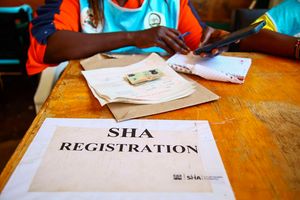
The decision by the government to provide medical health insurance through the Social Health Authority (SHA) is facing resistance from teachers who argue that the new plan might deny them some of the benefits they enjoy in the current scheme that will expire at the end of November.
The CEO of the Teachers Service Commission (TSC) Evaleen Mitei announced last week that all teachers will be migrated to SHA by December 1 2025. On Friday, she hosted a meeting of teachers’ union leaders, representatives of the Office of the President and the Social Health Authority (SHA).
The officials pledged sweeping reforms in the scheme including faster hospital pre-authorisations, an expanded network of 9,000 health facilities, and a 24-hour call centre to handle inquiries, provision for teachers to be admitted in non-accredited hospitals for up to two days in emergencies, and a guarantee that teachers will not be turned away during critical cases.
However, speaking to the Daily Nation , the secretary-general of the Kenya Union of Post-Primary Education Teachers (Kuppet) Akelo Misori was apprehensive of the deal and accused the government of pushing a “politically-engineered” cover without addressing glaring gaps.
“One of the unknowns is how they are going to surmount the challenges which were in the other cover. They were not ready to commit that they were going to include the group life cover, which is part of the other package,” he said.
Teachers employed by the TSC are currently covered by a consortium of insurances companies led by Minet Kenya.
Mr Misori questioned the practicality SHA promising reforms, including increasing overseas treatment allocations to Sh500,000 per patient and expanding its network to more than 9,000 health facilities.
He observed that many of the facilities listed are dispensaries and health centres run by counties, some of which lack specialists and advanced services required by teachers.
“They told us that the previous cover under Minet and Medical Administrators (K) Ltd (MAKL) was using about 800 facilities, while SHA is now claiming to have over 9,000. But many of these are just local health centres, dispensaries and county-run referrals some of which don’t even have specialists or consultants,” Mr Misori said.
Protection of teachers’ welfare
“This is not a small scheme. It needs careful management. What we are asking for is transparency, sustainability, and protection of teachers’ welfare. SHA is not yet stable, and the population of our members is big. Already, health facilities are complaining about the few members who are enrolled. It is not the best option at this particular time,” he said.
There are more than 400,000 teachers on the TSC payroll. Considering their spouses and children, the scheme has over one million people covered.
Mr Misori emphasized that teachers’ voices will be central in determining whether the cover is accepted or rejected. He made it clear that Kuppet would align its position with the decision of its members.
“If the teachers say no, we also say no. Much as people don’t like change, the truth is this is not the best time to move to SHA. Everything in Kenya has been politicised—housing, salaries, even health. That is why everything is now questionable. The challenges are real, and everything in this country is politicised, including health. That is why this deal is already raising questions,” Mr Misori said.
He argued that despite challenges in the Sh20 billion medical cover run by Minet, they were better off under the TSC-managed scheme.
"What teachers wanted was improved service delivery and enhanced packages. We did not ask to be migrated to an already struggling SHA,” he said.
He also argued that the transition appears to have been politically engineered rather than guided by professional assessments of teachers’ needs. He pointed out that President William Ruto, during a meeting with teachers at State House, Nairobi, expressed dissatisfaction with the Minet scheme but did not explicitly declare that teachers would be moved to SHA.
“We thought TSC was going to independently procure another cover. But after the State House meeting where the President hinted he was unhappy with Minet, it became clear we were being steered towards SHA,” he remarked.
The secretary-general of the Kenya National Union of Teachers (Knut) also said the union will not rush into endorsing the government’s proposal to transfer teachers’ medical insurance from Minet to SHA. He stressed that with over 400,000 teachers in public schools and their dependents affected, such a decision must go through thorough consultation with the union’s membership.
“It’s a matter we have to take back to our members very carefully. The SHA took us through several presentations. In our opinion, the process is not complete. We feel it is only right to take this matter to the National Executive Council (NEC) for a final decision,” he said.
The urgency of the matter arises from the fact that the current Minet medical cover for teachers expires in November.