Hospitals are facing growing legal scrutiny over the treatment of patients who cannot pay their bills, failures in emergency care and allegations of medical negligence, with courts awarding damages and ordering facilities to respect patients’ constitutional rights.
One case in the growing legal scrutiny, which spans both public and private health facilities, is that of Erick Migwa, who died at Cana Hospital in March 2026. His family faced a Sh4.4 million medical bill and a fight to bury him.
The hospital directed Umash Funeral Home not to release his body until the bill was paid. The family managed to raise only Sh360,000. His widow, Grace Migwa, went to the High Court, saying the family could not raise the amount and that withholding the body violated her rights.
Umash Funeral Home.
Photo credit: Francis Nderitu | Nation Media Group
She said the hospital and the morgue had refused to release the body despite repeated pleas, effectively holding her husband’s remains as collateral for a debt. In her view, the practice was not only unlawful but also morally untenable.
On June 18, Justice Patricia Nyaundi ordered the hospital and funeral home to release the body unconditionally. She awarded the widow Sh1 million in damages and ruled that mortuary charges accruing after the unlawful directive were not payable by the family or Migwa’s estate.
“There is no property in a dead body. It cannot be offered or held as security for payment of a debt,” the judge said. She added that a body could not be auctioned for default or used to earn rental income in a cold room.
Cana Hospital argued that it had provided care, including high-dependency and intensive-care treatment, and that the family had not offered a reasonable payment plan. It said unconditional release could expose it to irrecoverable financial loss. The court said the hospital remained free to pursue the debt through civil proceedings.
The judge, however, said there was no ambiguity in the law and that courts had repeatedly and consistently affirmed that where a patient dies while undergoing treatment, the hospital must release the body to the family for burial and thereafter pursue any outstanding medical fees through established civil recovery mechanisms.
“The law provides clear channels for such recovery, and none of them include the detention of a corpse as collateral,” she said.
In August 2026, the High Court ordered Karen Hospital to facilitate the unconditional release of Justin Njuguna Mwangi’s body. Mwangi was admitted on April 23 and died on May 24. The bill was Sh4 million.
The Social Health Authority paid Sh421,120, while relatives and well-wishers paid Sh1.1 million, leaving Sh2.4 million outstanding, according to the ruling. A relative sued, claiming the hospital had unlawfully detained the body, whose remains were at Montezuma Monalisa Funeral Home.
The court issued an interim mandatory injunction, leaving the underlying dispute unresolved. The hospital’s financial controller, Penninah Wambui Ndonga, acknowledged the outstanding Sh2.4 million bill but denied unlawfully detaining the body, saying it had been transferred to Montezuma Monalisa Funeral Home, an independent facility.
The hospital said it was willing to facilitate the body’s release if the family provided a written repayment plan, a legally binding undertaking or security for the debt. It argued that unconditional release without such guarantees would cause financial prejudice.
However, Justice Anne Okutoyi said the law does not sanction the detention of a body or insistence on payment as a condition precedent to burial.
“The injury occasioned by delayed burial transcends monetary compensation. It affects the dignity of the deceased, the emotional well-being of surviving relatives, cultural obligations, and the family’s right to accord their loved one a decent burial. The respondent’s loss is purely financial and remains recoverable through legal proceedings,” said Justice Okutoyi.
A similar dispute reached the High Court after Caroline Nthangu Tito died at Mater Misericordiae Hospital on August 2, 2025. Her sons said the hospital withheld her body over a bill of Sh3.3 million and continued charging Sh2,000 a day for mortuary services.
In a September 2025 ruling, Justice Nixon Sifuna ordered the release of the body after payment of the mortuary charges, while leaving the hospital free to pursue the treatment bill.
“There is no law providing for a hospital’s right of lien over patients or over their remains should they die while hospitalised or undergoing treatment,” he said.
Mater Misericordiae Hospital Nairobi on February 28, 2024.
Photo credit: Wilfred Nyangaresi | Nation
“Socially, the detention of bodies by mortuaries and hospitals, for debt claims, traumatize the bereaved families and disrespects the departed. It has in many instances been employed to blackmail, embarrass, traumatise and coerce bereaved families into submitting to the monetary demands by the hospitals,” added Justice Sifuna.
The same issue affects living patients. In January 2025, the High Court awarded Herman Kinoru Sh800,000 after finding that Labib Hospital had unlawfully detained him for more than two months to compel payment.
Mr Kinoru was admitted on August 24, 2021, and said he was ready for discharge on September 24. By November 15, he had paid Sh764,200 against a bill of Sh3 million but remained in hospital as charges accumulated.
“Holding a person who has been treated and fully recovered in hospital for over two months to compel him to pay the hospital bill is punitive, unfair, unreasonable and thus unlawful,” he said. The court awarded damages and costs for violations of his rights to dignity, security and movement.
A separate case involving Kenyatta University Teaching, Referral and Research Hospital shows that a finding against a hospital does not necessarily cancel a patient’s debt. Mercy Kinoti said she and her minor son were kept in a ward for patients unable to clear bills after the child was discharged in May 2023.
In June 2026, the High Court found that the mother and child had been unlawfully detained, awarded them Sh20,000 in nominal damages and ordered Kinoti to pay the remaining bill of Sh111,576. The order recognised the rights violation but preserved the hospital’s claim.
Patients’ rights disputes also concern the quality and timing of treatment. In August 2025, the High Court awarded Sh7.5 million to a woman identified as Ms LLN in a case against Pumwani Maternity Hospital.
The court found that the hospital’s mishandling and neglect during labour led to the death of her baby and the removal of her uterus. The judgment noted that the Kenya Medical Practitioners and Dentists Council had previously found negligence, including an 11-hour delay before an emergency Caesarean section. The court ruled that the failures violated her rights to healthcare and dignity.
The main entrance of Kenyatta University Hospital for Teaching, Referral and Research.
Photo credit: Francis Mureithi | Nation Media Group
“It is the finding of this court that to neglect offering emergency treatment for 11 hours to a patient whose assessment had showed that she needed immediate attention violated her right to the highest attainable standard of health care in contravention of Article 43 (1) and also her right to emergency medical treatment under Article 43 (2) while at the hands of the respondent,” said Justice Mugambi. The hospital is a public healthcare facility owned and operated by the Nairobi City County Government.
The courts have also examined claims of medical negligence beyond maternity care. In a separate recent ruling, a magistrate’s court ordered Nakuru County Government to pay driver Jackson Njue Sh4.1 million after treatment at Nakuru Level 5 Hospital was followed by an infection that ultimately led to the amputation of his right leg.
Principal Magistrate Linda Mumassabba found the county 100 per cent liable after it failed to defend the claim, awarding damages for pain and suffering, a prosthetic limb and reduced earning capacity.
“The permanent disability creates a real and substantial diminution in his ability to compete in the labour market and earn income in the manner he did before the accident,” the magistrate said.
The court found the county 100 per cent liable for the injuries and consequential losses proved by the claimant.
In June 2025, the High Court awarded a couple Sh157 million in a surgical negligence case against a surgeon and a private hospital.
The court found that the surgeon removed the woman’s cervix without the required consent and that the hospital failed to provide the necessary equipment. The award covered special and general damages. It was later challenged at the Court of Appeal.
The dispute also extends to medical insurance, as shown by a separate case involving a woman identified as NWM, Nairobi Hospital and AAR Insurance. In an August 13, 2025 judgment, Justice Mugambi rejected claims that the hospital had unlawfully detained the patient or caused her post-delivery complications, but ordered the insurer to pay Sh2.1 million for additional hospitalisation covered by her overall inpatient policy.
“Considering her overall in-patient medical cover had not been exceeded, that action by the third respondent was unconscionable,” the judge said, finding the insurer’s refusal to settle the bill unreasonable and an act of bad-faith insurance practice.
The Constitution protects the right to the highest attainable standard of health under Article 43 and says no person may be denied emergency medical treatment under Article 43(2). Section 7 of the Health Act, 2017, addresses emergency treatment, including stabilisation and referral where a facility cannot provide the required care.
These provisions do not require every service to be free or every non-emergency patient to be admitted regardless of payment. Negligence claims require proof of breach and harm; a bad outcome alone does not establish liability.
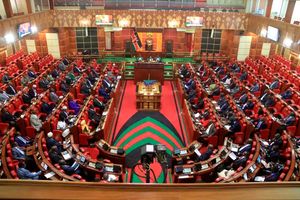
The debate has reached Parliament. In November 2025, the Health Ministry and private hospitals opposed a Senate proposal to criminalise the detention of patients or bodies over unpaid bills.
The Ministry argued that mortuary services are billable and that non-payment should be handled administratively. The Senate committee rejected that position, saying the proposal targeted detention as a collection method rather than the charging of fees.
The dispute reflects the question of how hospitals can recover costs without restricting patients’ rights.
Parliament has considered bills to amend the Health Act on emergency care and the detention of patients or bodies over unpaid bills. In February 2026, the National Assembly began debate on the Health (Amendment) Bill, 2024.