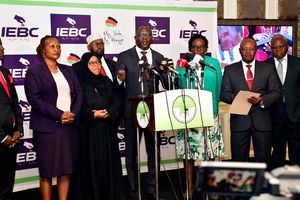
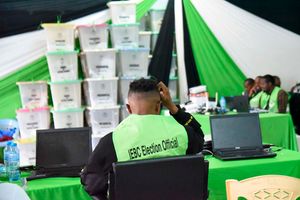
The High Court has declined to jail the chief executive officer of the Independent Electoral and Boundaries Commission (IEBC) over failure to pay a supplier a Sh5.84 million debt, saying the contempt application was wrongly directed at an office rather than the individual occupying it.
Justice William Musyoka dismissed a case by Soloh Worldwide Enterprises seeking to have the IEBC chief executive cited for disobeying a court order requiring payment of the money.
The judge, however, directed the electoral agency to return to court on October 28 to explain the steps it was taking to comply with the order requiring settlement of the debt.
The dispute arose from a decree issued in a Milimani Chief Magistrate’s Court civil case, where Sh2.9 million had initially been awarded. The amount later rose to Sh5.27 million, with costs of Sh237,980, while a certificate of order against the government put the total at Sh5,843,849.
The Milimani Law Courts in Nairobi.
Photo credit: File | Nation Media Group
Soloh Worldwide Enterprises complained that despite the court orders, the money had not been paid.
The company subsequently moved to the High Court seeking an order compelling the IEBC to settle the debt. On March 11, 2026, the court ordered the commission to pay the amount due, together with costs and interest.
When payment was still not made, the company filed an application dated June 4, 2026 seeking to have the IEBC chief executive jailed for contempt of court.
The company’s managing director, Mr Solomon Gitundu, told the court that the decree, certificate of costs and certificate of order against the government had been served on the relevant authorities.
He argued that the continued failure to pay amounted to disobedience of a court order and undermined the authority of the court.
But the IEBC opposed the application, saying it had taken steps to facilitate payment.
Through its Director of Legal Services, Chrispine Owiye, the commission said it had communicated with the National Treasury after receiving the court documents.
The debt, the commission said, had been submitted to the Pending Bills Verification Committee established by the Treasury.
The commission also argued that it could not simply divert money allocated to other activities to settle the court debt.
According to Mr Owiye, public funds could only be spent after the necessary budgetary allocation and approval had been made.
He said the money required to settle the decree had not been made available by the National Treasury and, therefore, there had been no deliberate refusal by the chief executive to obey the court order.
Justice Musyoka agreed that the failure to pay meant the order had not been complied with, but said this did not automatically establish that the chief executive had deliberately disobeyed it.
In his ruling delivered at the Milimani Law Courts in Nairobi on October 2, 2026, Justice Musyoka said the court had to be satisfied that the person accused of contempt had actual knowledge of the order and had deliberately chosen to disobey it.
The judge noted that the March 11 order had been made after the budget for the 2025/2026 financial year had already been passed.
“The said order could not be complied with in the 2025/2026 financial year, for no money had been appropriated for it,” the judge said.
He added that the debt could instead have been included in the budget for the 2026/2027 financial year, whose preparation was already under way when the order was issued in March.
Justice Musyoka, however, faulted the IEBC for failing to clearly explain whether the debt had been included in the 2026/2027 budget.
“Seemingly plausible explanations have been offered, but they are not good enough,” the judge said.
He nevertheless found that the evidence before him did not establish that the IEBC chief executive had deliberately refused to obey the court order.
“Before any court decree is satisfied or settled by a public entity, such as the 2nd respondent, the funds required for that satisfaction must be budgeted for by the public entity, the budget must be approved by the relevant Parliament, and appropriated for that purpose,” he said.
Justice Musyoka said the fact that a debt arose from a court judgment did not mean the agency could ignore the rules governing public finances.
“The satisfaction of a money decree, against a public entity, is subject to the law … on the handling of public funds,” he said.
The judge also identified another fundamental problem with the application: the company had targeted the office of the IEBC chief executive rather than identifying the individual holding the position.
“An office cannot be committed to jail, for only a natural person can be,” Justice Musyoka said.
He noted that the person currently occupying the office had not personally responded to the application and that there was nothing before the court to show that the individual had personally been notified of the order in the manner required for contempt proceedings.
The judge described the application as “wholly poorly conceived”, saying it was fatally flawed because it sought to have an office, rather than the person occupying it, committed to civil jail.
He consequently dismissed the application filed by Soloh Worldwide Enterprises and ordered the matter to be mentioned on October 28, when the IEBC will be required to update the court on the steps it has taken towards complying with the March 11 order.