Nearly two decades after abandoning duty to fight in the Middle East, a dark cloud still hangs over 25 former Kenya Defence Forces (KDF) soldiers as the State presses the court to uphold life sentences imposed by a Court Martial.
The soldiers, convicted of desertion, argue that they had effectively left the military and should not have been tried under military law. However, the prosecution insists the former servicemen were never formally discharged, remained subject to military rules and stayed away for far longer than the 90 days that legally constitutes desertion.
In documents filed before the High Court in Mombasa, the State has asked the court to find that the charges against the former soldiers were lawful and that they were correctly convicted of desertion, an offence it says exposed Kenya to serious security risks.
The prosecution argues that the soldiers challenge the charges based on a misunderstanding of how military prosecutions work. It says there is no legal requirement for the Director of Military Prosecutions (DMP) to personally draft or endorse charges for them to be valid.
The State argues that unlike civilian cases, military law allows investigators and unit commanders to prepare charges and forward them through the chain of command.
“The law does not require the DMP to endorse charges in order for them to be lawful,” the prosecution states, adding that investigators and commanders are empowered to initiate disciplinary proceedings.
The former military men are being retried after the Court of Appeal ordered a rehearing of their cases. The appellate court directed the rehearing after finding that the High Court had failed to render judgments in each of the 25 appeals as required by law.
Three judges of the appellate court held that the High Court ought to have re-evaluated the evidence on record in each soldier's appeals in order to reach its own independent conclusions.
The High Court had acquitted the former soldiers of the offence of desertion of duty, but the Court of Appeal declared that decision a nullity and ordered a rehearing. The soldiers, who have enjoyed their freedom since 2015, now risk being jailed again if their initial conviction by the Court Martial is upheld.
The High Court argued that the Court Martial and the Office of the Director of Public Prosecutions had not proved that they abandoned duty and that the soldiers were only absent without leave.
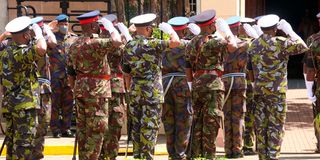
President William Ruto inspects a guard of honor during the 2025 Kenya Defence Forces Day celebrations at Moi Barracks in Eldoret, Uasin Gishu County.
Photo credit: PCS
The former soldiers had appealed against the conviction handed down by the Court Martial in Mtongwe, arguing that the charges of deserting during wartime were defective. They further argued that the acts for which they were convicted were alleged to have occurred in 2007, yet the statute they were said to have violated was enacted in 2012.
They also contended that Kenya was not at war when they left the country and that they had written letters of resignation before leaving the military.
The State accused the former soldiers of quitting the military on various dates between 2007 and 2008 to work for private American security corporations that deployed them to Afghanistan, Iraq, Kuwait, Syria and Jordan.
The former military men have claimed that they were unlawfully convicted under the KDF Act of 2012 despite leaving service under the Kenya Armed Forces Act.
However, the prosecution argues that the decision to charge the soldiers was made by their unit commander, who observed a sharp rise in desertion cases, adding that there is no evidence of interference, bias or improper influence.
The prosecution further argues that the soldiers have failed to demonstrate any unfairness in the process or show how their right to a fair hearing was violated.
On the claim that the soldiers had already left the military when they departed, the State maintains that none of them had been lawfully discharged.
Under military law, a soldier remains in service until formally released by the competent authority and issued with a discharge certificate.
“Until a discharge is approved and a certificate issued, a serviceman remains subject to military law,” the prosecution argues.
Most of the former soldiers were not commissioned officers and could not resign in the legal sense. State says any resignation letters they wrote were merely requests for discharge, not approvals. Until those requests were granted, they were required to remain on duty.
The prosecution cites cases where discharge requests were rejected yet the soldiers still left and stayed away for years, some even leaving the country. It argues that it was their responsibility to confirm their status before departing and that allowing informal resignations would amount to rewriting the law.
On whether desertion was proved, the State says the offence was clearly established.
“When the Armed Forces Act was replaced by the KDF Act, all serving personnel automatically transitioned into the new law with their oaths and obligations intact,” argues the prosecution.
Desertion, the prosecution contends, is a continuous offence that began under the old law and continued under the new one.
“The conduct charged under both laws is the same, being absent without authority for more than 90 days,” the State submits.
The prosecution says there is no evidence that any of the soldiers were properly discharged and that they understood the charges and defended themselves during trial.
The State insists the court must examine the entire period of absence, from departure to arrest or return, not just the first day. It says evidence showed that several soldiers sought work abroad and settled elsewhere, reinforcing the conclusion that they intended to stay away without following the required discharge process.
The prosecution maintains that the desertion occurred during active military service. At the time the soldiers left, the Kenya Navy was engaged in security operations aimed at controlling sea entry and exit points in response to threats from Somali based militant groups, including Al Shabaab.
“These were matters of common knowledge within the military,” the prosecution argues.
The State has dismissed claims that active operations began later, noting that Operation Linda Mpaka preceded Operation Linda Inchi, with both involving engagement with identifiable enemies.