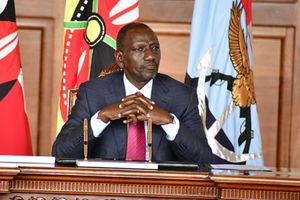
Cabinet Secretary for Mining, Blue Economy and Maritime Affairs Hassan Ali Joho.

Mining Cabinet Secretary Hassan Ali Joho has secured a reprieve from a bid to have him declared unfit to hold public office over his alleged disobedience of a court order while serving as Mombasa governor.
The High Court struck out a petition filed by businessmen Ashok Labshanker Doshi and Pratibha Ashok Doshi, who sought to bar Mr Joho from holding public or State office after he was found guilty of contempt of court and sentenced in 2021.
The decision effectively ends the petition against Mr Joho, removing the immediate threat to his eligibility to serve in public office arising from the case.
The court found that the petition had no sustainable basis against the Cabinet Secretary and could not succeed on the case as pleaded.

“For these reasons, the petition, as against Mr Joho, has been left without any sustainable foundation. On its pleaded basis, it cannot succeed against him, and it is beyond redemption,” the court said in a ruling delivered on August 6.
The court held that requiring the former Mombasa governor to remain subjected to the petition would amount to an abuse of the court process. It consequently struck out the petition dated July 29, 2021, together with the accompanying application against Mr Joho.
The dispute stemmed from a land case in which the Environment and Land Court found on February 12, 2020, that Mr Joho had disobeyed a lawful court order.
He was subsequently sentenced on May 21, 2021.
The finding prompted the Doshi family to file the constitutional petition, arguing that the alleged disobedience amounted to violations of the Constitution and rendered Mr Joho unfit to hold public or State office.
They sought declarations that he had breached constitutional provisions on leadership and integrity and wanted him permanently barred from holding public office.
But the CS moved to Court of Appeal over the decision finding and sentencing him for contempt.
The petition seeking to bar him from public office was then put on hold in March 2022, pending the outcome of an appeal he filed to set aside the contempt finding at the Court of Appeal in Mombasa.
The Court of Appeal overturned the contempt finding on November 8, 2024, after finding that Mr Joho had not been a party to the original land proceedings and ought to have been personally served with the application seeking to have him cited for contempt.
The appellate court found that the petitioners had failed to prove that Mr Joho had been personally served to the standard required in contempt proceedings. It consequently set aside the order finding him in contempt, together with the consequential orders.
"Collapsed foundation"
Mr Joho then moved to the High Court on November 15, 2024, seeking to have the original petition struck out or dismissed, arguing that the Court of Appeal decision had fundamentally changed the basis of the case against him.
He argued that the petition was anchored on the 2020 finding that he had disobeyed a court order, the subsequent dismissal of his attempt to overturn that finding and the sentence imposed in May 2021.
With the Court of Appeal having set aside the contempt finding, Mr Joho argued that the foundation of the petition had collapsed and that allowing it to continue would amount to an abuse of the court process.
“Setting aside the contempt of court findings means the very foundation and substratum of the petition has collapsed. There consequently remains nothing for the petitioners to pursue,” Mr Joho argued.
The Doshi family opposed the application, arguing that it was defective because it was supported by an affidavit sworn by Mr Joho’s lawyer, Mr Paul Buti, rather than by Mr Joho himself.
They also said a similar application filed in September 2021 was still pending, making the new application an abuse of the court process.
The petitioners further argued that the effect of the Court of Appeal decision on their petition should be determined during the hearing of the main case rather than through an interlocutory application.
They maintained that their petition was not based solely on the contempt finding overturned on appeal, pointing to another alleged finding against Mr Joho in a separate High Court case and a pending application seeking leave to introduce further evidence.
The Doshi family also argued that the Court of Appeal had overturned the contempt finding only against Mr Joho.
They said Bernard Ochieng Ogutu, who had been cited for contempt alongside Mr Joho, had not appealed the finding and had paid the fine imposed against him.
They therefore maintained that the petition, which sought relief against both Mr Joho and Mr Ogutu, could not be struck out in its entirety.
The High Court rejected the objections and found that the Court of Appeal decision had removed the central basis of the petition against Mr Joho.
The judge held that there was no legal requirement for an application of this nature to be supported by an affidavit sworn personally by the party seeking relief.
The court also dismissed the argument that Mr Joho’s application amounted to an abuse of the court process because a similar application had previously been filed.
It noted that the latest application was based on the Court of Appeal’s 2024 judgment, a development that did not exist when the earlier application was filed.
On the substance of the matter, the judge found that the Court of Appeal decision had removed the central basis of the petition against Mr Joho.
“A central plank, indeed, the very foundation, of the case against the 1st Respondent has thereby been removed,” the court said.
The court further found that the petitioners had not presented any other evidence capable of sustaining the case against Mr Joho after the contempt finding had been overturned.
It rejected the argument that the petition should be allowed to proceed on the possibility that further evidence might emerge, holding that a case could not be kept alive on speculation.
The judge noted that the collapse of the petition’s foundation was established by the court record and that there was no reason to subject Mr Joho to a full hearing when the finding on which the case had been stayed had already been overturned by the Court of Appeal.
“Where the foundation of a claim has been removed as a matter of record, and nothing has been placed before the court to take its place, there remains nothing to be tried,” the court held.
Legal battle
The dispute dates back to May 2019, when Mombasa County officials led by Mr Joho demolished a perimeter wall on a disputed two-acre parcel of land in Changamwe.
The county government claimed the land belonged to a local school, while the Doshi family maintained that it was privately owned and protected by a court injunction.
The demolition triggered a prolonged legal battle over ownership of the property and allegations that the county government had ignored a court order protecting the land.
Following the incident, the Environment and Land Court found Mr Joho guilty of contempt for disobeying the injunction and later imposed a fine and ordered payments of damages to the Doshis.
Mr Ogutu, who was the elected Changamwe Ward MCA at the time, was also cited for contempt and fined.
He allegedly lead county officials and youths who stormed the property and vandalised the perimeter wall.
However, in November 2024, the Court of Appeal overturned the contempt finding against Mr Joho, ruling that the petitioners had failed to establish that he had been personally served with the application seeking to have him cited for contempt.
Follow our WhatsApp channel for breaking news updates and more stories like this.