For years, the annual tea bonus has been sold to smallholder farmers as the ultimate verdict on their labour. It has ben heralded as the reward for better leaf, higher auction prices and prudent management of their factories.
A large second payment is celebrated at factory meetings, in trading centres and on political platforms as proof that the crop has performed well.
But an audit by the Tea Board of Kenya has exposed a different and deeply troubling arithmetic. In many factories, part of what farmers received as a “bonus” was not generated by tea sales at all.
It was borrowed from commercial banks, entered in the factory books and left behind as debt to be serviced from future earnings. It is the untold secret of some of the “best” performing factories.
While farmers may celebrate a ‘better’ payment today, believing it represents profit from their tea, they later discover that their factory must surrender future income to banks as principal, interest and penalties. This is the latest scandal in the tea sector where deceit has been a norm.
In the latest case, while the borrower on paper may be the factory or a facility arranged by Kenya Tea Development Agency Management Services Limited, the economic burden returns to the growers who own the factories and depend on them for monthly and annual payments.
The Tea Board’s March 2026 report, based on an audit ordered by the Ministry of Agriculture, paints the most detailed picture yet of how deeply borrowing has entered the smallholder tea economy.
Police officers outside Kenya Tea Development Agency offices in Nairobi.
Photo credit: Lucy Wanjiru | Nation Media Group
As at December 31, 2025, the 69 factories listed in the loan schedule had outstanding balances of Sh34.05 billion. Commodity loans accounted for Sh30.36 billion, asset-based financing Sh2.67 billion, and term or project loans another Sh1.01 billion.
The stakes reach far beyond factory boardrooms. Kenya's 71 smallholder factories are owned by more than 650,000 growers and account for roughly 52 per cent of national tea production. Across the wider value chain, tea supports an estimated 6.5 million Kenyans. In 2025 the crop generated more than Sh215 billion, including about Sh181 billion in exports. A debt crisis inside the smallholder system therefore threatens household incomes, rural commerce and one of the country's principal sources of foreign exchange.
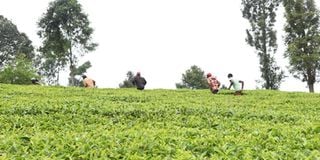
Farmers pick tea at a farm in Karingani ward in Chuka/Igambang'ombe constituency, Tharaka Nithi County
Photo credit: Alex Njeru I Nation Media Group
Insiders say that these are not marginal overdrafts. They are debts large enough to put the survival of some factories in question. The report’s conclusion is blunt: “The solvency and going concern of some of the KTDA managed factories is in doubt due to the high level of indebtedness.”
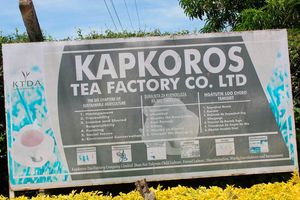
Kapkoros Tea Factory sat at the top of the debt table with Sh2.77 billion outstanding at the end of December 2025. It was followed by Litein with Sh1.88 billion, Mogogosiek with Sh1.60 billion, Kapset with Sh1.48 billion, Tegat with Sh1.32 billion, Tombe with Sh1.29 billion and Chebut with Sh1.27 billion.
Nyankoba owed Sh1.07 billion, Sanganyi Sh1.06 billion and Tirgaga Sh1.02 billion. Just below the billion-shilling line were Nyansiongo at Sh973.4 million, Nyamache at Sh915.1 million and Michimikuru at Sh906.1 million.
The geographic pattern is striking. Factories in the western tea block, where auction prices and accumulated old stocks have caused persistent cash-flow pressure, dominate the list of the most indebted institutions. The audit shows a system in which weak current earnings were repeatedly bridged with fresh borrowing, transforming a market problem into a balance-sheet crisis.
During the six months to December 2025, KTDA Management Services arranged commodity loans for 55 factories to finance the 2024/25 second payment. The borrowing came in four large tranches: Sh1.29 billion from Bank of Baroda, Sh3.99 billion allocated from a Stanbic facility, Sh5.17 billion from Co-operative Bank and Sh20.02 billion from KCB. Together, the facilities allocated to factories totalled Sh30.47 billion.
Yet the factories’ calculated requirement - covering the second payment, September green-leaf payments and settlement of inter-factory balances - was Sh25.29 billion. The audit could not establish why an additional Sh5.18 billion was borrowed.
The report also raises a separate question about the Stanbic facility. KTDA Management Services borrowed $32.5 million, equivalent to about Sh4.20 billion, but allocated $30.9 million, or Sh3.99 billion, to factories. That left $1.6 million, approximately Sh212.1 million, unallocated. Management told the auditors that factories were obligated to repay only the allocated portion and that the remainder financed KTDA subsidiaries.
The Bank of Baroda loan of Sh1.29 billion presented another mystery: the auditors said it was not clear what the money, acquired on August 15, 2025, was for.
It now appears that the “bonus” paid to some farmers is a loan. During the second payment of Sh28.53 billion declared for the 2024/25 financial year, it appears that commodity loans were not the only source: factories also used their earnings. But the audit found that the borrowing labelled for commodity or bonus financing was used for much more than the annual payout.
It funded monthly green-leaf payments, converted old inter-factory borrowings into bank debt, and settled obligations including Sacco deductions, microfinance loans, historical land purchases and fertiliser debt.
Thus, a payment presented to a farmer as the surplus from tea sales was actually consisting of money borrowed to cover an operating deficit or refinance an older liability.
The imbalance was most dramatic in the western block. Its factories required Sh6.37 billion for the second payment but borrowed Sh24.01 billion which is 377 per cent of the bonus requirement.
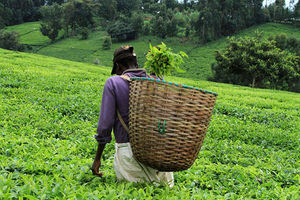
A farmer picking tea.
Photo credit: File | Nation Media Group
Eastern block factories, by contrast, declared Sh22.16 billion in second payments and borrowed Sh6.46 billion, equivalent to 29 per cent. Nine eastern factories recorded no loan financing for the bonus.
At individual factory level, the gaps were enormous. Mogogosiek declared a second payment of Sh55.5 million but received a commodity-loan allocation of Sh1.61 billion. Kapset’s second payment was Sh82.9 million against borrowing of Sh1.41 billion.
Chebut paid Sh80.2 million while its commodity allocation was Sh1.23 billion. Tombe declared Sh118.1 million and borrowed Sh1.26 billion.
Kapkoros, already the most indebted factory, declared Sh270.9 million as its second payment but was allocated Sh2.41 billion in commodity loans. Litein’s payment was Sh250.7 million against Sh1.85 billion in borrowing, while Tegat’s Sh216 million payout stood against a Sh1.26 billion loan.
The audit found that 29 factories borrowed more than they required for the second payment; 27 were in the western block. This does not mean every shilling of the excess was handed to farmers as a bonus.
It means facilities raised in the name of the payment were also sustaining a wider network of deficits and debts - and the factory books, not the farmers’ understanding of the payment, recorded the resulting liability.
The governance trail is equally disturbing. KTDA Management Services produced 50 factory-board resolutions authorising commodity loans. In 33 of them, the amount to be borrowed was not stated. The Tea Board described that omission as irregular because directors appeared to have authorised debt without defining its limit.
In seven other cases, the audit said borrowing exceeded the amount approved by factory directors, with the unauthorised portion totalling Sh1.41 billion. The affected entities included the Mogogosiek-Boito-Kobel group, Litein, Tegat, the Kapkoros group, Kapset-Rorok, Chebut and Mudete. Litein’s allocation exceeded the approved amount by Sh291 million; the Mogogosiek-Boito-Kobel group’s by Sh331.3 million; and Tegat’s by Sh208.8 million, according to the report.
While farmers elect factory directors to protect their interests, some resolutions do not state how much may be borrowed. It turns board approval into an open cheque, while the growers who ultimately finance the institution are told only the amount per kilogramme they will receive.
The Tea Board also found that loan balances were not accurately disclosed in audited financial statements at June 30, 2025. Forty factories understated their balances and six overstated them. At Kapkoros, the financial statements showed Sh1.51 billion while the loan schedule showed Sh3.50 billion - a difference of Sh1.99 billion.
Tegat reported Sh55.3 million against Sh1.38 billion in the schedule. Litein reported Sh898.7 million against Sh1.85 billion, and the combined Kiamokama-Rianyamwamu accounts showed Sh483.8 million against Sh1.17 billion.
KTDA Management Services told auditors that commodity loans and inter-factory borrowings had been captured under separate line items, including payables. However, at the time of the report, it had not supplied the reconciliation needed to explain the differences.
When contacted by the Nation on Friday August 14,2026 about the audit, KTDA National Chairman Enos Njeru promised to respond in detail but had not done so by the time of publishing this article.
At the centre of the borrowing machine was the valuation of unsold tea. Closing stocks were used as security for commodity facilities. The higher the stock value, the more a factory appeared able to borrow - and the larger a second payment it could declare.
The Tea Board found that stocks were overvalued, especially in the western block. In 21 western factories and one eastern factory, prices realised between July and December 2025 were lower than the values assigned to closing stock at June 30. It said most western factories had overvalued stocks by between 111 and 320 per cent and concluded that unrealistically high values led to excessive bonuses and borrowing.
Farmers pick tea on a farm in Kiangondu village in Tharaka-Nithi County.
Photo credit: File | Nation Media Group
Litein’s closing stock was valued at Sh811.17 per kilogramme, yet its average realised price in the following six months was Sh253.31. Motigo carried tea at Sh658.27 against an average price of Sh260.29. Chebut’s valuation was Sh614.31 against Sh242.30, while Kapset used Sh523.65 against Sh236.42.
Management explained that much of the tea sold in 2024/25 was old stock accumulated between 2021 and 2024, when reserve prices were in force. After the reserve was lifted, the tea sold for less, producing negative performance. Factory boards were advised to spread, or amortise, the loss over as many as five years.
The auditors rejected that treatment, saying International Accounting Standard 2 requires inventory to be written down to the lower of cost or net realisable value; it does not permit a stock loss to be carried forward through multi-year amortisation. In its final conclusions, the report went further, describing the overvaluation as deliberate and saying it had enabled overpayment of the second payment and over-borrowing.
Until October 2025, factories also borrowed from one another. In 2024/25, inter-factory loans totalled Sh12.30 billion and attracted gross interest of Sh748 million, plus Sh112.2 million in withholding tax. The Tea Board found “obvious mismanagement” in the scheme, which was then scrapped. Once internal borrowing ended, commodity bank loans were used both for bonuses and monthly green-leaf deficits, moving interest income out of the KTDA network and into commercial banks.
The loans were already attracting avoidable costs. Commodity facilities in 2024/25 incurred penalties of Sh8.02 million. Management blamed low sales, depressed auction prices and delayed repayments, and said it was seeking waivers. The auditors responded that the facilities had already been paid, making waivers impossible.
There are genuine pressures behind the cash crisis. The report says the government had not refunded Sh4.68 billion in fertiliser subsidies from the 2021/22 and 2022/23 financial years, draining KTDA’s working capital and increasing finance costs. But this does not explain borrowing without quantified approvals, unexplained excess facilities, distorted inventory values or unreliable reporting of factory debts.
Nor was the audit able to close every gap. It relied mainly on documents supplied by management, physically inspected only the Kebirigo project, and was denied or had not received key records, including reconciliation schedules for inter-factory loans and some Family Bank facility agreements. Those limitations make the unanswered questions larger, not smaller.
The Tea Board has now recommended that future second payments be based on actual performance and cash available, rather than borrowing and inflated stock values. It wants KTDA to account for the Sh5.2 billion borrowed above requirement, take responsibility for facilities obtained without proper factory-board approval, introduce a formal loan policy and seek government support for repayment of commodity debt accumulated between 2021 and 2025.
For the farmer, the lesson is stark. A high bonus is not necessarily evidence of a good year. It may be an advance against tomorrow’s crop, raised against tea that has not sold, at a value the market will not pay.