The electoral commission's preparedness for the August 2027 General Election began in earnest with a Sh12.7 billion bidding war for the supply of technology and ballot papers amid sticky issues that need to be addressed.
The high-stakes bidding war, announced by the Independent Electoral and Boundaries Commission (IEBC) on August 11, 2026, exactly a year before the general election, includes a Sh10 billion tender for the supply and maintenance of election technology and Sh2.7 billion for the supply of secure, tamper-proof ballot papers and official declaration forms.
But as the commission chaired by Dr Erastus Ethekon opens the scramble for the two mega-tenders, politicians and stakeholders are calling for absolute transparency in the process to safeguard the integrity of the election.
Immediately the tender was announced, Galadirel Investment Limited challenged the procurement for the Integrated Elections Management System (IEMS) over claims that it was flawed, discriminatory and in violation of Article 227 of the constitution.
The company argued that there is no value of the tender despite IEBC issuing a tender security value of Sh30 million, contrary to section 61 of the Public Procurement and Assets Disposal Act.
“The tender document contains vague, incomplete, or undefined technical standards and specifications, including provisions which remain in the nature of instructions to the procuring entity to ‘insert’ or specify the applicable standards, benchmarks and requirements, thereby exposing tenderers to uncertainty and subjective evaluation,” the company stated.
The company said it was apprehensive that the requirements in the tender document have been formulated in a manner that is tailor-made to a favour a foreign firm, to exclusion of otherwise qualified and technically competitors.
Immediate former Speaker of the National Assembly and Democratic Party leader Justin Muturi reminded IEBC that “democracy must never become captive to technology and shady processes” as he stepped up agitations for “absolute” transparency from IEBC.
“At every stage of the electoral process, transparency is key as it builds public confidence based on how the commission behaves,” Mr Muturi, also the immediate Attorney-General and Public Service Cabinet Secretary, said.
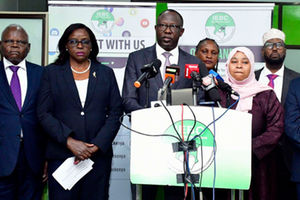
Independent Electoral and Boundaries Commission chair Erastus Edung (center) flanked by fellow commissioners address the media at the commission offices in Nairobi on January 27, 2026.
Photo credit: Francis Nderitu | Nation Media Group
On September 1, 2017, at the Supreme Court, Chief Justice emeritus David Maraga said that an election is a process and not an event as he nullified the August 2017 presidential election results, marking the first time in Africa that a court overturned a sitting president’s election victory.
The DP party leader also warned that any election technology that involves the “vending services” of Smartmatic, which supplied election management technology in the 2022 elections, “will not be accepted by us in the opposition because we know the kind of things that played out during the August 2022 general election.”
“Greater accountability for technology vendors in the election alongside independent audits of systems used by IEBC are non-negotiable. They are our irreducible minimums,” says Mr Muturi.
He also added that the “procurement of technology and election materials and services must be transparent, consultative and inclusive of all stakeholders in all the processes of procurement.”
Independent Electoral and Boundaries Commission (IEBC) Deputy Commission Secretary Operations and Director Ruth Kulundu makes her remarks during the Let Peace Win campaign launch held on June 18, 2022 at the Nairobi Safari Club.
Photo credit: Francis Nderitu | Nation
The DP leader spoke as IEBC acting CEO and commission secretary Ms Ruth Kulundu assured that the commissioners are working to ensure credibility in the entire electoral process.
“As a commission, we are on course to deliver a transparent and credible election,” said Ms Kulundu.
Through a tender notice on August 11, 2026, the commission invited eligible bidders to provide, install, test, commission and maintain the Kenya Integrated Elections Management System (KIEMS).
The tender includes the required hardware, equipment and accessories.
The tender also covers support and maintenance of the integrated Election Management System (EMS), which will form part of the technology infrastructure used in the management of the elections.
In a separate tender, the IEBC is seeking suppliers for the ballot papers, tactile folders, the register of voters and statutory election result declaration forms.
The two tenders close on September 1, 2026, with bidders required to have submitted their bids to the commission by 10 am, East African time.
Ms Kulundu revealed that “in a week after tender closure, we will have evaluated the vendors in readiness to award the tenders.”
“Everything will be above board and we will carry along stakeholders along the way,” said the IEBC acting CEO.
Mr Mule Musau, the national coordinator, Elections Observation Group (Elog)- Kenya, says that IEBC notes that price consideration is key, noting that technology costs are too high.
“There has to be transparency in the procurement process and stakeholders should be given access to interrogate the process,” says Mr Musau, adding, “the contracts must be public-friendly.”
At a previous meeting with the IEBC, the National Assembly Committee on Constitution Implementation and Oversight (CIOC), then chaired by Suba South MP Caroli Omondi, a number of sticky issues in election management, calling for greater accountability, were raised.
This was informed by the fact that in 2022, Smartmatic, the tech vendor for the KIEMS kits, “refused to share its source code, citing intellectual property rights, which made independent verification of the vote transmission algorithm impossible.”
“The ghost biometrics bred concerns over how the system handles offline or manual voter identification if biometric kits fail in opposition strongholds,” Mr Omondi said at the time.
Independent Electoral and Boundaries Commission Chairperson Erastus Edung Ethekon during the signing of a Memorandum of Understanding between IEBC and the Kenya Media Sector Working Group on March 27, 2026 at Pullman Hotel.
Photo credit: Francis Nderitu | Nation Media Group
Data hosting and sovereignty were also issues as it emerged that the cloud servers routing the results are physically located in a foreign country, raising fears of external hacking or local state security agencies intercepting the data transmission.
Cases of over-printing of ballot papers and their serial numbers were also flagged in the last general election.
This is because the committee demanded strict oversight on the exact number of ballots printed, with fears that the vendor will print millions of un-serialized "excess" ballots to be used for ballot-stuffing.
As the IEBC intends to award the KIEMS contract, the choice of the vendor will be critical.
“Awarding the contract to a foreign company with a history of corruption scandals in other emerging democracies will be a key consideration by the IEBC,” warned city lawyer David Ochami.
Mr Ochami added that the lack of tracking on how ballots are packaged and transported from the printer to remote polling stations “creates a window for diversion.”
This was reinforced by Mr Muturi, noting that the key is for IEBC to ensure that “whoever is the provider of the KIEMS kits gives the IEBC the ownership of the intellectual property rights.”
This, he says, will avoid “a situation similar to the one witnessed in 2022.”
The matter was canvassed at the National Dialogue Committee (Nadco) meeting and in a report that was adopted by parliament, there was a proposed amendment to section 44 (1) of the Elections Act.
The Bill was passed in the Senate in December 2024 and forwarded to the National Assembly in February 2025 for consideration.
“I call on the National Assembly to move with speed to enact the law and on the IEBC to ensure compliance with that proposal for greater accountability,” said Mr Muturi.
“They should also be able to provide audit trails which can be used for evaluation,” he said, noting that the reputation of the vendor is critical.
The Sh10 billion is required to purchase new Kiems kits to replace the 45,353 adjudged obsolete kits and 5,000 contingency kits required.
The other election cost-drivers include hiring and stipends for polling clerks, presiding officers and tallying staff, which requires Sh5.2 billion, and Sh4.8 billion for logistical mapping and delivery on non-technological assets and polling site support.
There is also Sh2.7 billion for voter registration and verification, which includes voter registration drives and biometric verification systems, Sh2.1 billion for polling centre infrastructure that includes geo-referencing and expanding polling stations, as well as Sh1.7 billion for public communication and civic media.
This includes civic engagement, media campaigns and public voter education.
The other cost drivers include Sh1.5 billion for transport and fleet management- movement of materials, field operations and distributing election day equipment, Sh500 million for voter register audit- independent auditing and cleaning of the national register before the election.
The purchase of motor vehicles requires Sh438 million and includes specialized institutional field vehicles for the commission.
The commission, in recent comments before the National Assembly Committee on Justice and Legal Affairs (JLAC), revealed that the budget requirement grew significantly.
This is because the total number of registered voters is projected to rise from 22 million in the 2022 general election to the projected 28 million by the time the 2027 elections are held.
This, as the polling station are expected to increase from 46, 229 to 55,393.
The introduction of widespread diaspora voting mapping and the technical obsolescence of electronic hardware originally bought in 2017 drove hardware procurement costs upward.