As the Independent Electoral and Boundaries Commission (IEBC) prepares for the 2027 General Election, Kenyans and political players have been raising concerns over the technology that the electoral body plans to deploy to deliver a credible election.
One such technology is the Iris Capture Technology or Iris Recognition Technology.
On September 29, 2025, the electoral body kicked off the continuous voter registration exercise, which aims to register at least 6.3 million new voters (mainly young people), to push the number of registered voters to 28.5 million by 2027.
The voter registration is currently ongoing in 278 constituencies, supported by 57 Huduma centres, and the IEBC has introduced the use of the Iris Capture Technology in its KIEMS kits. This, the IEBC says, promises greater accuracy in identifying voters on Election Day.
The electoral body said it has upgraded its technology by integrating a new Biometric Voter Registration module into the KIEMS kits to allow for faster, more secure and more reliable services.
The changes in the voter registration process, according to the IEBC are designed to foster transparency, improve accuracy, curb duplication, and prevent errors in voter details.
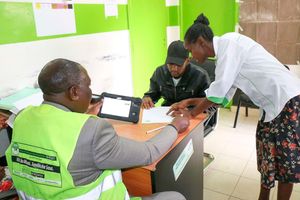
IEBC officers in Kapsoya Estate, Eldoret City of Uasin Gishu Country on the first day of the commission’s continuous voters registration on September 29, 2025.
Photo credit: Jared Nyataya | Nation
Iris recognition technology, according to experts, is a biometric authentication method that identifies individuals based on the unique patterns within their irises—the coloured portion of the eye surrounding the pupil—which distinguishes it from retina scanning.
The iris, situated at the front of the eye, is a pigmented, circular muscle that governs the diameter of the pupil, controlling the quantity of light entering the eye to ensure optimal vision.
The technology relies on high-resolution images of the iris, captured using specialised cameras or scanners, to extract distinct features such as the arrangement of furrows, crypts and rings.
According to Godfrey Ngunyi, an IEBC Information Communication (ICT) expert, the Iris Capture Technology is a game-changer in voter registration and is aimed at complementing the existing biometric identifiers which includes fingerprints.
"The reason the IEBC is capturing the iris during the voter registration is because of the uniqueness of a person's iris as well as how long it remains undistorted, unlike fingerprints, which, depending on the work that you do, may change over time," he said.
Mr Ngunyi explained that the new technology provides an alternative means of voter identification on Election Day, should fingerprint recognition fail.
"Its inclusion is permissible under the Elections Act and reinforces our commitment to credible, inclusive and transparent elections," he further stated.
The Election Act, Cap 7-Section 2, defines the term biometric, as unique identifiers or attributes that include fingerprints, hand geometry, earlobe geometry, retina and iris patterns, voice waves, DNA and signatures.
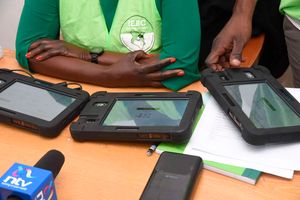
The IEBC plans to use iris identification technology to identify voters.
Photo credit: Pool
The Iris Capture Technology is part of a wider upgrade of technology by the IEBC, which will cost about Sh7 billion. However, the IEBC clarifies that the Iris Capture Technology is not mandatory for registration.
Ms Joyce Ekuam, IEBC’s Director of Voter Education, Partnerships and Communication, said that the use of iris data in the registration process is optional.
“Let me clarify that, in as in as much as we have included the iris, it is not compulsory. If you are not comfortable with it, you can bypass it and still get registered using our KIEMS kits. The additional option of iris data is meant to strengthen verification processes,” she explained.
IEBC Chairperson Erastus Ethekon told the Nation that all voter data, including the newly captured iris information, will be handled in strict compliance with the Data Protection Act, 2019.
"Access to voter information will be limited to authorised personnel and any breaches or misuse of data will attract legal sanctions," he said.
The IEBC chairman also assured Kenyans and political players that the technology that will be deployed in the 2027 General Election is tamper-proof, and that the electoral body's systems cannot be hacked.
"The technology we are going to deploy is tamper-proof. Our systems have enough safeguards in terms of security features, hence no need for alarm. I want to tell Kenyans and political players that we are a responsible commission in the discharge of our mandate and functions," Mr Ethekon said.
"We have put in place elaborate measures, including robust administrative structures, to ensure that the 2027 General Election is free, fair, accurate and credible."
Concerns about privacy, cyber security and trust have been growing, with experts warning that without strong safeguards even advanced technology could undermine public confidence.
Kenyans have also raised concerns, including on social media, over the new Iris Capture Technology and the effectiveness of the KIEMS kits.
During the 2017 and 2022 general elections, some of the kits malfunctioned and caused doubts over their reliability.
The voter registration drive also features enhanced measures, designed to bolster efficiency and prevent errors in voter details. The changes include scanning personal identifying information directly from the ID cards.
The commission will continue to capture fingerprints and passport photographs, with the additional option of Iris data intended to strengthen verification processes.
At the registration centres, the first thing an individual is required to do is to hand over their ID card to the polling officer to confirm that they are the holder of the card. Then the ID card is scanned on the registration kit – a tablet – to verify whether the person is a registered voter. If registered, the details will pop up, but if not, the individual will proceed to registration.
The polling officer will then scan the ID once again to automatically capture the details stated on the ID card, including the ID number, serial number, gender, date of birth and the rest.
This will eliminate any human errors that might occur when manually typing the details onto the kit. The next step involves capturing an individual's literacy levels, including whether they can read or have a disability or special needs that requires assistance during the voting process.
A person is then required to input pre-selected polling stations and wards where they plan to cast their vote.
Lastly, the person will move to the identifiers section, which will include capturing fingerprints, passport photograph, and the iris data.
Younger, tech-savvy people and more literate individuals can finish the process in about five minutes, according to the IEBC.
To reach the target of registering 6.3 million new voters before 2027, the commission has made several changes that will enable more Kenyans to register at their convenience.
One such change is that you no longer have to register at the polling station or constituency where you intend to vote. For example, if someone works in Nairobi, Mombasa or Nakuru but intends to vote upcountry, they can register at any nearby registration centre and select the polling station where they plan to vote.