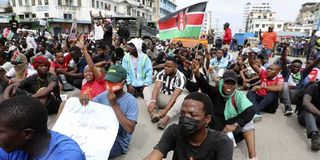
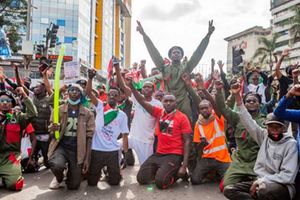
The 2024 Gen Z protests proved that young Kenyans have mastered multiple revolutionary tools.
They forced the withdrawal of the Finance Bill 2024 and halted the Jomo Kenyatta International Airport (JKIA) Adani deal through street protests. But revolutions don’t follow formulas.
They demand creativity, endurance, and the willingness to use every tool in the arsenal.
Kenya’s youth make up 75 per cent of the population but accounted for less than 10 per cent of votes cast in 2022, a stunning mismatch between demographic weight and political influence.
Global evidence from Chile to Senegal shows that youth movements succeed when they combine protests with voter registration, turning anger into organisation and organisation into power.
The math is staggering. Youth unemployment stands at 67 per cent. The 2022 presidential margin was just 233,211 votes, yet 7.8 million registered voters, mostly young people, stayed home.
The Independent Electoral and Boundaries Commission (IEBC) now targets 6.3 million new voters before 2027. If Kenya’s youth mobilise, they become the single most decisive bloc in every election. The revolution, in other words, could be won by arithmetic.
Chile’s Gabriel Boric offers the clearest blueprint for transforming protest energy into governing power. In 2011, at just 25, he led nationwide student protests demanding education reform.
Two years later, he entered parliament. By 35, Boric had become Chile’s youngest president, winning with 55.9 per cent of the vote. His journey shows that revolutions unfold differently, some take a day, others take years, but what matters is staying prepared for every possibility.
Africa has its own model. Senegal’s Y’en a Marre (“We’re Fed Up”) movement, launched by hip-hop artists and journalists in 2011, led protests that blocked President Abdoulaye Wade’s bid for a third term. Soon after their victory, they launched “Dos ak Bantal” - “My Voter Card, My Weapon.” In just a year, over one million new young voters registered.
When the election came, youth turnout was decisive. Wade lost, and Senegal’s democracy survived because young people chose to fight with both protest and the ballot.
Different revolutionary tools serve different purposes. Protests create urgency and visibility, forcing governments to respond and shaping a shared identity.
Digital platforms enable mass coordination at low cost, allowing information to spread faster than state propaganda. The ballot transforms that momentum into institutional power, the kind that changes budgets, laws, and leaders.
Research from Cambridge University found that when social movements strategically ally with alternative power centres during elections, they form coalitions capable of disrupting entrenched elites.
But Kenya’s opposition is now in coalition with the government, meaning the old playbook won’t work. The youth must be creative by forming new movements, new alliances, and using new tools to expand the battlefield beyond the streets.
On September 29, the IEBC resumed continuous voter registration targeting 6.3 million new voters by the next General Election. Yet after four days, only 7,048 had registered nationwide.
Daily Nation journalists visited centres across the country and found some recording zero turnout. Youth cited long distances and economic hardship, but the real barriers are deeper — structural and psychological.
Each registered youth reshapes Kenya’s political calculus. Each ID processed, each card collected, chips away at a system built on exclusion.
The 2024 protests in Kenya showed that when youth act collectively, they bend power. Voter registration ensures they never have to beg it again.
If 2027 becomes the year of record youth turnout, Kenya’s politics will never be the same. Ethnic patronage — the oxygen of Kenyan elections — will suffocate under a generation that identifies itself as tribeless.
The 2024 protesters already declared themselves the first truly post-ethnic political force in our history. Now they must institutionalise it through numbers at the ballot box.
Kenya stands at a revolutionary crossroads. The street has spoken; now the ballot must echo it. Musicians, influencers, and student leaders should champion a national campaign under the banner “My Voter Card, My Weapon.”
Universities and campuses should become voter registration hubs. WhatsApp groups and TikTok challenges should transform registration into a collective act of resistance. Civic duty must feel like joining a movement, not filling a form.
As the Gen Z movement reminded the nation: “The time to be leaders of tomorrow is over. We are leaders today.” Or as that viral meme declares, “I am the captain now.”
The ballot is not a separate path from protest but rather a part of the same revolutionary toolkit. Both require critical mass to succeed.
Just as the streets shook when millions turned up to protest, the ballot will shake the nation when millions turn up to vote. That is how movements become governments, and governments become accountable to the people again.
Mr Amenya is a whistleblower, strategy consultant and start-up mentor. www.nelsonamenya.com