The United States under President Donald Trump keeps releasing lists of countries prohibited from one thing or another, and Kenya somehow keeps dodging them.
The latest came too close for comfort. It was a list of “high-risk” countries whose citizens will not get immigrant visas starting January 21.
Immigrant visas are issued to people who intend to live and work permanently in the US, as opposed to non-immigrant visas meant for people visiting for tourism, business, medical treatment, or some types of temporary work.
Released on Wednesday, the list had 75 countries, 26 of them from Africa. Kenya’s East African Community (EAC) peers Uganda, Tanzania, Somalia, South Sudan, Rwanda, and the Democratic Republic of the Congo were all on the list.
Immigrant visas are issued to people who intend to live and work permanently in the US.
Photo credit: Shutterstock
Burundi, the only other EAC member not included, was from January 1 placed among countries whose citizens were barred from entering the US unless under exceptional circumstances.
A statement from the US Department of State on Wednesday said the 75-country list was created because “President Trump has made clear that immigrants must be financially self-sufficient and not be a financial burden to Americans.”
Other African countries on the list include Algeria, Cameroon, Cape Verde, Cote d’Ivoire, Egypt, Eritrea, Ethiopia, and The Gambia. There is also Ghana, Guinea, Liberia, Libya, Morocco, Nigeria, Republic of the Congo, Senegal, Sierra Leone, Somalia, Sudan, Togo, and Tunisia.
Countries from other continents that featured in the list included Brazil, Kuwait, Russia, Uruguay, and Yemen.
In a post on X, the State Department said the 75 countries have migrants who “take welfare from the American people at unacceptable rates.”
“The freeze will remain active until the US can ensure that new immigrants will not extract wealth from the American people,” it said.
That is not all on the ever-evolving immigration front. With effect from January 1, the US issued a travel ban against 19 countries – 12 of them from Africa – in what a presidential proclamation said was to “protect the security of the United States.”
The countries were Afghanistan, Burma, Burkina Faso, Chad, Republic of the Congo, Equatorial Guinea, Eritrea, Haiti, Iran, Laos, Libya, Mali, Niger, Sierra Leone, Somalia, South Sudan, Sudan, Syria, and Yemen.
Of these, some African countries like Mali and Burkina Faso issued reciprocal travel bans for US citizens.
Nineteen other countries were placed on a restricted list. Visa issuance to this group was partially suspended, with instructions that only special immigrants, participants in major sporting events, and lawful permanent residents would be allowed into the US. This list included Burundi and other African countries such as Angola, Benin, Cote d’Ivoire, Malawi, Nigeria, Senegal, and Tanzania.
That was not all. On January 8, the State Department released a list of countries whose citizens have to pay visa bonds to enter the US. They were 38 in total, but Kenya wasn’t among them. Uganda, Tanzania, Zambia, Zimbabwe, Burundi, Senegal, and Namibia were.
Most of the visa bond requirements will come into effect on January 21. By imposing visa bonds, the Department of State explained, anyone travelling to the US using a passport from any of the 38 countries who qualifies for a visa “must post a bond for $5,000, $10,000, or $15,000 (Sh645,600, Sh1.3 million, or Sh1.9 million).”
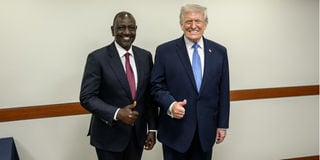
President William Ruto and US President Donald Trump after witnessing the signing of a peace deal between DRC and Rwanda in Washington DC, USA, on December 5, 2025.
Photo credit: PCS
The bond is refundable if the person abides by the rules of entry. Days earlier, on December 23, 2025, the US cancelled its diversity visa (DV) programme, commonly called the Green Card, after the shooting of a lecturer by a person who had gone to the country through the programme.
This one did not come with exceptions, and so Kenya – which has been sending thousands to the US every year through the programme – was among those locked out.
Immigration matters aside, Kenya was not on the adverse list last year when Mr Trump issued reciprocal tariffs applicable to various countries. The absence of Kenya from the list meant it belonged to the nations where a default 10 per cent tariff would apply.
Moreover, Kenyan trade with the US appears to be on a firm footing after the US House of Representatives on Monday passed a bill to renew the African Growth and Opportunity Act (Agoa) , which expired in September 2025. It is a preferential trade programme covering Kenya and 31 other African countries, allowing them duty-free access to the US market.
Kenya was also the first country to enter a government-to-government healthcare aid deal with the US, dubbed the Kenya-US Health Cooperation Framework. Through the agreement, which is now the subject of a court case in Nairobi, Kenya will receive $1.6 billion (Sh206.6 billion) from the US as it endeavours to keep Washington informed of any disease outbreaks by sending alerts and even samples.
US Secretary of State Marco Rubio and Kenyan Foreign Cabinet Secretary Musalia Mudavadi sign the US-Kenya health pact as President William Ruto looks on.
Photo credit: PCS
The pact, signed in December, was a replacement for the USAID and other aid programmes that the Trump administration had scrapped.
Health aside, Kenya is also one of the 20 countries in the list of major non-NATO allies. NATO stands for the North Atlantic Treaty Organisation.
“The Major Non-NATO Ally designation is a powerful symbol of the close relationship the United States shares with those countries and demonstrates our deep respect for the friendship for the countries to which it is extended,” says the Department of State.
Interestingly, some of the non-NATO allies are on the list of immigration curbs - but Kenya isn’t.
Being a major non-NATO ally, the Department of State explains, gives a country certain privileges that include being “eligible for loans of material, supplies, or equipment for cooperative research, development, testing, or evaluation purposes.”
So, why does Kenya appear to be favoured in the eyes of the US? On Thursday, the Daily Nation posed the question to Ms Irina Tsukerman, a US-based analyst who is the president of Scarab Rising, a geopolitical think-tank, and a US national security lawyer.
“Kenya’s apparent ability to avoid the harshest effects of recent US policy shifts is not accidental and it is not about personal favouritism. It reflects a long pattern in which Washington sees Kenya less as a problem to manage and more as a platform to rely on,” said Ms Tsukerman, who is also the editor of the Washington Outsider.
Collaboration with Washington
“In US strategic thinking, some countries are treated as leverage points rather than pressure points. Kenya falls firmly into that first category. The United States often differentiates between governments it wants to discipline and governments it needs to function. Kenya is viewed as essential to several US priorities at once, which creates a strong incentive to keep relations stable even during periods of global policy tightening,” she added.
“The US sees Kenya as a frontline state against terrorism, regional instability, and state collapse in neighbouring countries. Kenya hosts intelligence cooperation, military coordination and logistical infrastructure that the US cannot easily replicate elsewhere in the region. When Washington looks at Somalia, South Sudan, Ethiopia, and parts of the Great Lakes region, Kenya appears as the most predictable and capable partner. Punishing Kenya too harshly would risk weakening a pillar that supports US security goals across a very volatile neighbourhood. That calculation often outweighs concerns that might lead to tougher measures against other states,” Ms Tsukerman noted.
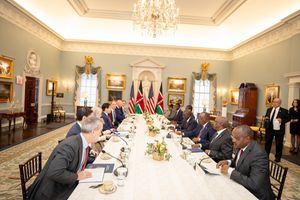
Kenya President William Ruto and US President Joe Biden during their talks at White house on May 23, 2024.
Photo credit: PSC
US Secretary of State Marco Rubio has said: “Kenya is one of our strongest partners in so many different fields, whether it’s the fight that we’ve fought together against terrorism on the continent but beyond that, and in our own hemisphere.”
“Kenya’s played an extraordinary role, a really heroic role in trying to help stabilise Haiti – it’s a very difficult situation. They’ve carried a huge burden as a country for the better part of two years now, and had it not been for their engagement – and I just expressed this to President William Ruto – as bad as Haiti is, it would be indescribable what it would look like today were it not for the efforts they have made. Our gratitude for the role they’ve played is extraordinary,” Rubio said on December 4 last year, flanked by President Ruto, who was in Washington.
Moreover, Ms Tsukerman noted, Kenya has been known to collaborate with Washington “even when relations are not perfectly smooth.”
“Kenyan governments have generally avoided dramatic anti-US rhetoric and have kept channels open even during disagreements. This matters in Washington more than many people realise. The US tends to reward governments that manage disputes quietly and pragmatically rather than publicly challenging American authority. Kenya has learnt how to signal independence without provoking confrontation. That skill helps it avoid becoming a target when Washington decides to tighten rules globally,” she said.
Retention of the non-NATO ally status, she said, is because the US views Kenya as a “long-term security partner whose military and political alignment is broadly reliable.”
Last year, the Foreign Relations Committee of the US Senate discussed Kenya’s non-NATO ally status, with its chairperson Jim Risch wondering why the country deserved the privilege while entertaining China. Regardless, Mr Trump hasn’t shifted the status. In terms of trade deals, Ms Tsukerman said Kenya is considered a “manageable economic partner.”
“Its exports do not seriously threaten US industries, and its market is seen as an opportunity rather than a risk. That makes Kenya less likely to be hit hard by punitive tariffs designed to protect American producers,” she said. “Kenya’s geographic position strengthens its leverage. It sits astride key transport routes, communication links, and economic corridors in East Africa. US planners understand that influence in Kenya translates into influence beyond Kenya.”
However, Kenya has recently featured in not-so-favourable light in the US as it was where some of the individuals who fleeced taxpayers through various aid programmes invested their money. It remains to be seen whether that will lead to consequences.
Also, Kenyans have been on the receiving end of deportations happening under Mr Trump. Just last month, Washington said it would deport 15 Kenyans convicted for various crimes.
Ms Tsukerman’s parting shot: Kenya’s “favoured” status reveals a lot about the US foreign policy under Mr Trump.