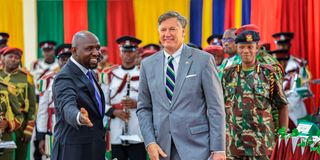
The United States has formally commended Kenya for its leadership role in stabilising Haiti, even as Nairobi grapples with mounting operational, financial and political challenges following the transition of the Multinational Security Support (MSS) mission to the new Gang Suppression Force (GSF).
US Deputy Secretary of State Christopher Landau described Kenya as an indispensable partner whose intervention prevented Haiti from collapsing under the control of violent criminal gangs at a moment when the country’s institutions had lost the ability to maintain law and order.
“The government of Haiti would not have survived the onslaught of these gangs without your presence,” Landau said on his official visit in Kenya, addressing Kenyan officers who served under the MSS mission adding,
Kenyan police officers disembark in Haiti to join an expanded multinational force with a mandate to fight gangs, at Toussaint Louverture International Airport, in Port-au-Prince, Haiti December 8, 2025.
Photo credit: Jean Feguens Regala | Reuters
“Kenya has been an indispensable partner- not only in deploying officers on the ground, but also in shaping what comes next.”
Kenya took the lead in the UN-backed MSS mission after the international community appealed for troop contributions to help restore stability in Haiti, where armed gangs had seized control of large parts of Port-au-Prince, paralysed public services and threatened the survival of the state.
“When the international community asked for countries to contribute, only one stepped up — and that was Kenya. It was necessary and proper for me to come here in person, on behalf of the President, the Secretary of State and the people of the United States, to recognise that sacrifice,” he said.
Earlier in the day, Mr Landau met with Prime Cabinet Secretary and Cabinet Secretary for Foreign Affairs, Musalia Mudavadi, who said Kenya’s leadership in Haiti reflects its growing role as a global security partner and its commitment to international peace and stability.
“This mission demonstrated how international cooperation can work when a country can no longer provide basic law and order for its citizens. Kenya answered that call, and we did so in close collaboration with the United States, the United Nations and other partners,” PCS Mudavadi said.
Prime Cabinet Secretary and Cabinet Secretary for Foreign and Diaspora Affairs Musalia Mudavadi.
Photo credit: File | Nation Media Group
He noted that the logistical demands of operating more than 12,000 kilometres away made US support essential, particularly in funding, transport and coordination.
“Working with the United States was absolutely critical in terms of logistics, international mobilisation and financial support. This cooperation made it possible for Kenyan officers to operate effectively in extremely difficult conditions,” he said.
He then added that Kenya remains committed to working with international partners to support peace efforts beyond its borders, but stressed that sustained global backing will be essential if the GSF is to succeed.
However, as the MSS mission transitions into the GSF, Kenya now finds itself carrying the weight of an ambitious but increasingly fragile operation.
During a last week’s (January 21, 2026) UN Security Council session, diplomats acknowledged a mission under strain, struggling to meet its mandate amid funding uncertainty, limited troop contributions and deep political divisions within Haiti over the post-transition order.
Mandated on October 1, 2025, through Security Council Resolution 2793, the GSF was envisioned as a 5,500-strong force with a 12-month mandate to neutralise gangs, secure critical infrastructure and support humanitarian access alongside Haitian authorities. Yet the mission has failed to reach even half its intended strength, as donor pledges remain largely unfulfilled.
Kenya continues to shoulder a disproportionate burden, having previously deployed up to 1,000 officers under the MSS, which itself never reached its target of 2,500 personnel.
Nairobi is now caught between an evolving criminal insurgency on the ground and a geopolitical tug of war in New York, where divisions among major powers have complicated efforts to reconfigure the largely Kenyan contingent into a fully multinational force with robust enforcement authority.
Russia’s Permanent Representative to the UN, Vassily Nebenzia, acknowledged the courage and political will shown by Kenya and other regional partners, but warned that the mission lacks a sustainable foundation.
Members of the Kenyan National Police Service hold a Kenyan flag after disembarking in Port-au-Prince, Haiti June 25, 2024.
Photo credit: Reuters
“It’s been four months since the adoption of Resolution 2793, but there have still been no real steps to reformat the predominantly Kenyan contingent into a larger multinational mission with the mandate to use force,” Nebenzia told the Council.
Despite these challenges, US credits the Kenyan-led deployment with preventing a total security collapse in Haiti, even as they acknowledge the fragility of current gains.
President William Ruto shakes hands with Kenyan police officers when he arrived in Port-au-Prince, Haiti.
Photo credit: PCS
“I do not exaggerate that things are good in Haiti, but it could have been worse. The level of stability we see today exists because of the courage and professionalism of the officers on the ground.”
During his first official visit day, Mr Landau met with President William Ruto, then Mr Mudavadi before heading to meet Kenyan officers at Embakasi A Police College who recently returned from Haiti. While at the police college, he revealed that the primary purpose of his trip was to personally thank them for their service.
“You answered the call of your own government and the international community. Your work gave the people of Haiti a chance,” he said.