Kenya may yet carry the burden of Haiti for longer, as the world continues to haggle over the form and substance of the Gang Suppression Force (GSF), created to dismantle criminal groups in the Caribbean nation.
The revelations emerged on Wednesday night as the UN Security Council, which mandated the GSF, discussed the escalating humanitarian and security crisis in Haiti.
Kenya, which contributed the bulk of police officers to the Multinational Security Support mission (MSS) — the precursor to the GSF — remained behind to continue serving in the new force, which has yet to be properly constituted.
That has become problematic, as the Haitian transitional government led by Prime Minister Alix Didier Fils Aimé is due to expire in February, amid divisions over whether to extend its tenure or hold elections.
Both issues are contentious. The US has warned that any extension of the government’s tenure would amount to support for criminal gangs.
“The US objective for Haiti remains the establishment of baseline security and stability. The US would regard any effort to change the composition of the government by the non elected Transitional Presidential Council at this late stage in its tenure (set to expire on February 7) as an attempt to undermine that objective,” said Christopher Landau, US Deputy Secretary of State.
“The US would consider anyone supporting such a disruptive step favouring the gangs to be acting contrary to the interests of the United States, the region, and the Haitian people, and will act accordingly.”
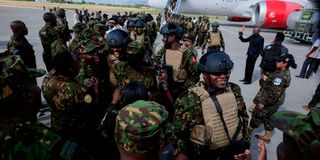
Kenyan police officers disembark in Haiti to join an expanded multinational force with a mandate to fight gangs, at Toussaint Louverture International Airport, in Port-au-Prince, Haiti December 8, 2025.
Photo credit: Jean Feguens Regala | Reuters
The GSF was designed to work with both Haitian police and the military to dismantle gangs, protect civilians, and secure key installations. It was meant to be better equipped, more professional, and broader in scope than the MSS. Both missions are UN mandated but not UN funded — and that is where the GSF’s problems begin. It remains unclear which other countries will contribute troops, or when operations will formally commence.
During Wednesday’s Security Council session, rhetoric surrounding Haiti reflected acknowledgement of a mission in peril. With the force struggling to meet its mandate, funding uncertain, and Haiti’s political class divided over the post transition order, Kenya now finds itself bearing the weight of an ambitious but increasingly fragile mission.
Nairobi is caught between an evolving criminal rebellion on the ground and a geopolitical tug of war in New York.
The GSF was mandated on 1 October 2025, after the Security Council adopted Resolution 2793 to transform the MSS into a 5,500 strong force. With a 12 month mandate, the GSF is expected to work alongside Haitian authorities to neutralise gangs, secure infrastructure, and support humanitarian access. Yet the MSS, which had aimed for 2,500 troops, never reached its target, with Kenya contributing up to 1,000 officers.
Legal and operational limbo
Russia’s Permanent Representative to the UN, Vassily Nebenzia, acknowledged Kenya and other regional partners had shown courage and political will, but argued the mission lacked a sustainable foundation. The GSF has failed to reach even half its projected capacity, as donor pledges remain unfulfilled.
“It’s been four months since the adoption of Resolution 2793, but there have still been no real steps to reformat the predominantly Kenyan contingent into a larger multinational mission with the mandate to use force,” he said.
He warned that Kenyan personnel were operating in a precarious legal and operational limbo, expected to transition into a combat ready force while promised support remained largely on paper. He also pointed to the unhindered flow of weapons from Florida, suggesting that as long as the arms pipeline remained open, Kenyan led forces were being asked to “empty a flooding room with a teaspoon.”
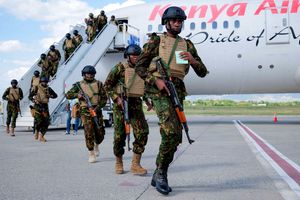
A Kenyan police officer carries a Kenyan flag after disembarking in Haiti to join an expanded multinational force with a mandate to fight gangs, at Toussaint Louverture International Airport, in Port-au-Prince, Haiti December 8, 2025.
Photo credit: Jean Feguens Regala | Reuters
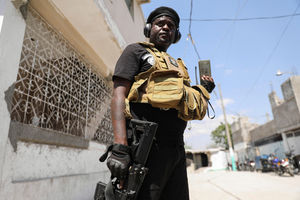
John Brandolino, acting executive director of the United Nations Office on Drugs and Crime (UNODC), described how Haiti’s gangs have evolved from loose criminal outfits into structured, professionalised networks. He said they now possess defined leadership, territorial ambitions, and diversified revenue streams.
The coalition known as Viv Ansanm, he noted, has demonstrated a level of coordination that challenges the traditional police support model of the MSS. Gangs are now coordinating large scale attacks on critical infrastructure, relying on extortion as a core revenue source, and exploiting weaker regional ports to evade the arms embargo — effectively turning the crisis into a regional one.
The UN has already established the UN Support Office in Haiti, funded through the regular budget, but has been slow to mobilise the troops needed for the GSF, creating what critics describe as a bloated bureaucracy.
Meanwhile, the Haitian National Police is losing officers, accounting for 22 per cent of casualties in anti gang operations, according to the UN.
Kenyan forces are therefore operating under intense scrutiny, with any misstep quickly amplified by domestic critics at home and sceptical voices at the UN.
The GSF is dependent on voluntary contributions for personnel costs, while its administrative backbone is covered by assessed UN funds. This arrangement, Brandolino argued, leaves operations unpredictable.
The UN estimates that gangs still control around 90 per cent of Port au Prince, Haiti’s capital, and have seized swathes of land in the country’s central region. More than 8,100 killings were reported across Haiti between January and November last year, though the UN cautioned that the figure may be conservative, given large parts of the country remain inaccessible.