Kisumu’s hopes of hosting 2027 Africa Cup of Nations (Afcon) matches have been dealt a blow after the government confirmed that Moi Stadium will be rebuilt as a 10,000-seater facility, which is below the 30,000 capacity initially promised.
China Road and Bridge Corporation (CRBC) is constructing the stadium under the supervision of the Kenya Defence Forces (KDF). Work on the Sh700 million facility is expected to be completed in December 2026.
Speaking during yesterday’s groundbreaking ceremony in Kisumu, Defence Cabinet Secretary Soipan Tuya said the facility will meet international standards.
“Upon completion, this modern stadium will be equipped with state-of-the-art infrastructure, including roofed western, eastern, northern and southern pavilions. The football pitch will be constructed to Fifa and Caf standards,” CS Tuya said yesterday.
Soipan Tuya, Kenya’s Cabinet Secretary for Defence, officiates the ground breaking ceremony of Moi Stadium, Kisumu, on December 18, 2025.
Photo credit: Alex Odhiambo | Nation Media Group
She added that the stadium will have an eight-lane athletics track with a tartan finish compliant with World Athletics standards. The stadium will feature mechanical, electrical and civil works such as fencing and adequate parking for VIPs and spectators.
In October 2023, the Ministry of Sports, then led by Cabinet Secretary Ababu Namwamba, indicated that Moi Stadium would be upgraded to a 30,000-seater facility as one of the venues ear-marked by Kenya to host 2027 Afcon matches. The proposed upgrade was to include an indoor arena, an aquatics centre, and an outdoor recreational and service block.
Ababu Namwamba.
Photo credit: Dennis Onsongo | Nation Media Group
At the time, Kisumu Governor Prof Anyang’ Nyong’o said plans to modernise the stadium had existed for years but were constrained by financial limitations. The national and county governments later announced intentions to replace the ageing facility with a new 30,000-capacity stadium.
“This is a very old facility, and we intend to work with the county government of Kisumu to put up a new stadium here in preparation for the 2027 Afcon,” Namwamba said during a visit to the city.
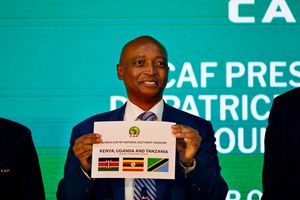
Caf awarded Kenya, Uganda and Tanzania hosting rights for 2027 Afcon under the East Africa Pamoja bid. Kenya initially proposed Moi International Sports Centre, Kasarani, Nyayo National Stadium in Nairobi, and Kipchoge Keino Stadium in Eldoret as its tournament venues.
The exclusion of Kisumu and Kakamega from the initial list drew protests from Western Kenya governors, led by Prof Nyong’o and Kakamega Governor Fernandes Barasa, who argued that the region is home to a large base of football fans and deserved inclusion.
Moi Stadium’s redevelopment has, however, been dogged by delays, mismanagement and controversy for more than a decade.
Renovation plans announced in 2012 aimed to upgrade the facility to international standards but were delayed by logistical challenges, including shipment delays caused by new government duties. FIFA allocated Sh50 million for the installation of artificial turf, while the Ministry of Sports set aside Sh45 million for further refurbishment.
In 2013, renovation works stalled due to delayed release of funds by the main contractor, Dutch firm Greenfield. The delays affected procurement of materials and payment of workers, forcing Kisumu to forfeit hosting the CECAFA tournament.
Further attempts to revive the project emerged in April 2019, when Kisumu County Government announced a two-year renovation plan budgeted at Sh90 million. The broader vision included a sports museum, new terraces, modern changing rooms, and a 500-seat amphitheatre for arts performances, with the total project estimated at Sh1.3 billion.
Those plans were halted in March 2020 after the Ethics and Anti-Corruption Commission (EACC) launched investigations into alleged procurement irregularities.
The commission instructed the county to suspend all procurement and payments related to the project following complaints of corruption, inflated costs and fraudulent practices.
Subsequent reports pointed to payments for incomplete or substandard work and allegations of restrictive tendering favouring politically connected firms.
During yesterday’s ceremony, Governor Nyong’o said Moi Stadium has been the cradle of legends, citing football icon Peter Dawo who is the stadium’s manager. Dawo won the 1987 Africa Cup Winners Cup (Mandela Cup) with Gor Mahia.
“Moi Stadium has been the cradle of legends. A home of dreams for many, an avenue for livelihoods for countless families. In our midst today is Peter Dawo, the Stadium manager here. Peter is a man who ‘dared to dream through football’ right here on this pitch,” he said.
“He didn’t just become a household name; he became a continental icon, lifting the African Cup Winners’ Cup as the top scorer, and being ranked among the best in the Continent,” he added.