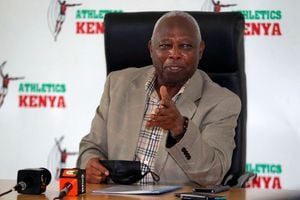
From left: Two-time Boston Marathon Champion Moses Tanui from, former 3,000m Steeplechase World Champion Wilson Kipketer Boit and Hosea Kogo, a former athlete.

The year 2025 comes to a close with long-overdue Athletics Kenya (AK) elections still pending nine years later.
As per AK’s constitution, the elections were to take place in 2017 but a year earlier, the High Court in Nairobi stopped the federation from going to elections under a proposed new constitution.
Retired Kenyan athletes, among them former Boston Marathon champion Moses Tanui and Julius Kariuki sought legal redress at Nairobi High Court on November 26, 2016. They sought to stop the application of the proposed AK constitution that had been earlier adopted at AK’s Annual General Meeting on April 27, 2016, terming it “null and void.”
The current AK executive committee came into office in 2013 with the late Isaiah Kiplagat, who had been chairman since 1992, being elected unopposed as president along with four chairmen (David Okeyo, Jack Tuwei, Fatma Awale, and Paul Mutwii). They were elected with no term limits, as the Sports Act 2013 was yet to come into effect.
Kiplagat resigned alongside vice president David Okeyo following a siege on Riadha by athletes in November 2015. They were later suspended by World Athletics for six months on allegations of corruption and obstruction of anti-doping efforts. Tuwei replaced Kiplagat as chairman.
In 2016, Tanui and the former athletes went to court, arguing that AK’s proposed constitution was the product of a process that lacked public participation, and was not compliant with the Sports Act 2013 that advocated for county federations, not affiliates or regions. The retired athletes also wanted athletes to be given a chance to directly participate in the elections instead of the delegate system. Under the delegate system, delegates from each of AK’s regions and institutions totalling 16 would each produce three voting delegates for a total of 48 delegates.
The AK regions are Nairobi Region, Central Region, Southern Region, Coast Region, South Rift Region, North Rift Region, Nyanza North Region, Nyanza South Region, Eastern Region, North Eastern Region, Central Rift Region and Western Region.
The AK affiliates are Kenya universities, National Police Service, Kenya Defence Forces, and Kenya Prisons Service.
Tanui and his group also faulted the decision by the Registrar of Sports to issue AK’s president Jack Tuwei with a certificate of registration signalling the conclusion of AK’s constitutional review process, saying the process did not conform to the Sports Act 2013.
However, the case that was amended twice (in 2017 and 2018) dragged on at the High Court for eight years till 2024. Two rulings - the first which was delivered last year and the second which came this year - unlocked the stalemate. The High Court delivered its verdict in March 17, last year. Justice Lawrence Mugambi declared AK’s current office illegal, but ordered the office holders to facilitate a further review of AK’s constitution as per the Sports Act 2013 to pave way for AK elections within 90 days.
Justice Mugambi declared that AK’s current office had served two eight-year terms. Having served their mandate in full, he ordered them to vacate office but Tuwei’s team appealed the ruling, with the High Court directing that the appeal be heard within six months. The Court of Appeal bench of three judges (Justice Pauline Nyamweya, Justice Aggrey Muchelule and Justice George Odunga) delivered its ruling on on March 21, this year.
They termed Justice Mugambi’s order preventing Tuwei’s office from seeking another term of office unfair. The Court of Appeal found that the officials had not been given a chance to defend themselves, and that their stay in office was occasioned by the delayed court process.
However, the three judges concurred with Mugambi that AK had failed to conduct a proper public participation exercise during the process that midwifed the proposed new constitution. The Court of Appeal directed that a more inclusive process be instituted, and ordered AK to complete the process within 90 days.
“AK must now review its constitution again with better public participation,” the Court of Appeal said in its ruling that set aside Justice Mugambi’s order.
The Sports ministry and AK constituted a 15-man committee chaired by Joshua Kiptoo to oversee the public participation exercise. The committee started the two-week process on November 3, and concluded it on November 24. Already, AK has indicated that the elections could be bheld by April next year.
Kiptoo says that besides capturing views from Athletics Kenya’s 14 regions and stakeholders such as local corporates and the media fraternity, his committee also received 120 written memoranda.
It remains to be seen what electoral laws AK will adopt but what is clear is that campaigns have started in earnest in the background.
“The documents we have are bulky and we are just summarising them into different clusters for ease of understanding in the next stage,” Kiptoo said, adding that his team hopes to finish the work before Christmas break.
Kiptoo said his team has focused mainly on three clauses touching on the public - elections, membership and structures of AK with regard to counties and regions.
Kiptoo said that during public participation, members of the public wanted Kenya to tighten its anti-doping laws to deter cheats in line with recommendations from Athletics Integrity Unit (AIU), World Anti-Doping Agency (WADA) and Anti-Doping Agency of Kenya (ADAK).
Kiptoo said his team will call a meeting of all athletics stakeholders in January next year during which all the contributions will be discussed and validated.
“They (stakeholders) need to have a look at the document and see if that is a reflection of the contributions they had made,” Kiptoo said. Afterwards, the document will then be tabled before Athletics Kenya’s executive committee for discussion. It will then be presented for adoption at AK’s Annual General Meeting. If approved, it will then be forwarded to the Registrar of Sports for registration.
Follow our WhatsApp channel for breaking news updates and more stories like this.