Allan Buluku In Dallas, Texas
The 2026 Fifa World Cup was always destined to be historic. For the first time, 48 teams, up from the traditional 32, would scatter across the United States, Mexico, and Canada from June 11 to July 19, 2026 in a footballing carnival of unprecedented scale.
More teams meant more stories, more upsets, and more magic. African fans were supposed to savour nine confirmed berths, the continent’s largest allocation in history. The tournament was designed to be the most inclusive, most spectacular, and most globally representative ever staged.
The escalating conflict involving Israel, the United States, and Iran has created a diplomatic labyrinth so complex that even Fifa’s famously creative legal department is struggling to find the exits.
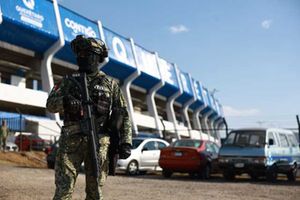
The entrance to the soccer stadium at Kino Sports Complex, where the Iranian men’s soccer team is scheduled to practice for the FIFA World Cup, in Tucson
Photo credit: Reuters
Iran and the US, to put it diplomatically, are not exchanging Christmas cards. They are, by most measures, in active conflict. Iran qualified through the Asian Football Confederation’s gruelling campaign. The question now is no longer whether they can play. It is whether they will play.
The opening match of the tournament will be a Group ‘A’ affair between Mexico and South Africa on June 11 at Mexico City Stadium. Co-hosts USA will play their first match of the tournament in Group ‘D’ on June 12 against Paraguay at the Los Angeles Stadium.
Three days later on June 15, Iran will be at Los Angeles Stadium to play New Zealand in a Group ‘G’ match.
With the confrontation widening into a regional firestorm, the beautiful game is suddenly playing second fiddle to a geopolitical chess match where the board is on fire and the pawns have long‑range ballistic capabilities.
For Iran to participate, their delegation would need iron‑clad assurances of safety on American soil. They were supposed to be the dark horses of Group G, ready to face Belgium, New Zealand, and Egypt.
But as of this week, the Iranian Football Federation sounds less like a sports body and more like a defence ministry issuing travel advisories.
Fifa’s statutes require member associations to be free from governmental interference, but nothing in the rulebook anticipated a scenario where the host country is at war with a qualified participant. If Iran withdraws, Fifa faces a legal and logistical nightmare dressed in a football kit.
Director of Kino Sports Complex Sarah Horvath poses for a photo at the soccer stadium, where the Iranian men’s soccer team is scheduled to practice for the FIFA World Cup, in Tucson.
Photo credit: Reuters
The most likely replacement for Iran, based on AFC qualification standings, is Iraq. Let that sink in. Iran exits the World Cup partially because of a war involving the US.
Iraq, a country the US famously invaded, occupied, and whose cities became global shorthand for conflict, steps in as their replacement.
It’s the kind of plot line a novelist would be told to make less obvious. Iraq have been improving steadily as a football nation. But arriving at the World Cup through geopolitical substitution is hardly the job anyone dreams of. Still, football has never been shy about writing stories that reality insists on.
As chaotic as 2026 feels, this is not the first time the World Cup or major tournaments have unfolded under the shadow of global conflict.
The 1978 World Cup in Argentina was held under a brutal military dictatorship, with political prisoners tortured within earshot of stadiums. Johan Cruyff famously refused to participate, later saying, “There are moments when football cannot be the most important thing.”
The 1990 World Cup in Italy was played months before the Gulf War, with tensions already simmering. The US and Iraq were both present, their group‑stage journeys unfolding against a backdrop of diplomatic hostility.
In the 2010 Africa Cup of Nations in Angola, the Togo national team was attacked by gunmen in Cabinda, killing three members of their delegation.
The tournament continued, but the tragedy cast a long shadow. In the 2012 Euros in Poland/Ukraine, Ukraine was already embroiled in political turmoil, with international calls for boycotts over human rights concerns, and the 1942 and 1946 World Cups were cancelled and then delayed due to World War II.
Even Pelé, the game’s greatest ambassador for peace, once said, “Football is more than a game. It is a universal language that can stop wars and start friendships.”
Yet even he would admit that sometimes the world refuses to listen. The conflict has done something that no pandemic or economic crisis has managed so completely. It has made international travel feel like an act of courage.
Freshly printed copies of the newspaper PM bearing the headline "US mapped ‘El Mencho’ and Mexico delivered the final blow, Caught between two fires," are seen at a printing facility, following the killing of drug lord Nemesio Oseguera, known as 'El Mencho,' in a military operation on Sunday, in Ciudad Juarez, Mexico, February 22, 2026.
Photo credit: Jose Luis Gonzalez | Reuters
If conflict has so often crept into the world’s biggest tournaments, nature has proved an equally uninvited guest. Sport, that dependable escape hatch from the planet’s anxieties, has never been fully immune to calamity.
In 2020, as Covid‑19 swept across continents and turned city streets into ghost towns, it also shut stadium gates. By March, the global sports calendar collapsed in unison.
A century earlier, the 1918 influenza pandemic delivered its own brutal interruption. The so‑called Spanish Flu tore through the world between 1918 and 1920, infecting an estimated 500 million people, which was a third of the earth’s population at that time.
Sport, already staggering under the weight of the First World War, found itself further undone as matches were postponed, seasons abandoned and stadiums repurposed for far grimmer duties.
The war only hastened the virus’s spread. Troop ships became accidental couriers, carrying soldiers, and the flu, across continents as they made their way home. The result was a second wave of cancellations that left administrators with little choice but to shut everything down. For months, whistles stayed tucked in pockets, and crowds stayed home.
And now, as the Iran conflict ripples across the Middle East, sport finds itself once again at the mercy of forces far beyond the touchline.
Airspace disruptions, re-routing, airline suspensions, and insurance complications are already reshaping how the world moves. Flights that once passed smoothly through Middle Eastern hubs such as Dubai, Doha, and Amman now face uncertainty.
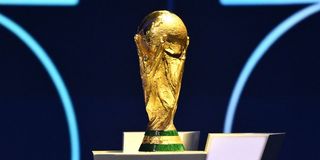
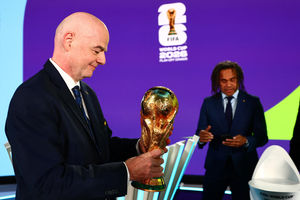
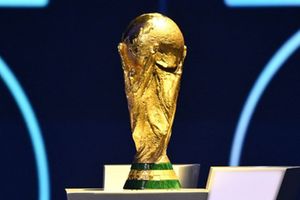
The Fifa World Cup trophy during the 2026 Fifa World Cup draw at John F. Kennedy Center for the Performing Arts in Washington DC on December 5, 2025.
Photo credit: Reuters
Fares have spiked. Insurers are attaching caveats thicker than Fifa’s rulebook to travel policies. For national teams, pre‑tournament preparation tours to North America will become logistical nightmares. Training camps, friendly matches, and acclimatisation visits now subject to flight disruptions, delayed visas, and security assessments that change by the week.
For fans, especially those flying from Africa, the challenge is even more acute. Already navigating the expense and complexity of intercontinental travel, African supporters now face the added burden of a world whose aviation networks are being reorganised around a war. Africa enters 2026 with nine qualifying slots, the largest allocation ever.
Morocco, who co‑bid for this tournament before losing to the North American consortium, arrive with semi‑final pedigree after their historic 2022 run.
Nigeria, Senegal, Egypt, Côte d’Ivoire and South Africa all have squads capable of unsettling the established order. But before any of them can dream of upsets in Los Angeles or Guadalajara, they must first solve the simplest, most maddening question of all; how to get there.
African fans who have saved for years to attend this tournament might find flights more expensive and routes less reliable. The dream of watching their heroes on the world stage now competes with the reality of a global conflict that has nothing to do with them, yet affects them.
Football has always existed in the world, not above it. This World Cup was designed to celebrate the sport’s global reach and its ability to bring together 48 nations, three host countries, and billions of fans into a single shared moment. What the Iran conflict has demonstrated is that no amount of Fifa infrastructure, glossy host‑city branding, or television rights deals can insulate the world’s most popular sport from humanity’s oldest habit… war.
The tension surrounding 2026 has revived old conversations about football’s role in a fractured world. Didier Drogba famously helped broker peace in Cote d’Ivoire, urging warring factions to lay down arms. George Weah, now a former president, often told the world that football “teaches us unity, discipline, and the power of shared purpose”. These voices echo louder now, as the sport prepares for a tournament overshadowed by conflict. Football cannot stop wars. But t has, time and again, offered moments that show humanity what it could be.
Fifa is currently in its favourite pose; the ostrich with its head in the sand. It says it is “monitoring developments”, which is code for praying for a ceasefire. This tournament was meant to be football’s great expansion. Right now, it risks becoming its most complicated, defined as much by who couldn’t make it as by who lifts the trophy.
Iran’s fate hangs by a diplomatic thread. Iraq waits in arguably the most historically loaded substitution scenario in football history. African fans and teams, who deserve this tournament most, given how long they have been marginalised by Fifa’s allocation politics, face obstacles that were never part of their 2026 dream. The ball is round. The game is 90 minutes. But the world, unfortunately, is anything but simple.