In Seattle, USA
George Weah won the Ballon d’Or in 1995. That sentence has hung over the continent for 30 years. No African has won it since, and this week it hung a little heavier. The shortlist came out with 30 names and only two Africans on it, Achraf Hakimi of Morocco and Sadio Mané of Senegal. Neither has a realistic path to the podium, let alone the trophy.
Then came Yaya Touré, walking into the Parc des Princes as the first African head coach to lead a team in the Champions League main phase. His Slovan Bratislava side lost 6-1 to Paris Saint-Germain. The scoreline was ugly, but the milestone was not.
The connection between these events is the same story told from two different angles. Weah won the Ballon d’Or in 1995, the first year non-European players were eligible. He was at PSG and AC Milan, scoring goals that made defenders reconsider their career choices. He remains the only African winner. Mozambican-born Eusébio won in 1965, but he played for Portugal, so that does not count here.
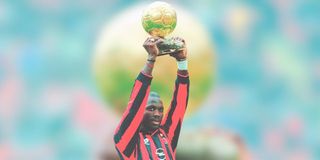
AC Milan striker George Weah raises the Golden Ball to receive a standing ovation from fans, before the start of an Italian Serie A match between AC Milan and Sampdoria at San Siro Stadium on January 7, 1996.
Photo credit: File | Nation Media Group
Since Weah, Africa has produced an extraordinary volume of elite footballers, especially from the late ‘90s, early 2000s up to the mid-2010s. Didier Drogba, Nwankwo Kanu, Jay Jay Okocha, Samuel Eto’o, Lauren Etame Mayer, Benni McCarthy, Yaya Touré, Lucas Radebe, Salomon Kalou, Samuel Kuffuor, Michael Essien, John Obi Mikel, Asamoah Gyan, Kolo Touré, Emmanuel Adebayor, Sulley Muntari.
The list reads like a constellation. These players dominated the Champions League, won league titles across Europe, and carried national teams to continental glory.
And yet, in 30 years, only one African has finished in the top three of the Ballon d’Or. Mané in 2022, second behind Karim Benzema.
Start with the voting body. The Ballon d’Or is decided by 100 journalists, one from each of the top 100 Fifa-ranked nations. These are not neutral observers. They carry the footballing cultures they come from, the biases those cultures have absorbed, and the hierarchies those biases reinforce.
European football has spent decades positioning itself as the center of the sport. The journalists who cover it often reflect that assumption, even unconsciously.
You think it’s a conspiracy? No. It’s something subtler and harder to address. It’s the way a Brazilian or Argentine attacker arrives in Europe already wrapped in mythology, already expected to be great, while an Ivorian or Cameroonian must prove it twice over.
Samir Nasri said this plainly in 2014, speaking about his Manchester City teammate.
“If he wasn’t African, everyone would say he’s the best midfielder in the world.”
Yaya Touré scored 20 Premier League goals from midfield in one season. He never finished higher than 12th in the Ballon d'Or voting.
Nasri continued: “Of course it counts against him being from Ivory Coast. If he was Argentinian or Brazilian everyone would talk about him.”
Manchester City’s Yaya Toure gestures during a match against Liverpool in the International Champions Cup at Yankee Stadium, New York on July 30, 2014.
Photo credit: AFP
Yaya himself said something similar around the same time. He pointed out that people in Europe might know Lionel Messi's face but not his own, despite being one of the most dominant midfielders of his generation. There is a visibility gap.
The Ballon d’Or rewards players who fit a particular story. The story usually involves a club with global reach, a media machine behind it, and a player whose nationality does not require explanation. African players often arrive at those clubs later, or they play in positions that voters undervalue, or they simply do not get the same benefit of the doubt when form dips.
Drogba was Chelsea's warrior, but the club’s marketing orbit revolved around Frank Lampard and John Terry. Eto'o was Barcelona’s spear, but the spotlight followed Ronaldinho, then Messi. Essien was the engine of Jose Mourinho's Chelsea, but engines rarely win awards.
Yaya was Manchester City’s midfield monarch, yet the Premier League’s global narrative was built around Steven Gerrard. African excellence has often been framed as supporting brilliance rather than defining brilliance. The continent's stars have been celebrated, but not mythologised.
Then there is the World Cup. The Ballon d’Or has historically weighted World Cup performances heavily. African nations have never won a World Cup. They have come close to the semi-finals, but close does not translate into votes.
Real Madrid's French forward Karim Benzema receives the Ballon d'Or award during the 2022 Ballon d'Or France Football award ceremony at the Theatre du Chatelet in Paris on October 17, 2022.
Photo credit: AFP
European and South American players who excel at the World Cup receive a boost that African players cannot access because their teams, however talented, have not gone all the way. This is a structural disadvantage disguised as a meritocratic standard.
The award is also married to the Champions League. It is the competition that shapes global opinion. African players have thrived in it, but they have rarely been the central figure in winning teams.
Eto’o came closest. He was magnificent for Barcelona and Inter Milan. He scored in Champions League finals. Yet, he played in squads with towering personalities and global superstars. His brilliance was undeniable, but it was not positioned as the defining storyline.
Drogba had a similar fate. His performance in the 2012 Champions League final is one of the greatest clutch displays in modern football. But Chelsea's season was chaotic, and the award went to Lionel Messi, who scored 73 goals that year. No one was beating that.
Yaya himself was extraordinary in the Champions League, but he played in a Manchester City side still building its European identity. His dominance was domestic, and domestic dominance rarely wins the Ballon d'Or.
Slovan Bratislava coach Yaya Toure follows the Uefa Champions League match against Paris St Germain at Parc des Princes in Paris on September 9, 2026.
Photo credit: Reuters
Now consider Yaya Touré again, this time as a coach.
He became the first African head coach to lead a team in the Champions League main phase. He took charge of Slovan Bratislava in June and guided them to the league phase.
His opening match was against the defending champions, away, in Paris. Slovan lost 6-1. That result does not diminish the achievement. It contextualizes it.
“We have to work two or three times harder,” he said. That sentence could have come from any African player discussing the Ballon d'Or. Talent is abundant. Access is not.
The same barriers that keep African players from winning the Ballon d’Or are now visible in the coaching pipeline. European clubs are reluctant to hire African managers for top jobs. The few who get chances often start at smaller clubs in smaller leagues, with fewer resources and less margin for error.
George Weah won the Ballon d’Or in 1995 because he was undeniable. He scored goals that no one could ignore, for clubs that everyone watched.
Liberia's George Weah won the Ballon d’Or in 1995.
Photo credit: File | Nation Media Group
The voters had no choice. That is the standard African players still face. They must be undeniable, in a way that European and South American players rarely are.
Sadio Mané came second in 2022. He won the Africa Cup of Nations with Senegal. He was instrumental in Liverpool's run to the Champions League final. He was, by any reasonable measure, one of the best players in the world.
Benzema won because Benzema had a remarkable season for Real Madrid, winning the Champions League and La Liga. The margins were thin. The margins are always thin for African players. Thin margins are where bias lives.
Yaya stood on the touchline in Paris this week, watching his team get dismantled by the best club in Europe. He had been in that stadium many times before as a player, controlling midfields for Barcelona and Manchester City. Now he was there as a coach, a pioneer whether he wanted to be or not.
Weah opened the door in 1995. Yaya has opened another in 2026. The next African Ballon d'Or winner will walk through both. Yaya’s presence in the Champions League will not fix that overnight. But it is a crack in the door. Another one. Eventually, the door has to open.