When the final whistle blew at the Kenya Secondary Schools Sports Association (KSSSA) National Championships on Thursday, some coaches felt relieved while others were heartbroken.
Victories strengthened coaches’ careers, enhanced their schools’ reputations, opened pathways to the East African stage, and showcased their players to scouts looking for talent.
This is what has changed about secondary school sport in Kenya. Previously, the games were largely regarded as an opportunity for teenagers to play, compete and enjoy themselves.
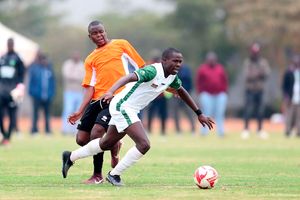
Julius Ochieng (left) of Kakamega High School tussles for the ball with Vincent Onyango of St Mary‘s School Yala in boys’ football final of the Kenya Secondary Schools Sports Association Term Two national games at M-Pesa Foundation Academy, Kiambu County on August 6, 2026.
Photo credit: Chris Omollo | Nation Media Group
However, the games have since evolved into fierce contests where winning a national title can have consequences that extend far beyond the school field. And the pressure did not end in Thika.
The champions will travel to Morogoro in Tanzania for the 23rd Federation of East African Secondary Schools Sports Association (FEASSA) Games, which take place from August 12 to 23. This will give schools another reason to compete fiercely for honours.
Schools must negotiate county and regional competitions to reach the national level, and success in Thika provided a passport to the winning teams to the international stage where top schools from across East Africa will compete. This creates a competitive environment where everyone wants to progress to the next level.
Coaches wanted their teams to qualify, schools wanted the title, players wanted exposure, and teachers who double as coaches knew that sporting success can have implications for their own careers.
Peter Mayoyo, the coach of St Anthony’s Boys, says coaching had become a career and that the school games provide an important foundation for it.
“For most of them, it’s a career. It’s a great way to build your CV,” says Mayoyo.
He says that coaches who treat coaching as a profession want their players to reach the highest possible platforms because those competitions provide greater exposure. The higher a team progresses, the more likely it is to encounter scouts searching for talented youngsters.
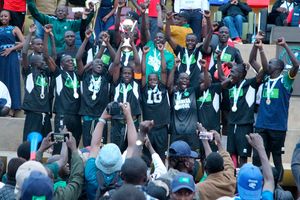
Butula Boys High School players together with their Principal Josphat Otsiena celebrate with the boys’ sevens rugby trophy at the conclusion of 2026 Kenya Secondary Schools Sports Association Term Two national games at M-Pesa Foundation Academy, Kiambu County on August 6, 2026.
Photo credit: Chris Omollo | Nation media Group
“There are coaches like me now; we always want to guide players through all the levels. Especially the higher ones, for scouting purposes. The higher you go, the more scouts you get,” he says.
The coach had two ambitions; to win for the school, but he also wanted to provide a platform for his players to be seen by people who can change their futures.
A quarter-final is no longer just a quarter-final. It could mean the difference between a player being noticed or overlooked, a coach adding another achievement to their CV or going home empty-handed, or a school travelling to Tanzania to watch the FEASSA Games or watching them from home.
Another less obvious incentive is professional advancement in the teaching service, which has become a significant part of the equation.
Mayoyo identifies sporting achievement as an important factor in Teachers Service Commission interviews.
Teachers who help their schools win at provincial, regional or national level can earn points that improve their standing when they appear before the TSC for career progression. “A teacher who has successfully led a school to the national championship is not only returning with a trophy.
That achievement can become part of their professional record when they seek advancement, including ambitions to become a principal,” he adds.
He says sporting achievement has benefited teachers, adding that KSSSA and TSC have strengthened this connection.
“The KSSSA has enhanced that in conjunction with TSC. Teachers who win the national championship are automatically promoted to the next level,” he adds.
Mayoyo says combination of professional recognition, exposure, and prestige can be so powerful that some coaches are willing to take extraordinary risks to secure this honour.
He says that this desperation partly explains why some teams resort to fielding ineligible players despite the risk of disqualification if the breach is discovered.
He argues that titles have become valuable enough to some coaches that the temptation to gain an advantage by fielding players who do not meet competition requirements can outweigh the consequences.
Kakamega High School players celebrate with the boys' football trophy that they won in the final of the Kenya Secondary Schools Sports Association Term Two national games at M-Pesa Foundation Academy, Kiambu County on August 6, 2026.
Photo credit: Chris Omollo | Nation Media Group
Booker Odhiambo, the head coach of Kisumu Boys, agrees, saying: “Teams have really invested in the school games. Everybody wants the title. Any coach who goes to the nationals is eager to win.”
“When a teacher who also coaches goes for a promotion interview, they are likely to be selected,” says Odhiambo.
The money is an additional motivation, particularly when combined with the other rewards attached to the games. Winning at national and regional levels also brings financial rewards, as schools receive greater funding and recognition.
Mayoyo says that some coaches and teachers involved in major competitions receive substantial allowances, the amount of which depends on the distance travelled and the status of the destination. He estimates this to be around Sh180,000 to Sh200,000 in some cases.
“It averages 200,000. It depends on the distance. It also depends on the status of the town you’re playing in,” he said.
The story of the late Paul Otula is perhaps the clearest evidence that secondary school sport can become a career springboard. He used his time in school sports to build a reputation as a coach, administrator and leader, eventually moving from the basketball court to national sports governance.
His journey began at Kenyatta University, where he captained the basketball team. When he became a teacher at Mang’u High School in the late 1990s, he took charge of the school’s basketball programme and built a disciplined team from scratch.
Former Kenya Basketball Federation chairman Paul Otula died on May 01, 2025 at his Kitengela home in Kajiado County.
Otula guided Mang’u to the 2002 national finals. This success attracted the attention of education officials, contributing to his appointment as Chief Principal of Maseno School in 2001.
In 2003, he coached the school’s basketball team to a historic victory at the Engen Africa Youth Basketball Championship in Durban, South Africa.
He also applied his sporting philosophy to rugby, developing Maseno’s programme until the school qualified for the Dubai Sevens global tournament.
By 2010, his success in school sports had earned him the title of Best Coach at the East Africa Secondary School Games. He used the success of Maseno’s sports programmes to attract corporate sponsorship, which helped to support the school’s infrastructure.
Otula also created a pathway through which talented schoolboys could access opportunities beyond Kenya.
Otula’s success on the basketball court eventually led to him becoming a national sports leader. In 2008, he became president of the Kenya Basketball Federation.
Apart from Otula and Cosmas Nabungolo, there are many other coaches and school administrators whose achievements have demonstrated how sustained success can build professional reputations. The headteacher of St Joseph’s Boys Kitale has won nine national championships: three with Kapenguria Boys, five with St Anthony’s Boys Kitale, and one with St Joseph’s Boys Kitale.
Nine national titles suggest that it is more than just a lucky generation of players. According to Nabungolo, coaches have had to move deeper into the talent pipeline as the competition has become more sophisticated.