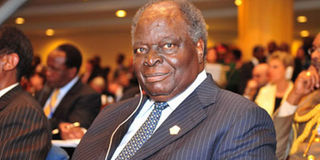
One of the enduring legacies of President Mwai Kibaki (2002-2013) was his prudent management of public finances.
He assumed office when Kenya, under President Daniel arap Moi, had been shunned by development partners for nearly a decade because of poor economic governance and weak fiscal accountability.
During that period of international isolation, the country relied almost exclusively on its modest domestic resources—about 85 to 90 percent—for budget financing, constraining economic expansion.
Upon President Kibaki’s assumption of office, the economy began to recover, triggering a revenue boom that further reduced the need for external financing. By the 2004/2005 financial year, the economy was on a steady growth trajectory.
An impressive 91 percent of recurrent and development expenditure was financed through domestic resources, enabling the government to widen income tax bands by about five percent and remove many low-income earners from the tax net.
By the end of the Kibaki administration in the 2012/2013 financial year, domestic resources financed an impressive 86.4 percent of the national budget despite the economic shocks arising from the 2007/2008 Post-Election Violence.
The economy, however, came under considerable strain in the 2014/2015 financial year when President Uhuru Kenyatta’s administration embarked on aggressive external borrowing to finance infrastructure projects, principally the Standard Gauge Railway and urban road networks. As a result, the domestic share of budget financing fell to between 70 and 72 percent. By the final year of the Kenyatta administration (2021/2022), that figure had declined further to about 65 to 68 percent.
Owing to ongoing fiscal consolidation measures, including stronger tax enforcement, expansion of the digital tax base and debt rollover initiatives, the debt burden is beginning to ease. A more positive outlook has emerged, with domestic financing accounting for between 73 and 75 percent of the budget in the 2025/2026 financial year.
There are valuable lessons to draw from President Kibaki’s fiscal management strategy. Foremost was the restoration of public trust through transparent public spending on programmes such as Free Primary Education. This strengthened civic responsibility and improved tax compliance.
At the same time, the Kenya Revenue Authority underwent far-reaching reforms aimed at strengthening human resource capacity, instilling a customer-centred culture, modernising internal processes and sealing loopholes that enabled tax leakages. Tax rates were also rationalised through wider income tax bands and lower compliance costs. As a result, the tax burden on small businesses and low-income earners eased, encouraging voluntary compliance and self-assessment.
Tax compliance, however, deteriorated markedly during the 2013-2022 period owing to structural weaknesses and policy missteps, particularly repeated tax increases. The VAT net was expanded to include basic consumer goods, imposing a heavier burden on households and pushing many micro, small and medium-sized enterprises towards non-compliance. Moreover, the financing of major infrastructure projects through expensive short-term external loans—many surrounded by controversy—rather than domestic revenue weakened the psychological contract between taxpayers and the State.
The government’s relentless pursuit of additional tax revenues, reflected in repeated increases in excise duty, income tax and VAT, prompted both corporations and small businesses to adopt defensive tax avoidance strategies. At the same time, high compliance costs discouraged many small enterprises from formalising their tax affairs.
Equally troubling was the widespread perception of weak public accountability and inefficient use of public resources. Meanwhile, the predominantly cash-based informal economy, estimated to account for about 45 percent of GDP, continued to pose significant traceability challenges for the Kenya Revenue Authority.
Institutional bottlenecks further compounded the problem. The deployment of inadequately trained personnel to critical tax administration roles, coupled with data migration challenges, created structural opportunities for tax evasion.
This weakened tax compliance culture, together with a sovereign debt portfolio of about Sh9.1 trillion, was inherited by the current administration. It is something of a fiscal miracle that Kenya has not defaulted on its external obligations despite forecasts, made two years ago, that such an outcome was imminent.
The consequences of a narrow tax base and persistent non-compliance threaten the country’s long-term economic sustainability. The government struggles to meet annual fiscal targets and budgetary obligations, widening the fiscal deficit, now estimated at about Sh1.15 trillion in the 2026/2027 financial year.
To bridge these financing gaps, Kenya has historically resorted to external borrowing, further worsening its debt sustainability position. Debt servicing now consumes about 68 percent of ordinary revenue, effectively crowding out spending on essential public services such as education, healthcare, clean water, electricity and road infrastructure. From an economic perspective, compliant businesses are placed at a significant competitive disadvantage compared with non-compliant firms that operate with lower, untaxed costs. What strategies should Kenya adopt to improve tax compliance?
First, the Kenya Revenue Authority should leverage third-party data matching to strengthen evidence-based tax administration. Payroll records, for instance, could be cross-checked against National Social Security Fund data, while electricity and water consumption patterns could help identify undeclared rental income.
Second, the authority should enforce automated transaction verification through eTIMS across all commercial enterprises to establish a comprehensive digital audit trail. Third, Kenya should replicate the success of previous strategic tax amnesties to encourage taxpayers to regularise outstanding obligations. Fourth, the government should expand hyper-localised taxpayer education and awareness campaigns targeting sectors with persistently low compliance in order to bridge tax literacy and behavioural gaps. Fifth, Alternative Dispute Resolution mechanisms should be strengthened through greater use of tribunals and out-of-court mediation to shorten the time taken to resolve tax disputes.
Kenya’s fiscal outlook remains high risk, albeit with improving prospects. The country must pull itself up by its bootstraps and emerge from the debilitating debt burden if it is to restore fiscal autonomy and economic sovereignty. The public finance management approaches pursued during the Kibaki administration offer valuable lessons for navigating Kenya’s challenging fiscal terrain. The country should adopt what has proved effective and implement it consistently for the benefit of present and future generations.
Prof Ongore is a public finance and corporate governance scholar at the Technical University of Kenya.