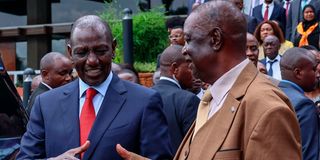
When the August 9, 2022, polls closed, President William Ruto’s United Democratic Alliance (UDA) secured 148 seats in the National Assembly, making it the largest party in the country.
Raila Odinga’s Orange Democratic Movement (ODM) bagged 86 slots, becoming the second most consequential party in the country.
Analysis of how the seats are spread out in the country shows that the UDA slots are largely from Dr Ruto’s Rift Valley and Mt Kenya. Of the seats bagged by UDA, 41 were from the Rift Valley, while 66 were from Mt Kenya constituencies and parts of Nairobi.
UDA won the remainder of the seats in Gusii, Coast, Ukambani, Western, Turkana, North Eastern, Rongai and Kajiado.
On the other hand, ODM under Odinga — who passed away on October 15, 2025 — secured most of its seats in Nyanza (27), Western (17), Coast (13), Nairobi (nine), and Gusii (five), with the rest spread out in other parts of the country.
UDA and ODM, who are partners in the broad-based government arrangement, are now each scheming to retain their strongholds, as well as make inroads in new zones, in a bid to retain their influence post 2027 General Election.
It is this scramble for numbers and the attendant influence that is threatening to cause a fallout between UDA and ODM.
ODM has listed zoning as one of its irreducible minimums before entering a pre-election coalition agreement with UDA, while the ruling party has rejected the plan. UDA wants to field candidates across the country.
Zoning is a political deal where parties in a coalition opt not to field candidates in each other’s strongholds. Analysts observe that both parties are justified in their demands.
ODM Party leader Dr Oburu Oginga (left), President William Ruto and ODM Chairperson Gladys Wanga share a cake during ODM@20 celebrations at Sarova Whitesands in Mombasa on November 16, 2025
For UDA, analysts argue that with the Mt Kenya voters appearing to drift away, President Ruto requires significant numbers from new areas to replace the possible loss.
Failing to field candidates in new areas, including ODM zones, has a potential of exposing the president to political manipulation by other parties in the next Parliament. Should Mt Kenya ultimately ditch UDA, the party is likely to lose close to half of its current Members in Parliament.
“Winning the presidency is only half the job. The Executive also needs numbers in Parliament to advance policy. Zoning will be UDA conceding ground to a competitor – ODM,” US-based university lecturer and political analyst Prof David Monda said.
“Ruto is keyed into this and will not allow zoning. He will oppose it and go further to challenge ODM for seats in its strongholds to boost UDA's parliamentary numbers.”
Mr Frankline Mukwanja, the Executive Director at Centre for Multiparty Democracy (CMD-Kenya), noted that with Mt Kenya drifting away, UDA is unlikely to retain its dominance in the National Assembly and the Senate.
“For William Ruto, the calculus is clearer. His numbers will likely shrink below 2022 UDA/Kenya Kwanza performance. It is therefore in his interest to position himself strategically for both pre and post-election coalitions in order to assemble the parliamentary numbers necessary to govern if re-elected,” said Mr Mukwanja.
He, however, said that the president can still control Parliament by courting other parties post-2027 polls, citing how the country’s presidential system gives significant leverage to the eventual winner.
“In 2022, the Azimio la Umoja–One Kenya Coalition initially held the majority in Parliament. But even before Parliament fully settled, the Ruto side had already succeeded in taking control of the legislature,” said Mr Mukwanja.
UDA Secretary-General Hassan Omar has dismissed the zoning proposal outright, saying the strength of any party must ultimately be tested at the ballot.
“ODM claims it is the strongest party, yet insists on zoning. Let us meet at the ballot,” he said.
UDA National Elections Board chairman Anthony Mwaura told Sunday Nation
UDA national elections board’s chairman Anthony Mwaura.
Photo credit: File | Nation Media Group
Mr Mwaura said the only compromise the party can make is to have joint nominations with ODM in areas the two parties stand to lose if they field candidates separately.
Sunday Nation has established that ODM and UDA are likely to consider joint tickets in Nairobi, including for the governor, where the incumbent, Mr Johnson Sakaja, is set to face off with other heavyweights.
Mr Mwaura said that Odinga—who led ODM into the current broad-based arrangement — had agreed to joint nominations in selected areas.
“We have made it clear that there would be no zoning. As UDA, we will field candidates in all areas,” Mr Mwaura said.
Similarly, ODM risks losing its stake in Dr Ruto’s administration should its numbers fall. It is on the basis of the party’s numerical strength that President Ruto reached out to Odinga to form the broad-based government following the political siege by Gen Zs in June 2024.
ODM members pushing for the arrangement have already started raising fears that Dr Ruto is likely to ditch them for parties with more numbers should they fail to ring-fence their strongholds. They argue that the ODM risks being cannibalised by its allies.
“For ODM, zoning is a defensive strategy—protecting its traditional strongholds from encroachment by UDA while still benefiting from proximity to State power under William Ruto,” Prof Masibo Lumala of Moi University said.
He argued that by Dr Ruto conceding space to ODM, he may inadvertently strengthen a future rival with intact regional dominance.
“In Parliament, such a set-up can also produce a transactional alliance—loyalty driven less by ideology and more by negotiated interests—making governance more dependent on continuous deal-making rather than stable party discipline,” Prof Lumala said.
Homa Bay Governor Gladys Wanga speaks during the Orange Democratic Movement (ODM) Special Delegates Convention at the ASK Dome, Jamhuri Expo Centre in Nairobi.
Photo credit: Bonface Bogita | Nation Media Group
ODM National Chairperson Gladys Wanga told Sunday Nation that zoning remains a strategic tool to ring-fence the party’s traditional bases. She said that if it is not done, ODM and UDA will be caught in sibling rivalry that can cost them seats.
“Zoning is a key political strategy for the party, especially as we prepare for coalition negotiations. It is a political tool used to manage seat distribution among coalition partners or to balance internal interests,” the Homa Bay governor said.
“As ODM, we have consistently advocated structured negotiations that protect our strongholds while ensuring equitable representation in any coalition arrangement.”
On the other hand, Homa Bay Town MP Peter Kaluma has threatened that ODM will field a presidential candidate should UDA reject zoning.
“Zoning is common sense for winning the presidency and being able to effectively govern the country after elections. We either do zoning and field a single candidate for all seats from the president’s to the MCAs’ position or avoid zoning and allow all parties to field candidates for all seats and await a post-election coalition,” Mr Kaluma said.
The push for zoning has become a major talking point, especially in Nyanza, with locals openly opposed to it. They see it as scheme to protect some sitting MPs, seen to be loyal to the current leadership of the party.
Those opposed to zoning also said that such an arrangement would deny the region the right leaders. There are also fears that it could lead to voter apathy. In the run-up to the 2022 elections, ODM dished out direct tickets to nearly all its sitting MPs, senators and governors.
“In the medium to long-term, zoning carries deeper structural implications. It risks entrenching regional political silos, where parties become confined to ethnic or geographic bases rather than evolving into truly national platforms. This could weaken democratic competition by reducing voter choice in “zoned” areas and encourage elite bargaining over open contestation,” Prof Lumala said.
Mr Mukwanja described the demand as “selfish, naïve, and unrealistic” within any functioning democratic system.
“Rather than positioning the party for renewal, it risks confirming the perception that ODM’s political vitality ended with Raila Odinga, ” he said.
“In a democracy, it is voters who confer strongholds and power to political parties based on the agenda, issues, and interests they represent and aggregate.
“That is precisely how ODM and Raila built dominance in the Nyanza region and extended strong support into other regions, particularly Western, Coast, among pastoralists and urban constituencies. The current push for zoning suggests a troubling bankruptcy of ideas among ODM’s post-Raila leadership.”
A number of ODM lawmakers are opposed to the zoning plan. They are: Elisha Odhiambo (Gem), Millie Odhiambo (Suba North), James Oyoo (Muhoroni), Jared Okello (Nyando) and Phelix Jalang’o (Lang’ata).
“I encourage our party to carry credible nominations. If you do credible nominations, you do not have to worry about zoning because ODM is still a popular party. If you do credible nominations, the ODM candidate will still win the elections,” said Mr Odhiambo.