A familiar voice once rose from Kenyan radio and found its way into weekend evenings, settling gently into living rooms where families gathered around a single speaker. That voice belonged to John Karani, and for the better part of three decades, it was part of how Kenya spent its weekends.
His journey runs from the hiss of shortwave to the scroll of TikTok, and through all of it he kept one rare gift. He knew what listeners wanted before they had words for it. He was a cultural guide and a teacher of how to listen.
It began at Cardinal Otunga High School, Mosocho, where a debater with a flair for drama became “the DJ” because he knew which song could lift the spirit of a room. It grew in the glow of a shortwave set, where he leaned in close to catch Larry Wambua, John Obong'o and Abdul Haq, along with the BBC and South African broadcasts that reached him from other continents on a good night.
That’s where the passion was ignited,” he recalls, a line that still carries the spark of discovery. From those early fascinations grew a career defined by invention and the ability to stay ahead of the audience even as technology reshaped the world.
“To everything there is a season,” and Karani, who has just turned 60, sensed each season before it arrived. The true ignition point came after school, in the hours he spent close to the radio, listening obsessively to KBC’s General Service and chasing signals.
Curiously, he never intended to become a broadcaster. His dream was the military. He admired the discipline, the spectacle of parades on television, and the crisp uniforms. But fate intervened.
“The KIMC (Kenya Institute of Mass Communication) letter came before the military selection,” he says with a shrug. And so the Kenya Institute of Mass Communication became his doorway into a world he had only admired from afar. Proverbs captures the moment: “A man's heart plans his way, but the Lord directs his steps.”
In the 1980s, KIMC advertised in newspapers, and applicants went through the Public Service Commission. Two hundred people competed for 20 radio slots. Karani was one of the chosen few. His classmates would become a roll call of Kenyan broadcasting. Johnston Omurunga, Patrick Rukwaro, Topista Nabsoba, and Alex Muriithi. It was a generation that would redefine radio.
The bond with Omurunga, his closest collaborator, formed instantly. “We loved music so much,” Karani says. While others focused on program production, the two gravitated toward continuity, the art of playing music, shaping mood, and keeping listeners hooked. Their chemistry was effortless, and their instincts aligned.
Even as students, they were summoned to KBC to fill in for presenters who fell ill. It was unprecedented. The pipeline between KIMC and KBC was so strong that their student admission numbers became their KBC personnel numbers. Employment was guaranteed.
“Those were good days,” he says, and you can hear the warmth in his voice. The Saturday Night Show was Omurunga’s creation, and Karani was his assistant. Pre-recorded and running from 8pm to 10pm, it quickly became one of the most beloved programmes in the country. It had everything: a Top 10 countdown, interviews and the segment that would become legendary, “Words of Your Favourite Song”.
There was no internet. No Google. No lyric websites. So Karani and Omurunga bought imported magazines from Book Point on Moi Avenue, paying Sh200 out of pocket. “Get your pen and paper ready,” he would say on air, and listeners would literally write down the lyrics to recite to girlfriends and boyfriends. “It played a very big role in the dating scene… that time there was no internet, no ChatGPT,” he says.
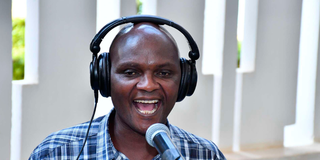
John Karani is an iconic Kenyan radio presenter, producer and DJ celebrated as one of the golden voices of the Kenya Broadcasting Corporation English Service.
Photo credit: Pool
“People used to write down the lyrics… when they are going to meet their girlfriends or boyfriends.” It was a simple idea, but it changed a generation. When Omurunga died, Karani took it over.
The loss was devastating. “We were like the two musketeers,” he says. He never found another partner with the same chemistry. But he kept the show alive, and in doing so, carried forward the legacy of a friend who might have become one of the country’s greatest broadcasters.
Long before streaming, and long before digital libraries, getting music was a hustle. The KBC library was slow, so Karani found workarounds. Club DJs like Paco Perez, DJ Karis, and Adams supplied extended 12 inch mixes. Kenya Airways air hostess fans carried vinyl from abroad. That’s how he got Londonbeat’s “I’ve been thinking about you” straight from London.
Playing club versions on air flipped the pressure. Suddenly clubs had to keep up with radio. People would walk into discotheques asking for the mixes they had heard on Karani’s show. It was a reversal of power, and a reflection of how deeply he understood the audience.
Karani played in almost every town. Lodwar, Malindi, Voi, Meru, Nyeri, Kisumu, Kakamega, Busia, Nakuru, Kitale, Isebania et al. Even Arusha. Only Mandera and Lamu escaped him. Touring grew the radio audience, and listeners still date memories by venue; Club Dimples in Meru, Makuti in Nyeri and Kitale.
On ‘Yours for the Asking’ weekend edition, salaam cards arrived in their thousands. He would begin sorting on Friday for the Sunday show. The trick was reading fast, a skill learned from Abdul, who “used to read like a computer”.
The salaams were a communication network. “That was our social media… that was the Facebook and the TikTok,” he says. Fans in different towns who had never met communicated through him. It was a national conversation conducted through postcards and radio waves.
On ‘Beat Time’, Karani transformed Fridays into a dancehall and lovers rock sanctuary; Shabba Ranks, Cutty Ranks, Apache Indian, Chaka Demus & Pliers, Freddie McGregor, Marcia Griffiths, Sean Paul, Shaggy, and Tony Rebel, among other ragga stars. He stayed out of the roots and culture lane Jeff Mwangemi owned on Thursday mornings with ‘Reggae Time’.
He recruited Charity Karimi after noticing her response to reggae at youth variety shows. He presented the kings; she presented the queens. It became massive. People still ask him, “Where is Charity?” CGTN’s Peninah Karibe also passed through Karani’s hands.
The creation of Metro FM, Kenya’s first all-reggae station, was a turning point. The MD, Washira Waruru, a huge fan of the British reggae group UB40, tasked Karani with inventing the station from scratch, and he became its first head. Advertisers were skeptical. Reggae? But the team played R&B reggae during pitches, and soon the big brands came on board. The station exploded.
“I don’t think we knew it was going to be a monster,” he says. It became audible everywhere; matatus, shopfronts, estates, offices. It cut across generations and social classes “from the ghetto to Lavington”. To this day, he believes no station has been purely dedicated to reggae 24/7 since.
After Metro, Karani spent eight years in Tanzania. Four with Radio Free Africa in Mwanza, two at East African Radio in Dar es Salaam, and two in another station. KBC English Service listeners there already knew him. He broadcast in both Swahili and English.
“Language should never be a barrier. It’s what you bring to the table that matters,” he says. It is one of his most resonant lines. When he returned to KBC English Service, the landscape had changed. Streaming, social media, TikTok. But the transition was seamless. “Music is music,” he says.
The physical fanbase simply moved online. The people who once sent salaam cards now send messages through social platforms. His advice is blunt. “Adapt or perish. Don’t ever be cheated. TikTok is now very massive… that is how you perish.”
He has seen his audience become two generations at once; fathers, daughters, sons tuning in together. What he values most is being told he touched people’s hearts, got them chased out of school for carrying a radio, or helped them win their wife. These stories matter more than ratings.
The Kenya Broadcasting Corporation offices.
Photo credit: File | Nation Media Group
Karani, a father of two, recently announced his retirement from radio, a milestone that carries the weight of an era ending for the listeners who grew up with his voice. Yet, he is not retiring from life. “Broadcasters don’t hang up their microphones. They just move on to a new chapter.” For him, that chapter is wheat farming in Narok and rearing goats.
Karani’s announcement created a moment of pause for many who had followed him across the years. It invited a look back at the breadth of his work, the shows that shaped evenings, and the choices that defined his craft. It also opened space to consider the pillars of his legacy, the programmes that carried his signature touch and revealed the instincts that guided him from one era of radio to the next.
‘Late Date’ was “the Shika Shika show”, running from 10:30pm to midnight. Massive, he says. Another piece of his legacy. Across 35 years, 25 at KBC and 10 in Tanzania, one thread runs through Karani’s story. Instinct. He has always known what people want in terms of lyrics, dancehall, nostalgia, club mixes, salaams, reggae, and energy. He has always given the audience what they didn’t know they needed until they heard it.
“I’m basically looking at what people want… You give the people what they want.” That is the essence of his craft. And that is why, decades later, Kenya still remembers his voice as a companion, a curator of feeling, a bridge between generations, and a man who taught a country how to listen.
Many listeners say they owe him more than entertainment. They talk about weekends his voice arranged for them, about evenings when a song he chose held them steady, about memories that have not faded with the equipment that carried them. Gen X and Millennials say, often without hesitation, that he changed the course of their lives in small and lasting ways.
Some say they won their wives with lyrics he read on the Saturday Night Show, words they copied down because he told them to get their pen and paper ready. They describe a man who touched hearts and left his mark on a country’s emotional life. The dial has moved on. The voice stays. Thank you, John Karani, for the sound that carried a generation forward.