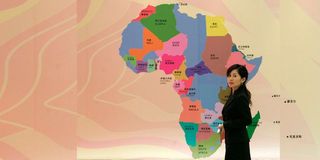
What’s in a map? That seems to have been the question on many minds as the United Nations General Assembly passed a resolution on Friday, seeking to correct the world map.
The “Correct the Map” resolution fronted by the African Union challenged the continued use of the Mercator map, which visually shrinks Africa and exaggerates the sizes of countries closer to the North pole, notably in Europe.
It was supported by 164 countries, with Estonia, Georgia, Lithuania, Moldova, Serbia and Ukraine abstaining, while the US was the only dissenting country.
One of the most vivid illustrations of what the vote sought to correct is that the projection makes Africa and Greenland appear similar in size.
In reality, the continent – spanning more than 30.4 million square kilometres – is approximately 14 times bigger than the island, which sits on an area of only 2.17 million square kilometres.
The central argument in the resolution revolved around the question of equality and fairness, with critics saying the visual distortion effectively shapes how Africa is perceived and represented in media, education and even policy.
“A fair world begins with a fair map”, said the Foreign Minister of Togo, which led the AU campaign.
The Mercator map was developed in 1569 by Flemish cartographer Gerardus Mercator to aid navigation by European sailors, apparently without paying attention to relative sizes of countries.
Indeed, the International Cartographic Association has long maintained that there is no flat projection of the world that can preserve shape, area and distance at once. The Mercator trade-off thus focused on helping sailors to find their way across the world more easily, but in so doing compromised on other key features of the map.
Far from being a simple technical projection, the Mercator map has, for more than 450 years, endured as an apparently neutral representation of the world itself.
The result is that Africa has spent generations looking at itself through a representation developed elsewhere for purposes determined elsewhere. One could think of other “maps” that work this way in Africa - economic classifications, development indicators, credit ratings, climate models, university rankings, AI training data and the list is endless.
Even the very categories through which many African countries diagnose their own development trajectories are aligned to this logic.
The motion before the General Assembly was, therefore, not just about the size of a continent on a map. After all, the physical expanse of Africa did not change because of the vote. The real paradox was that Africa had to mount a multi-year campaign for the world to see its true size.
More consequentially, the vote put the spotlight on the uncomfortable question of just how many other things about Africa remain distorted for the very reason that the instruments through which reality is measured and communicated were designed elsewhere.
Who constructs the categories? What purpose were they designed to serve? What do they illuminate? What do they distort? And does Africa possess sufficient knowledge capacity to recognise the difference?
While these are, at bottom, questions of epistemic sovereignty, the UN vote complicates this frame. It shows agency operating precisely where sovereignty does not. Here was a patient, disciplined, AU-backed diplomatic campaign that moved 164 states, being exercised entirely within a UN system whose procedures, funding structure and permanent-membership architecture Africa still doesn’t control. In essence, Africa won the argument in a court whose bench it cannot appoint.
A pragmatic African lens must, therefore, see sovereignty and agency as joint imperatives operating on different timescales of the same project.
In October, for example, the AU is expected to launch the Africa Credit Rating Agency (AfCRA) to provide what it has described as “fair” credit ratings. But will Moody’s, S&P and Fitch need to vanish before AfCRA can start rating African countries and businesses?
On the contrary, the continental credit rating agency will need to get to work immediately, because it is only after it accumulates enough ratings, cited in enough transactions, that the market’s habit of deferring to the “Big Three” can truly begin to bend.
The risk for Africa, therefore, runs in both directions. On the one hand, settling for agency without a horizon of real sovereignty would reduce the continent to permanent lobbying for better outcomes using someone else’s rules. But sovereignty demanded without the discipline of pragmatic agency risks staying rhetorical, defined only by claims made but not capacity built to get sustainable results.
Finally, the true value of the US vote is worth taking into account. While it came across as retrogressive, it may yet hold a deeper, legitimate reflexive question for Africa. The US objection was essentially that the General Assembly had turned a technical cartographic question into an ideological argument about justice and fairness. Simply put, the US was asking: does changing a map materially alter Africa’s condition? And does it, really?
The honest answer is layered, but it turns on one reality: owning an instrument and having the world actually act on it are different achievements.
So, what’s in a map? For one, representation, which is a form of power. And Africa found the sweet spot at the UN. It built a strong case for a different instrument, but still worked the existing room for results. That combination is perhaps the enduring lesson of the Friday vote.
Dr Ageyo is the Editor-in-Chief of the Nation Media Group. He holds a PhD in Media Studies with a focus on Science and Environment Communication.