For more than three decades, Raila Odinga bestrode Kenya’s politics like a colossus.
His name became a shorthand for resistance, reform and the enduring struggle against entrenched authority. To his supporters, he was the conscience of the nation; to his critics, a relentless disruptor of the status quo. To allies and adversaries alike, he was unavoidable.
On October 15, Raila Odinga died in India, closing a political chapter that shaped Kenya’s democratic journey more profoundly than that of any single individual since independence. With his death, an era ended — and an intense, emotionally charged succession battle began.
Analysts argue that Odinga’s influence was never confined to electoral cycles or formal leadership positions. He shaped ideologies, mobilised generations and built a political machine that survived detention, exile, state repression, internal revolts and repeated electoral defeats.
From the Saba Saba protests of the 1990s to the handshake diplomacy of 2018 and the broad-based government arrangement with President William Ruto, Raila dictated the rhythm of opposition politics — deciding when to confront, when to negotiate and when to retreat.
With his exit, that unifying force has weakened, leaving behind a vacuum that ODM — and the wider opposition — is struggling to fill.
The depth of that vacuum was laid bare during ODM’s 20th anniversary celebrations in Mombasa in November last year, where what was meant to be a commemorative event quickly morphed into a public airing of unresolved tensions.
Odinga’s daughter, Winnie openly questioned whether the leaders currently managing the broad-based arrangement between ODM and President Ruto’s UDA have the authority, political capital and legitimacy to sustain it without her father’s personal touch.
Winnie Odinga alleges plot to 'sell' ODM
“The broad-based relationship is complicated,” she said. “Those managing it now — are they capable? There is only one Baba Raila Odinga who could manage it.”
She called for a national delegates convention to allow party members to determine the future of ODM’s cooperation with the government — remarks that triggered a sharp war of words within the party.
Some ODM stalwarts pushed back, arguing that participation in government reflected Raila’s final political decision and was intended to protect ODM’s relevance at the centre of power.
“Without Raila as the final arbiter, old rivalries are resurfacing and long-suppressed ambitions are coming to light,” observes political analyst Dismas Mokua.
Within ODM, a new generation of leaders is testing whether influence built inside party structures can translate into national leadership.
Party secretary-general Edwin Sifuna, national chairperson Gladys Wanga, Embakasi East MP Babu Owino, and Cabinet Secretaries Hassan Joho, Opiyo Wandayi and John Mbadi are all emerging as key actors in a fluid post-Raila landscape.
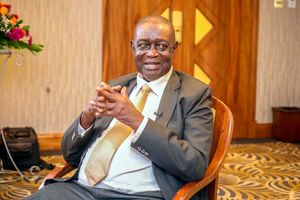
ODM party leader and Siaya Senator Oburu Oginga.
Photo credit: Dennis Onsongo | Nation Media Group
ODM party leader Oburu Oginga, Raila’s elder brother, has sought to calm succession anxieties by urging patience and organic leadership growth.
“Leaders emerge naturally, just like mushrooms grow overnight,” Dr Oginga says. “You wake up one morning and find them grown. Even Raila Odinga — there was no convention where he was elected our leader. He just emerged.”
A recent poll by Infotrak, however, places Embakasi East MP Babu Owino far much ahead of Dr Oginga in the Luo Nyanza succession politics.
Among respondents asked who is most likely to emerge as the leading political figure representing the Luo community following Odinga’s death, 33 per cent named Babu Owino — far ahead of Raila’s brother who polled at 10 per cent.
Embakasi East MP Babu Owino speaks during the World Teachers Day Celebrations at Kenya Science Campus in Nairobi on October 5, 2025.
Photo credit: Lucy Wanjiru | Nation Media Group
A further 37 per cent said they were undecided, underscoring how open and contested the Raila succession has become.
Other figures trail distantly: Gladys Wanga and James Orengo at seven and four per cent respectively, while Wandayi and Interior Principal Secretary Raymond Omollo polled two per cent each.
Mr Owino who is gunning for Nairobi governor seat even shocked, both friends and foes, after he emerged fourth in the presidential preferences, beating former deputy president Rigathi Gachagua among other hopefuls.
President Ruto leads in the poll at 28 per cent, followed by former Interior Cabinet Secretary Fred Matiang’i at 13 per cent and Wiper leader Kalonzo Musyoka at 12 per cent. But it is Babu Owino’s seven per cent — surpassing Mr Gachagua’s five per cent — that has sparked intense political debate.
Analysts believe that the results hint at a generational shift, where emotional attachment to lineage and long service is giving way to charisma, defiance, confrontation and visibility.
In his new year interview on Thursday, Dr Oginga insisted that as the ODM Party leader, he remains at the helm.
If ODM chooses to contest the 2027 election as a standalone party, Dr Oginga says, there will be no open presidential contest within the party.
“If we are to go it alone as a party, let people not bring debates and chest-thumping that they want to vie,” he said. “If you want to be an ODM presidential candidate, you must first remove me as party leader. Our constitution states that the party leader is the automatic presidential candidate.”
He went on: “So if we are to go it alone as ODM, I am the party leader and the presidential candidate. I will be on the ballot if our party decides that we go it alone,” he said, adding that he would bank on the support of ODM members.
Raila’s authority was forged through decades of personal sacrifice — detention without trial, exile, political isolation and unwavering consistency. Those credentials, analysts say, cannot be manufactured.
“Raila’s leadership came from suffering and consistency,” says Safina Deputy Party Leader Willis Otieno. “You don’t just step into that space. You earn it over decades.”
Nowhere is the transition more delicate than in Luo Nyanza, where Raila’s word for decades carried near-scriptural political weight. Every election, alliance and protest echoed his voice.
Since his death, the region has entered a period of restless introspection. Public unity remains, but beneath the surface, leaders are quietly jostling to inherit not just Raila’s political clout, but his symbolic authority as the community’s national voice.
ODM co-deputy party leader Abdulswamad Nassir says Raila’s exit has left “shoes too big for any one person to fill.”
Mombasa Governor Abdulswamad Nassir speaks to the media in Mombasa on June 13, 2025.
Photo credit: Kevin Odit | Nation Media Group
“ODM has structures, but Raila was the glue,” Mr Nassir says. “The task now is to ensure unity as we chart a post-Raila future.”
Treasury Cabinet Secretary John Mbadi dismisses claims of a leadership vacuum, insisting that ODM’s institutional mechanisms remain intact.
He says Dr Oginga holds the mandate to steer the party through the transition and into any future coalitions, including decisions around the 2027 General Election.
Speaking recently on NTV, Mr Mbadi said ODM’s roadmap remains anchored on structured consultations and party organs, not personality-driven pressure.
“ODM will make its choices based on what strengthens the movement and protects its identity,” he said.
President William Ruto (left) confers with ODM party leader Oburu Oginga during the Piny Luo Festival in Senye Beach in Nyatike, Migori County on December 17, 2025.
Photo credit: Alex Odhiambo | Nation Media Group
As ODM grapples with succession, President Ruto has moved swiftly to deepen his footprint in Nyanza — a region long considered politically hostile.
Since Raila’s death, the President has made multiple high-profile visits to Kisumu, Homa Bay, Siaya and Migori, commissioning development projects, launching housing initiatives and promising increased funding for roads, ports and fisheries.
“With Raila gone, Nyanza is politically unanchored,” says political analyst Javas Bigambo. “Ruto understands that this is a rare window to soften resistance and court a constituency that has historically stood firmly against him.”
The visits, however, have unsettled sections of ODM, with critics warning that development promises could be used to fracture the party’s base.
Complicating matters further are claims — circulating within ODM ranks — that former President Uhuru Kenyatta is using money to influence or even “buy” sections of the party.
Dr Oginga has publicly dismissed the allegations, saying he has no evidence to support them.