When 52-year-old driver Tirus Kamau Githinji stood before cameras to speak about the December 13, 2025, accident that took the life of former MP and Cabinet minister Cyrus Jirongo, he unwittingly added himself to a long list in Kenya’s history.
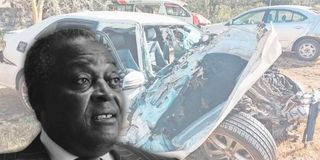
The wreckage of the Mercedes Benz that former Lugari MP Cyrus Jirongo was driving before a road crash that claimed his life on the Nakuru-Nairobi highway on December 13, 2025.
Photo credit: Boniface Mwangi | Nation Media Group
He became one of the people thrust into the limelight after the sudden death of prominent Kenyans by witnessing an accident, being the first at the scene, or discovering the body.
Tirus Kamau, the driver of the bus that collided head-on with former Lugari MP Cyrus Jirongo's Mercedes Benz at the scene of the crash on the Nakuru-Nairobi highway on December 13, 2025.
Photo credit: Boniface Mwangi | Nation Media Group
Along with an attendant at the Eagol Petrol Station, who spoke with Nation on condition of anonymity, the two became witnesses in what has now turned out to be a controversial demise.
The Directorate of Criminal Investigations (DCI) said on Tuesday last week that Mr Kamau had recorded a statement and that he is out on cash bail “pending further investigations into the offence of causing death by dangerous driving”.
The Director of Homicide Martin Nyuguto inspects the wreckage former Lugari MP Cyrus Jirongo's Mercedes Benz on December 16, 2025.
Photo credit: Boniface Mwangi | Nation Media Group
“Additionally, both the petrol station’s night guard and fuel attendant have provided their personal accounts of the events that occurred on the fateful night,” the DCI further noted.
Tirus Kamau, the driver of the bus that collided head-on with former Lugari MP Cyrus Jirongo's Mercedes Benz at the scene of the crash on the Nakuru-Nairobi highway on December 13, 2025.
Photo credit: Boniface Mwangi | Nation Media Group
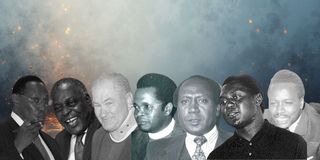
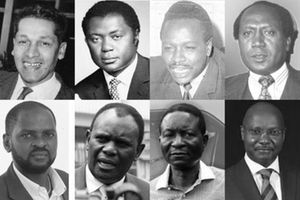
From as far back as two years post-independence, names of people like Mr Kamau have been intertwined in the circumstances under which some personalities died. Some names also emerged as suspects who were, in some cases, taken to court.
February 1965: Pio da Gama Pinto
Pio Gama Pinto.
Photo credit: File | Nation Media Group
Recognised as the first victim of political assassination in independent Kenya, Pinto was shot at his home in Westlands. His death thrust into the limelight two names: Kisilu Mutua , then aged 18; and Chege Thuo, who was then 19. They were tried for causing Pinto’s death, and Kisilu was found guilty and sentenced to death. The sentence was, however, commuted to life imprisonment.
Mr Kisilu Mutua speaks during the interview at his home in Eastleigh Section III.
Photo credit: Francis Nderitu | Nation Media Group
He stayed behind bars until 2001 when President Daniel arap Moi released him. In 2017, the High Court awarded him Sh2.5 million after finding that he had been tortured while in police custody to force him to sign a document that was used as evidence to implicate him in the murder. He died in 2023.
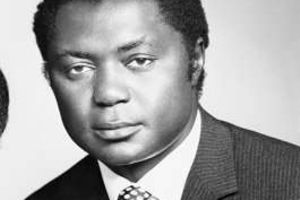
Tom Mboya.
Photo credit: File | Nation Media Group
The shooting of Mboya, who was the Economic Planning minister, at Mohini Sehmi’s Chemist in Nairobi, was a most controversial moment in Kenya. He died in July, and by September, one Nahashon Isaac Njenga Njoroge had been convicted of killing him. He was reportedly hanged, though a theory emerged that he was relocated to another country. Nahashon had been trained in Bulgaria, and Mboya was instrumental in his education. One key witness to the murder was Mrs Chani, a friend of the politician who was at the pharmacy.
September 1970: George Morara
George Morara.
Photo credit: File | Nation Media Group
He was the West Mugirango MP when he died in a head-on-collision involving his car a Peugeot and a police Land Cruiser that was being driven by Constable Fredrick Kugo. The accident happened on a Saturday night near Chavakali. He had earlier addressed the Press about Njoroge, Tom Mboya’s killer, claiming he had seen the man in Lusaka, Zambia. During the presser, he gave the government a 48-hour ultimatum to produce Njoroge — but he is the one who died within that timeframe. This led many to conclude that Morara was eliminated. The last person he was with was his friend Ezekiel Nyarangi, then the Kakamega District Commissioner. Family sources later said the DC tried to dissuade him from proceeding to Kisii that night where his wife and family were, but his mind was made up.
December 1972: Ronald Ngala
Ronald Ngala.
Photo credit: File | Nation Media Group
He died when he was the Minister for Power and Communications in a Jamhuri Day accident on Mombasa Road near Konza. During an inquest into his death, Ngala’s driver, Elijah Nzibo, said the accident happened after he swerved to avoid hitting an animal. His account was disputed by other witnesses who claimed that he had initially told them that he lost control after bees flew into the car. One of the pressing questions after the death was why Ngala suddenly decided to travel from Nairobi to Mombasa that morning, yet he was scheduled to attend the Jamhuri celebrations in Nairobi. The inquest, done by Senior Resident Magistrate SK Sachdeva, ended in a ruling that no one was to be blamed for the “unfortunate” accident.
The late politician Josiah Mwangi (JM) Kariuki.
Photo credit: File | Nation Media Group
The controversial death of the then Nyandarua North MP , whose bullet-riddled body was found at Ngong Hills after he had gone missing, thrust into the public glare a Maasai elder named Musaite ole Tunda, the first person to spot the body. Tunda was the subject of initial controversy when a local daily said he had gone missing, but the Nation interviewed him and also took a photo on the day the report ran.
A parliamentary select committee that investigated Kariuki’s assassination, chaired by Elijah Mwangale, said it was unable to place a more conclusive report “largely due to the refusal of the heads of police to render any assistance. The committee heard that Tunda and Meja ole Nchoki, who reported to the Ngong Police Station that they had seen the body were turned away and told to return later. Tunda died in December 2022.
September 1985: Kitili Mwendwa
Then Kitui West MP Kitili Mwendwa, who was also Kenya’s first African Chief Justice, died in a car crash near the Kenyatta University gate as he drove towards Thika. He died in hospital at 4pm after the crash. Eyewitness John Guchu, a motorist who was driving towards Thika, took him to hospital. Guchu told Nation: “I stopped my car and went to the scene. The man in the car was unconscious, he was bleeding from the head. A lot of people were present but few were ready to help. Some army men arrived and helped me pull the injured driver out of the car.”
February 1990: Robert Ouko
Former Minister of Foreign Affairs the late Dr Robert Ouko.
Photo credit: File | Nation Media Group
Ouko died when he was the Foreign Affairs minister . After the government announced that he was missing, his body was found at the foot of Got Alila Hill. Herdsboy Paul Shikuku, 17, who found the body on February 13 was thrown into the limelight. Ouko had been shot, his arm and leg had been broken, and his body set on fire. It is the smoke that drew his attention to the body.
August 1990: Bishop Alexander Muge
Alexander Kipsang Muge.
Photo credit: Jared Nyataya | Nation Media Group
Then Anglican bishop based in Eldoret was an outspoken critic of the government. He died in an accident after defying a warning by Moi-era minister Peter Okondo not to visit Busia . The former Labour minister, who came from Busia, told Muge that he “would not leave alive”. But a defiant Muge said that he would go to Busia “waiting to die”. The man of the cloth, who held an open-air service in Busia, termed Okondo’s remarks irresponsible. On his way back, his Peugeot collided head-on with a lorry at the Kipkaren River trading centre. David Omanyo, one of the people who was in the car with the prelate, and who suffered injuries during the accident, told Nation that Bishop Muge had remarked before the fatal crash: “Aah, look. How is it coming?” The lorry driver, Nicanoli Omukobe Munai, 35, was later charged over the death.
August 2000: Fr John Anthony Kaiser
Father John Kaiser.
Photo credit: File | Nation Media Group
The American priest, then based in Morendat, Nakuru County, had been a fearless critic of government officials for fanning violence in the Rift Valley. When he disappeared from Ngong and his body was later found beside his vehicle near Naivasha, with a single gunshot wound to the head. Many suspected foul play. Njumbe Munene, a petrol station attendant at a Caltex Petrol Station in Naivasha, was a key witness. He saw Fr Kaiser shaking hands with two men at the petrol station at 11.10pm, hours before his body was discovered. The State claimed Fr Kaiser committed suicide, but a public inquest ruled out the suicide theory.
August 2001: Tony Ndilinge
The then Kilome MP was shot while parking his car outside a bar in Githurai , Nairobi. Initial police investigations revealed that he was shot by people he was with in his Pajero. Ten months later, Margaret Wambui Njoroge and Joakim Ngure were arrested in connection with the murder. They were later released unconditionally by the Attorney-General.
September 2003: Odhiambo Mbai
The TJRC report concluded that Dr Chrispine Odhiambo-Mbai was killed because of his political views about devolution. Photo/FILE
Considered by many as the martyr of the 2010 Constitution, Dr Mbai was the chairman of the Devolution Committee of the National Constitutional Conference when he fell to gunmen’s bullets at his Nairobi home. Former Minister for Roads, Public Works and Housing Raila Odinga termed it an assassination. Two suspects, Musa Gitogo Mbuthi and Ramadhan Karume Otieno were charged with the death, but were acquitted in 2006. They accused the police of conducting shoddy investigations and implicating them yet the real culprits were still free.
June 2012: Saitoti and Ojode
Former Vice President George Saitoti.
Photo credit: File | Nation Media Group
Among the first witnesses at the scene was Elijah Mucheru who said: “I watched the helicopter. It looked like it was burning while up in the air, a few minutes later we heard a loud bang, and we rushed to the scene to find the wreckage and the bodies.” Another witness, Julius Mochai said: “After the crash, we tried to put out the fire using soil. But after every few minutes there was an explosion and people ran away for their safety.”
Slain IEBC manager Chris Msando. Investigations into his murder are ongoing. FILE PHOTO | NATION MEDIA GROUP
Just a month to the 2017 General Election, the acting ICT director at the Independent Electoral and Boundaries Commission (IEBC) Chris Msando went missing. His body was later found in Kikuyu, off Waiyaki Way, and a postmortem showed that he died due to strangulation. The body of Caroline Ngumbu was found next to his. A teenager, who had mistakenly dialled Msando’s number, was arrested but later released. Msando’s former landlord Andrew Rono was also detained and released. Former minister Moses Kuria threatened to take legal action against those who linked him to the incident.