Beatrice Wangare Kamau is a farmer from Molo in Nakuru County who has grown cereals and vegetables for the past two decades.
However, the effects of climate change have increasingly undermined her efforts in recent years.
She grows maize, beans, peas, cabbages, tomatoes, onions, carrots and leafy greens such as sukuma wiki and spinach. However, frequent climate shocks in Kenya and across Africa drastically reduced her yields, forcing her to rethink her farming approach.
A woman works in her farm. Small plots, low prices and limited resources haven't stopped female farmers from pioneering sustainable agriculture.
Photo credit: Photo | File
Making matters worse, she had relied heavily on synthetic fertiliser, which she says no longer benefits farmers as much as it once did.
“Soil health has really deteriorated, further compounded by the effects of climate change,” she says.
A few years ago, Wangare made the bold decision to switch to sustainable farming and abandon chemical inputs.
She embraced agroecology — the scientific term for this holistic farming model — and says it has transformed her production.
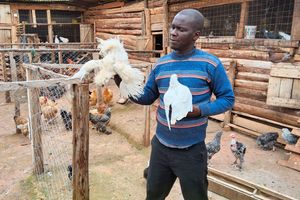
“I have integrated livestock into my farm: cows, goats, sheep and chickens. I use the manure to fertilise my crops instead of synthetic fertiliser,” she explains.
With the support of development partners such as the Participatory Ecological Land Use Management (Pelum) Association and the Kenya Cereal Enhancement Programme (KCEP), which run climate-resilient agriculture initiatives across the country, she has received training in making bio-pesticides and bio-fertilisers to replace chemical pesticides and herbicides.
Agroecological practices integrate ecological principles into farming to enhance soil fertility, biodiversity and resilience.
These practices include crop rotation, intercropping, using organic fertilisers, conservation tillage, agroforestry, integrated pest management and water-efficient irrigation. These practices reduce reliance on synthetic inputs, boost sustainable yields, and strengthen farmers’ ability to withstand climate shocks, all the while promoting healthier ecosystems and long-term food security.
Wangare can now see the results of organic farming. "For example, an acre of maize that previously produced an average of 15 90-kg bags is now yielding over 40 bags," she says.
She has also started growing vegetables for home use and sale in conical and vertical gardens in her kitchen garden.
A similar experience has been had by Agnes Mwende, a farmer in Makueni who grows drought-resilient crops such as sorghum, millet, green grams, maize, beans, and indigenous vegetables like managu, terere, and Kunde.
“Through our group, Smart Future Bio-Diversification Farming FSC, we have agreed that agroecology is the way forward,” she emphasises.
“We also process and add value to what we produce,” the farmer adds.
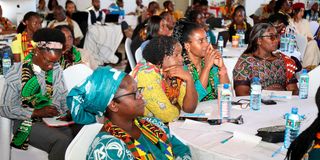
World Resources Institute Food, Land and Water Director Dr Susan Chomba during the Africa Women in Agro-ecology Learning Exchange and Expo at the Desmond Tutu Conference Centre in Nairobi on December 2, 2025. The event brought together women practitioners, farmers, and stakeholders to share knowledge, showcase innovations, and promote sustainable agroecological practices across the region.
Photo credit: Bonface Bogita | Nation Media Group
Held in Nairobi from 2 to 3 December, the third edition of the workshop was themed “Bold Voices: Championing African Women’s Leadership in Food Sovereignty through Land Rights, Agroecological Entrepreneurship, and Territorial Markets”, the event brought together over 100 participants, including rural women, agripreneurs, farmers, market actors, policymakers, young women and men, and male allies.
"Sustainable farming methods hold the key to improving food systems in Africa," said Christina Oforo, a Tanzanian farmer, in an interview with Seeds of Gold .
Ms Oforo, who is the CEO of Organic Moringa Herbal Products, grows moringa and chia seeds on over 40 acres of land, and claims that sustainable farming methods have enabled her to access export markets in the United States and the European Union.
“I also sell value-added products to East African countries, including Kenya, Uganda, Rwanda, Burundi and Somalia,” she revealed.
Monica Nyaga, Pelum Kenya's Gender Programme Officer and Awola Coordinator, said that the project plays a crucial role in building women's capacity in agroecology.
“Women make up around 70 percent of the agricultural workforce. However, their voices are not amplified. We want to strengthen their participation in agroecology because they make a significant contribution to food systems,” she said.
Since its inception in 2023, Awola has expanded to five African countries — Kenya, Zimbabwe, Uganda, Malawi and Nigeria — mentoring women to become leaders in agroecology.
Ms Nyaga said the goal is to extend the programme to all 54 African countries.
This year, 60 women graduated from the initiative and are expected to pass on their skills within their communities.
“Women are crucial to supporting food systems in Africa. They are the backbone of feeding populations, yet they often lack control over land, financing and other resources. We need to change this," said Josephine Atangana, Afsa's Member Support Officer and Congo Basin Coordinator.
She emphasised that without women in decision-making spaces, Africa cannot effectively defend its identity and food sovereignty.
Hepzibah Abiodun, the AWOLA Programmes Coordinator in Nigeria, praised African women for their leadership in advocating sustainable farming. She noted that their efforts are central to improving soil health and addressing lifestyle-related diseases.
"In Nigeria, the adoption of sustainable farming methods has increased by more than 100 percent over the last three years,’ she said.
"We now have supportive policies, and Pelum Nigeria works closely with the government. It is crucial that we focus not only on farming practices, but also on protecting the environment, because soil is the backbone of agriculture.”
Women have been pushing for sustainable farming practices for a year now, since the Kenyan government launched the National Agroecology Strategy for Food System Transformation (NAS-FST) 2024–2033.
As agriculture is a devolved function, several counties, including Murang'a and Vihiga, were among the first to introduce agroecology policies. Others, such as Kiambu, Nakuru, Busia, Kakamega, Laikipia and West Pokot, are following suit.
"Agroecology is not an outdated tradition; it is a farming system that can increase productivity and prevent lifestyle-related diseases before they occur. In the market, we say 'mama mboga', not 'baba mboga', which highlights the central role of women in food systems. Yet, despite their significant contributions, many women lack resources such as land ownership due to cultural barriers. This must be addressed," said Dr Susan Chomba, Director of Food, Land and Water at the World Resources Institute (WRI), during the Awola 2025 workshop.
In Kenya, agroecology advocates are calling on the government to introduce a subsidy programme similar to the fertiliser subsidy in order to promote sustainable farming.