It belongs to a much older Kenyan tradition in which parties punish rebels, only for them to discover that punishment can become currency. Kenya’s political past has shown that a leader pushed out of party office does not necessarily go home. Sometimes, they walk out into history.
This month marks 60 years since the Little General Election of 1966, when Jaramogi Oginga Odinga, having been cornered inside the ruling party Kanu, built a new political base around the Kenya People’s Union. The same grammar of political survival has appeared repeatedly since independence.
Kenneth Matiba and Charles Rubia resuscitated their political careers through the multiparty crusade. William Ruto t urned his humiliation inside Jubilee into political capital. Rigathi Gachagua , after his fall from the Kenya Kwanza order, is now attempting his own reinvention through DCP, a new political vehicle.
This is the road Sifuna appears to be testing within ODM. His troubles have, therefore, reopened an old question: what happens when a politician loses the party machinery but gains the language of betrayal?
ODM resolves to eject Senator Edwin Sifuna
In a country where political parties are often built around personalities, ethnic bargains, patronage networks and succession wars, expulsion can do what ordinary speeches cannot. It can transform an insider into a victim, a functionary into a symbol, and a party officer into a national figure. That explains the ‘Sisi Ni Sifuna’ mantra.
In 1966, Jaramogi found himself caged inside Kanu. Tom Mboya, in his bid to control the party machinery, had outmanoeuvred and dethroned Jaramogi. The pro- Jaramogi faction had numbers, popular sympathy and ideological energy, but it could not match the combined force of Jomo Kenyatta’s presidential authority and Mboya’s brilliance in party organisation. Within ODM, Oburu Oginga and Gladys Wanga are playing with Ruto’s machinery of second term and might end up creating Sifuna as an expelled patriot.
This is the paradox of expulsion. While it is meant to isolate, under the right conditions, it advertises a person.
Jaramogi’s break with Kanu did not give him power. It gave him a political identity, and he became the founding face of opposition politics in postcolonial Kenya. Even when the KPU was banned in 1969, and Jaramogi was consigned to political exile, the memory of his rupture with Kanu became part of his moral capital.
The Daniel Moi years perfected the punishment machine. Kanu became not simply a party, but the gatekeeper of political citizenship. To be expelled from the party was to be removed from public life. The party could deny one the right to participate in politics, often without due process, without a proper disciplinary hearing, and without meaningful appeal. The party card became a passport to public life.
Yet the same system that tried to bury dissidents created the language of the Second Liberation. By closing the door, Kanu created the romance of the outsider. By expelling, detaining and humiliating its critics, it gave them the moral vocabulary with which to return.
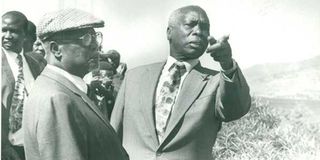
Mr Kenneth Matiba (left) and Mr Charles Rubia.
Photo credit: File photo
Kenneth Matiba and Charles Rubia understood this. Both were established men like Gachagua. They were not unknown agitators trying to manufacture relevance. They had been inside the system, close enough to understand its arrogance and confident enough to challenge it. When they called for multiparty democracy in 1990, Moi’s state treated them as enemies. They were arrested and detained before the Saba Saba rally. The intention was to scare the country back into silence.
Instead, detention turned Matiba and Rubia into national emblems. Matiba’s transformation was especially dramatic, and he became the man who had paid for democracy with his health.
But expulsion alone does not make a career. Many politicians have been expelled and forgotten. Some lost political standing. Others later returned to become defenders of the very system that had humiliated them. Their cases remind us that expulsion is only raw material. What matters is how a politician narrates it, organises around it, and turns personal injury into public meaning.
Mwai Kibaki rebuilt himself after leaving Kanu by presenting the Democratic Party as a sober, respectable and constitutional alternative to Moi’s party-state. Kibaki did not carry the emotional fire of Matiba or the radical aura of Jaramogi. His brand was different.
Humiliation and isolation
William Ruto’s rise also belongs to this history, though from the other side of the ideological spectrum. After Kanu’s collapse in 2002, he had to rebuild. After his fallout with Raila Odinga and ODM, he rebuilt again. After the humiliation and isolation he suffered inside the Jubilee government during Uhuru Kenyatta’s second term, he turned political exclusion into the “hustler” narrative. He presented himself as the Deputy President locked out by dynasties, state mandarins and handshake politics. Then he built UDA into a vehicle. The result was not just survival. It was a victory.
Democracy for the Citizens Party (DCP) leader Rigathi Gachagua.
Photo credit: Bonface Bogita | Nation Media Group
Gachagua is now attempting the same conversion. After rising through the Kenya Kwanza wave and becoming Deputy President, his fallout with President Ruto ended in impeachment and public humiliation. But in Kenyan politics, humiliation is not necessarily terminal. Gachagua is trying to recast himself as the betrayed defender of the mountain, the man used and discarded by the very system he helped bring to power. Whether that reinvention succeeds will depend not on grievance alone, but on whether he can turn grievance into organisation.
His politics was built around the creative use of rupture. Detention under Moi gave him the credentials of sacrifice. The battles inside FORD-Kenya gave him the image of a man unwilling to be contained by inherited party hierarchies. His move to the National Development Party showed that he understood something many Kenyan politicians never grasp: a party is not merely a structure; it is a vehicle. If it cannot move you, you move from it.
Again and again, Raila turned political friction into reinvention. From FORD-Kenya to NDP, from cooperation with Kanu to the Rainbow revolt, from LDP to ODM, and from opposition politics to the politics of the handshake, he repeatedly converted quarrels into new stages. His genius was not that he avoided betrayal. It was that he metabolised it. Each fight gave him a new vocabulary. Each fallout allowed him to reorganise his following. Each rupture became a referendum on loyalty, reform and betrayal.
This is why Raila remained central even when outside formal power. He understood the emotional economy of Kenyan politics. Voters do not follow only policies. They follow injury. They follow humiliation. They follow the leader who appears to have been wronged by a closed system.
Sifuna is being disciplined over the meaning of ODM’s accommodation with President Ruto. ODM says discipline is necessary for party order. Sifuna says due process and principle are at stake. But beneath the legal arguments lies the deeper political question: can he turn removal from office into reinvention? Can he transform himself from ODM Secretary-General into a wider symbol of resistance to party capture, generational impatience and the uneasy relationship between ODM and state power?
His opportunity is obvious. He is articulate, urban, combative and media-savvy. He has a Senate platform. He has the advantage of appearing to confront the party establishment at a moment when many younger voters distrust closed political bargains. If he frames his removal as punishment for opposing ODM’s dalliance with Ruto, he can claim to be defending the party’s soul rather than merely fighting for a title.
Nairobi Senator Edwin Sifuna, address a crowd at Mazembe Grounds in Nakuru City on April 19, 2026 where he led the Linda Mwananchi team for a rally. They supported planned Tuesday protest against the high cost of fuel.
Photo credit: File | Nation
But the danger is also obvious. Kenyan history rewards rebels who build an organisation, not those who only trend. Jaramogi had KPU. Matiba and Rubia had the multiparty movement. Kibaki had DP and later NARC. Raila had parties, networks, grievances and numbers. Ruto had UDA. Gachagua is testing a new vehicle. Without a machine, expulsion becomes theatre. Without a constituency beyond sympathy, rebellion becomes noise. Without discipline, the victim becomes just another ambitious man complaining after losing office.
ODM should understand this better than most. Its own DNA was formed in rebellion, fallout, resistance and betrayal. It is a party built from the ruins of other parties, from quarrels that became movements, from men and women who walked out of closed rooms and found crowds waiting outside. To punish dissent without understanding this history is to forget the very grammar that produced ODM.
Sifuna may yet fade. He may negotiate his way back. He may build something new. He may become a footnote or a founder. But the larger lesson remains: in Kenya, the party office is not always where political careers are made.
Sometimes they are created at the moment of removal, when the door is shut, the cameras gather, and a politician discovers that exclusion can be converted into destiny. But Sifuna should be careful not to sell noise. Jaramogi didn’t.