One March afternoon in 1980, an exchange unfolded on the floor of the National Assembly. Attorney-General Charles Njonjo stood unflinching as 36-year-old Michael Wamalwa Kijana pressed him for clarity – were police licensed to kill, or merely to incapacitate suspects for arrest?
Njonjo, ever the imperial relic, responded with the cold logic: “Police have my authority to shoot to kill.” The applause that followed was not unanimous, but it was telling. A policy once whispered in backrooms had found its voice in Parliament.
More than four decades later, Interior CS Kipchumba Murkomen echoes the chilling refrain. In a Kenya wrestling with police excesses, rights abuse, corruption and institutional decay, the past is bleeding seamlessly into the present. Murkomen’s shoot-to-kill policy, unveiled under the guise of restoring order as the Gen Z continue to press for change, is not a bold or new – but a well-worn script in the playbook of punitive power.
Though a lawyer, Murkomen is like a later day Capt Richard Meinertzhagen, the infamous colonial officer who, in 1903, encouraged his askaris to shoot first and never bother with questions. It was this doctrine of state-sanctioned violence that culminated in the cold-blooded killing of Nandi Orkoiyot Koitalel arap Samoei and the decimation of entire homesteads in across Nandi country. In his macabre notebooks, Meinertzhagen recorded – with neither remorse nor restraint – the massacre of 1,500 Africans in one punitive expedition.
To Meinertzhagen and his imperial contemporaries, Africans had no rights. They were mere subjects to be pacified, silenced or slaughtered. That logic lingers still in the marrow of the Kenyan state, where defiance is often met with death, not dialogue.
It appears the ghosts of Fort Smith and Dagoretti still whisper in the corridors of the Interior Ministry. It was at these colonial outposts that resistance met retribution, and where defiance bore a fatal price. It was here that Waiyaki wa Hinga, the Kikuyu elder and statesman, was seized and exiled for confronting the excesses of the British East Africa Company and its askaris. His crime was courage – refusal to cower before Capt Purkiss – and his defence of his people’s dignity.
For standing on principle and challenging the British imagination of order, Waiyaki was arrested, wounded and forced on a march towards the Coast. He died in Kibwezi and was buried in an unmarked grave. In a collective act of mourning and fury, the Kikuyu torched Fort Smith – a symbol of imperial arrogance. It was a fire lit not merely in protest, but in memory. It was a reminder that state violence, then as now, breeds resistance and that those who forget history often find themselves haunted by it.
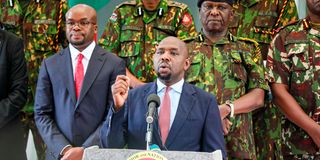
CS Murkomen tells police to shoot people threatening them
Njonjo romanticised the order and rigidity of British colonial rule, and in doing so, laid the legal and ideological foundations for modern police impunity. By the early 1970s, as the post-independence dream sagged under the weight of inequality and escalating political repression, President Jomo Kenyatta sought a shortcut to law and order: he called for thieves to be hanged “until they die”.
To its credit, Parliament initially resisted the return of executions. But the tide turned. By 1973, robbery with violence had been codified as a capital offence. By 1975, even armed robbery – regardless of whether violence occurred – could lead one to the gallows. The law had become a weapon.
Under Njonjo’s watch, Section 71 of the Constitution explicitly permitted the use of lethal force – not just in self-defence, but to protect property, prevent escape or stop suspected crimes. The judiciary was relegated to the sidelines as police assumed the roles of judge, jury and executioner – often acting on suspicion alone. With the courts bypassed, Kenya began its descent into a police state, where law enforcement answered not to the Constitution, but to their own sense of power.
It was in this atmosphere of unchecked authority that police reservist Patrick Shaw thrived. Shaw enforced the shoot-to-kill doctrine with a cold, almost biblical certainty. His signature Volvo – an ominous fixture on Nairobi’s streets in the 1970s and 1980s – was the predecessor to today’s Directorate of Criminal Investigation’s Subarus, vehicles of speed and fear. Shaw was revered as a paternal figure and benefactor at Starehe Boys Centre. But beyond those gates, in the backstreets and slums, he was a law unto himself. Shaw held the power of life and death, dispensing it without oversight, trial, question and consequence.
Murkomen’s edict, cloaked in the language of national security, breathes new life into a troubling legacy. The continuity is not merely legal, it is ideological. In this worldview, Gen Z protesters, the poor and all who dare to question the state – those exercising their constitutional rights to assemble and speak – are cast as threats too dangerous to deserve due process. In such a system, justice is not blind – it is calibrated by class, politics and fear. It sees what it wants, punishes who it must and protects who it chooses.
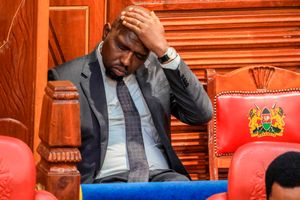
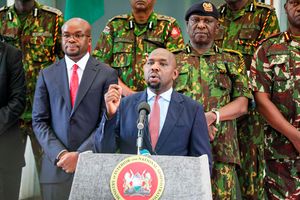
Interior Cabinet Secretary Kipchumba Murkomen appears before the Senate Nairobi on June 11, 2025
Photo credit: Dennis Onsongo | Nation Media Group
To grasp the full weight of Kenya’s shoot-to-kill policy, one must reckon with its most brutal manifestations. At Wajir Airstrip in February 1984, more than 5,000 men were rounded up and subjected to days of unspeakable torture by the military acting under nebulous orders to “quell insecurity”. When the operation ended, the airstrip was littered with the bodies of up to 2,000 men – victims of a massacre that has never been accounted for, let alone prosecuted. At Wagalla, there was no trial, no verdict, no semblance of due process. Only a brutal lesson. When the Kenyan state feels threatened, it reaches for the gun.
Murkomen’s rhetoric is, in effect, a pre-emptive declaration that the enemies of the state – real or imagined – will not be brought to court, but to their knees.
The second example is the 1980s, when amid collapsing state control and soaring ivory prices, poaching surged. President Daniel Moi issued a shoot-on-sight order against suspected poachers, many of them pastoralists or northern Kenyans. Richard Leakey, then head of the Kenya Wildlife Service, turned rangers into paramilitary units.
By 1989, more than 100 people had been shot dead – more deaths than arrests. Conservation replaced due process and elephants were now safer than citizens.
Murkomen: Police officers were not given guns for decoration
In Parliament in 2005, Mt Elgon MP John Serut posed a question in response to a similar order by Minister John Michuki: “What would the judges, magistrates and other institutions be doing if judgment would be passed by police on any suspected criminal?”
Shoot-to-kill policies appeal to a certain strain of public sentiment – one that confuses violence with order, and swift death with justice. In moments of national anxiety, they appear decisive, manly, effective. But they leave in their wake a bloodstained erosion of liberties, the emboldening of rogue police units, and a culture of impunity that feeds on fear. Murkomen’s directive disguises brutality as necessity. It makes a mockery of the rule of law and legitimises a state that sees force not as a last resort, but a first impulse. Like many of his predecessors, he avoids the more urgent, uncomfortable questions: Why are people angry? What drives citizens to the streets? How can a society claim to uphold justice when it kills on suspicion?
Even more alarming is the slow erosion of fundamental rights under the banner of national security. Freedom of expression and peaceful assembly – pillars of a functioning democracy – are increasingly treated not as rights, but as threats to be neutralised. When citizens rise to protest injustice, they are met with teargas and bullets. When they speak, they are branded enemies of the state. The gun replaces dialogue, fear replaces freedom and the state drifts from the people it claims to serve.
As Kenyans prepare to mark Saba Saba day, Murkomen and police should be reminded that a truly secure nation does not kill its way to order. It invests in fairness, tackles inequality, strengthens institutions and protects its most vulnerable.
The shoot-to-kill mantra betrays the Constitution and the memory of those who fought for the right to live, to be heard and to be tried. That was the spirit of Saba Saba, which gave us the 2010 Constitution.
Murkomen will likely not be the last official to call for deadly force. From Meinertzhagen’s massacres to Murkomen’s press briefings, the state has too often chosen the gun over the law. Time has come to choose differently.
John Kamau is a PhD student, University of Toronto. Email: [email protected] ; on X: @Johnkamau1