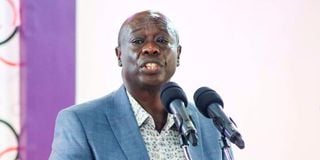
Former Deputy President Rigathi Gachagua recently sparked debate with his comments at a church service in Kariobangi North that the Kikuyu should occupy key elective political positions in Nairobi owing to their economic and numerical strength.
Archival records show that such a tactic of political mobilisation was first employed in Nairobi in 1960, in an attempt to kick out Tom Mboya from his colonial-era Legislative Council (LegCo) seat in the capital city.
Mboya, a man with roots in Nyanza, felt his political position in Nairobi was so much under threat that he considered shifting his base to Mombasa and sent direct appeals to Jomo Kenyatta, who was still in prison, to intercede with his tribesmen on his behalf.
President Jomo Kenyatta (left) with Kanu secretary-general Tom Mboya after a three-hour National Executive Committee meeting at State House, Nairobi. The meeting was also attended by all provincial Kanu vice-presidents and vice-president Daniel arap Moi.
The declaration of the State of Emergency in 1952 and the subsequent removal of old guards such as Jomo Kenyatta from the political scene left a vacuum, which Mboya perfectly filled. Riding on his charisma and force of character, he was able to establish himself as the dominant African personality in Nairobi, which was the hotbed of Kenyan politics.
With all the political parties banned by the British colonialists, the labour movement became Mboya’s vehicle for furthering African causes, which built him a multi-ethnic support base. Immediately after he joined the Legislative Council following the 1957 elections that were held under a qualitative multiple vote franchise, he outsmarted all the eight African elected legislators and emerged as the foremost political leader.
However, 1960 saw a major shift on Kenya’s political landscape, a situation that left Mboya in a precarious position. To start with was the First Lancaster House Conference that marked Kenya’s initial step towards self-rule. With internal self-government becoming a possibility, divisions, some of them ethnic, began to emerge among African leaders as they started to haggle for power and positions.
Even before they left London, the rift between them was already visible with Mboya facing the greatest hostility. As he later explained in his memoirs; “There was apparent antagonism against me, it was said because in the reporting of the London talks in British newspapers I had been given too much prominence.”
Jomo Kenyatta (left) and Tom Mboya attend the Lancaster House Conference in London.
Photo credit: File | Nation Media Group
The second key event that had an effect on Mboya’s political position in 1960 was the lifting of the State Emergency. The removal of Emergency Restrictions of Movement imposed on the Kikuyu, Embu and Meru ethnic groups by the British changed the landscape.
This led to the political renaissance of the Kikuyu, whose numbers increased enormously in Nairobi. Because of divide-and-rule tactics employed by the colonialists during the Emergency, the Kikuyus who were returning to Nairobi after being restricted in the reserves for many years viewed other communities in the city suspiciously.
This suspicion was exploited by ambitious tribal politicians, who were determined to reclaim their grip on the politics of Nairobi by weakening Mboya, considered an outsider.
The theatre for this absurdity was the 1961 common roll General Election, which was one of the consequences of the first Lancaster House Conference.
A group of Kanu politicians had coalesced into a formation known as the Central Province Group, to agitate for the interests of Mount Kenya, including taking control of Nairobi. It was composed of Dr Munyua Waiyaki, Margaret Kenyatta, Gikonyo Kiano, Dr Njoroge Mungai and Josef Mathenge, among many others.
This group did not only want to dispose Mboya from his Nairobi LegCo seat, but also wanted their community to control all Kanu branches in the city. Their strategy was to slander Mboya through a smear campaign in the hope that it would alienate the Kikuyu electorate from him. Also targeted was Kanu acting president James Gichuru — who came from the Mt Kenya region — because of his close friendship with Kanu secretary-general Mboya.
Tom Mboya is greeted by jubilant crowds flashing the Kanu one finger salute after the elections in 1963. Mboya was described in the Western world as personable and articulate. He even appeared on the ‘Time’ magazine cover in 1960.
Photo credit: File | Nation Media Group
A report marked “secret” compiled by the Director of Intelligence and Security Kenya Colony and copied to the Permanent Secretary in the Office of the Chief Secretary and the Permanent Secretary for Defence read: “Approximately twenty leading Kikuyu met privately in a house near Kiambu on the evening of 6 December 1960. They discussed the current predominantly Kikuyu efforts to slander Mboya and Gichuru in order to bring about their political downfall, including the slander campaign based on the rumours that they had signed a document agreeing to the continued restriction of Kenyatta. The delegates agreed that their plans to slander Mboya and Gichuru were going well, but some expressed concern at the possibility of matters getting out of hand in the sense that the thug element might assault and even kill Gichuru. The meeting then discussed the forthcoming elections and agreed that Mungai Njoroge would stand against James Gichuru for the Kiambu seat and Munyua Waiyaki against Mboya for the Nairobi East Constituency seat.”
True to the intelligence report, a couple of weeks later Munyua Waiyaki and Njoroge Mungai announced their candidature against Mboya and Gichuru, respectively, despite Kanu prohibiting prospective candidates from vying against party officials.
Waiyaki would later withdraw his candidature after being reprimanded by the Kanu Governing Council, but he changed his mind two days later after being incited to vie as an independent candidate against Mboya, who was the official Kanu candidate for the Nairobi East open seat.
Hovering above like an egret was Kanu’s vice-president Jaramogi Oginga Odinga, who because of his own political rivalry with Mboya, decided to throw his weight behind Waiyaki. His reason was that Mboya had equally planted his future father-in-law Walter Odede to vie against him as an independent candidate in Nyanza.
Then vice president Jaramogi Oginga Odinga and president Jomo Kenyatta.
Photo credit: File
Since Mzee Kenyatta was a revered nationalist figure, his name became a tool for Waiyaki and his counterparts to whip emotions during the campaigns. In one instance, they circulated rumours in Nairobi that Mboya had misused funds intended for Jomo Kenyatta, who was in detention.
But Mboya countered this at a rally in Bahati by revealing that, in fact, he had personally negotiated for the monthly Sh600, which Kenyatta was receiving from the Ethiopian government through his daughter Margaret.
Because of the heightening hostilities, on November 26, 1960, a delegation of Luo leaders made up of Alfred Akech Mingusa, Zefania Adhola, Zadok Orifa, Henry Gaya and Wilson Opuch, met a Kikuyu delegation in Dr Waiyaki’s clinic.
According to a report of the meeting marked “secret”, Waiyaki told the elders that Mboya was planning to assassinate him by poison or in a motor accident. The allegation was dismissed by all those present after Waiyaki failed to substantiate. Another meeting was rescheduled for the following day during which Mboya and Waiyaki shook hands, but the hostilities still continued.
Realising how Kikuyu support was important to his re-election, Mboya resorted to writing directly to independence heroes Fred Kubai and Jomo Kenyatta, who were still in detention, to intercede with their tribesmen on his behalf.
He even publicised his correspondence with Kenyatta to counter accusations that he and Gichuru were working with the government to have the iconic figure jailed longer.
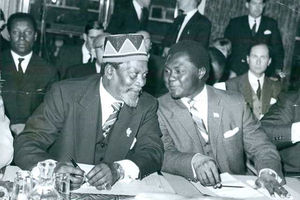
Mzee Jomo Kenyatta and Tom Mboya share a joke at the 1962 independence conference in London.
Photo credit: File | Nation Media Group
In one letter to Mzee Kenyatta, he complained about Margaret (Kenyatta’s daughter) who had ganged up with Waiyaki against him. Mboya wrote that Margaret’s attitude towards his election campaign was puzzling, adding that her apparent lack of enthusiasm was more than “a symptom of the present confusion that exists in Kenya African National Union”.
Mboya also apologised to Kenyatta for making their private letters public, pointing out that he did so in order to counter rumours that were being spread by his detractors. He was at pains to explain that he made the disclosures with the greatest reluctance, and promised not to repeat it in future.
At one point, the Permanent Secretary was so concerned with how Mboya managed to keep tabs with Kenyatta, who was still in detention, and demanded an explanation from the Director of Intelligence and Security.
“I regret that I am not able to say exactly how Mboya has been communicating with Kenyatta. It has certainly not been by means of the proper channels which undergo censorship. Mboya is known to be aware of the facilities for smuggling letters which exist in relatives’ visits to Lodwar,” the Director of Intelligence responded.
Bearing in mind that the Kikuyu made up 65 per cent of the electorate in the Nairobi East Constituency where Mboya was contesting, the Central Kenya elite were confident of unseating him with little difficulty.
Tom Mboya.
Photo credit: File | Nation Media Group
Although Mboya’s close friends had urged him to shift his political base to Mombasa or his home district of South Nyanza which would provide him with a safe seat, he feared that such a move would be akin to surrendering to tribalism.
He, therefore, decided to fight it out in Nairobi by keeping himself in the vanguard of the campaign to free Mzee Kenyatta, while also relying on the support of Gichuru and his own talents as an orator to attract Central Kenya voters from their leaders that were imbued with the doctrine of the divine right of their tribe.
On February 28, 1961, there was celebration in Nairobi when Mboya was announced the winner after garnering 31,407 votes against his closest challenger Munyua Waiyaki who got a paltry 2,668 votes.
Voters with Mt Kenya roots, particularly women, had lined up early in the morning to vote for Mboya while singing “Mboya ndege (airplane)”, which was his electoral symbol.
It was not only a win for Mboya, but also a victory against ethnic mobilisation by some leaders. Sixty-four years later, there are echoes of a similar ethnic plot by some leaders whose feet are still embedded in the outdated tribal agitation.
But they stand a risk of being embarrassed by the younger generation whose political activism has continued to redefine democracy in Asia and Africa.