The original plan agreed upon by the colonial government and Kenyan nationalists at Government House, Nairobi, in May 1963 was for Kenya to continue with internal self-government from June 1, 1963, until mid-1964.
This would then be followed by full independence towards the end of 1964. Duncan Sandys, the British Secretary of State for the Colonies, was therefore taken aback when, in July 1963, Kenyan nationalist Tom Mboya asked to visit London to discuss an early independence date.
A bewildered Sandys, archival documents show, quickly telegrammed colonial Governor Malcolm MacDonald in Nairobi: “Before fixing the date for meeting Mboya, I would like to have your views… When I was in Nairobi, you thought it might be possible to carry on with internal self-government until the middle of 1964.
It now looks as though (Jomo) Kenyatta, with active support of (Julius) Nyerere (of Tanzania) and (Milton) Obote (of Uganda), is trying to rush independence before the end of the year. Please let me have your thoughts and advice on tactics and timetable.”
MacDonald explained that the change of plan was because the three East African countries wanted to form a federation, but could not do so unless Kenya was also independent. Mboya left almost immediately for London, where he camped in the corridors of the Colonial Office to exert pressure on Sandys for early independence.
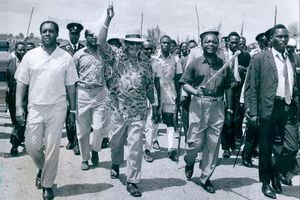
March 4, 1964: Prime Minister Jomo Kenyatta, and the Commonwealth Secretary, Mr Duncan Sandys, meet for two hours in Nairobi. Also present are from left the Minister of State for Pan African Affairs, Mr Mbiyu Koinange, Premier Kenyatta and Mr Sandys waving to the crowd.
Photo credit: File | Nation Media Group
Although Sandys caved in to Mboya’s demands, he remained evasive about giving a specific date. Mboya, however, was resolute, insisting that he could only return to Kenya after securing a date. Sandys eventually yielded to the pressure and gave December 12, 1963, as the date for independence, but it was to remain a secret until the official communiqué was drafted.
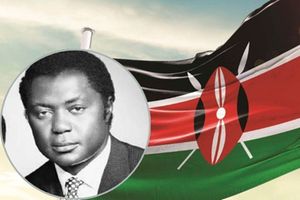
With the independence date secured, preparations for the celebrations began in earnest. Because a flag is a key component of nation-building, the new Kenyan flag was first unfurled on July 27, 1963, at a press conference attended by Mzee Jomo Kenyatta and Mboya.
“This National flag is a flag of unity, and we expect it to be respected. We would like to appeal to the public not to fly the National flag on bicycles and so forth. We do not want to see it made of some cheap material in River Road. It must be treated with respect,” Mboya said.
One of the biggest challenges the government encountered was finding accommodation for the massive influx of guests expected to attend the Uhuru celebrations. By August 1963, the government had booked all suitable hotel accommodation from December 7 to 17, including Norfolk, North Avenue, Ambassadeur, Brunners and New Stanley, but the shortfall remained glaring. Consequently, a direct appeal was made to members of the public to provide their furnished homes for accommodation.
“Occupiers will be well compensated for the trouble of moving out of their homes, and the houses will be really well looked after,” the government promised.
With only 12 households heeding the call, the government decided to use emergency powers to take over houses and other suitable premises by compulsion. In a dramatic illustration of desperation, a draft Bill granting the government this power was hurriedly presented in the House of Representatives for approval. The Government Accommodation Ordinance, 1963, came into force on December 3, 1963.
For the celebrations, a forest on the site where Uhuru Gardens in Nairobi currently stands was cleared for the construction of a temporary stadium. When Dalgety and New Zealand Limited were awarded the contract, they were given only three weeks to complete the work. Within just 36 hours, a consignment of construction material was already at sea, making its way to Mombasa from Britain aboard six ships.
Other materials were sourced from Uganda, where they had been used in the erection of Kololo Independence Stadium. The Uhuru Stadium was erected at a surprising speed, leaving passers-by wondering how a previously forested area occupied by wild animals could be transformed in a matter of days.
Even amid the exhilaration of Uhuru, Cold War intrigues surfaced. Britain put pressure on Kenya not to invite East Germany, arguing that Her Majesty’s Government recognised only the Federal German Government as the legitimate authority in Germany. The United States, on the other hand, driven by its unofficial security partnership with Taiwan, also known as the Republic of China, pushed for the invitation of a Taiwanese delegation to counter a delegation from the People’s Republic of China invited by Jaramogi Oginga Odinga.
A decision was eventually reached to invite individuals from the two territories in their private capacities to avoid diplomatic protests from West Germany and China — and a rift between the West-leaning Mboya and the East-leaning Jaramogi within the Cabinet.
President Kwame Nkrumah of Ghana was to be the chief African guest at the celebration, owing to his friendship with Jomo Kenyatta and Ghana’s Pan-African credentials. However, he declined the invitation because of Kenya’s push for an East African federation, which he felt threatened his ambition of a United States of Africa that he hoped to lead.
This forced Kenyatta and his Cabinet to send an invitation to Emperor Haile Selassie, revered as a symbol of Black resistance. A suitable house was found in the upmarket Muthaiga suburb and redecorated to accommodate the Ethiopian leader and his delegation of ten. However, the invitation was later withdrawn out of fear of a protocol nightmare owing to Selassie’s eminence.
The Governor informed London: “I learnt from Mboya last night that the Kenya Cabinet reversed its earlier inclination and decided it would cause protocol and perhaps other embarrassment if the Emperor himself led the Ethiopian delegation to the independence here.
He is a royal head of state of a unique nature in this part of the world.” It was also feared that his presence would overshadow that of Prince Philip, the Duke of Edinburgh, who was to hand over the statutory instruments on behalf of Queen Elizabeth II.
Kenyatta was unhappy that the Queen could not attend, but as Governor MacDonald later informed London: “I explained to him that all the precedents were against Her Majesty’s coming, and that if she broke precedent in this case it could arouse criticism in other Commonwealth countries. Kenyatta then said that he understood this, but with great regret.”
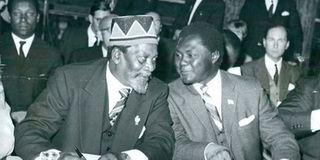
Mzee Jomo Kenyatta and Tom Mboya share a joke at the 1962 independence conference in London.
Photo credit: File | Nation Media Group
As Uhuru approached, gifts were received from across the world as gestures of goodwill, mutual respect and diplomatic engagement. American businessmen gave Kenyatta a Lincoln Continental convertible worth £25,000, while the Germans gifted him a Mercedes-Benz Pullman.
These luxurious cars added to a Rolls-Royce Phantom he had bought in London for £20,000 in October 1963. On November 1, 1963, a Kenyan chauffeur was sent to the Rolls-Royce Company in Britain for a two-week maintenance course.
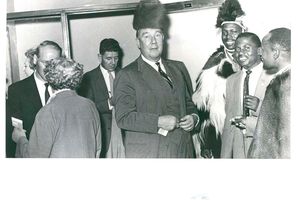
The British Parliament gifted the Kenyan Parliament a bookcase containing parliamentary and constitutional works, while Her Majesty’s Government offered a silver table centrepiece. Other gifts included ten ambulances from West Germany, one Jeep-type ambulance from Israel, a Speaker’s chair from the Indian government, 33 microscopes from the Swiss government, 24 lorries from the American government, radio equipment from the Soviet Union, and 200 colobus monkey headgear for the Kenya Army band from Emperor Haile Selassie, among others.
The arrival of Uhuru was marked by festivities throughout the country. Kenyan students abroad were not left out. Celebratory materials — including Kenyan flags, Uhuru badges, recordings of the national anthem, a letter from Prime Minister Jomo Kenyatta and magazines — were sent to them through British embassies.
In one instance, archival documents show that a student named Robert Onyango Onger, studying at Kwame Nkrumah University of Technology, Kumasi, on a Ghanaian government scholarship, visited the British High Commission in Accra to request funds from the Kenyan government to facilitate Uhuru celebrations.
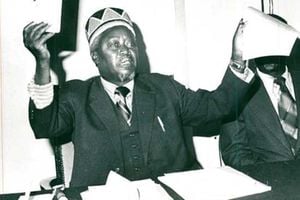
Jomo Kenyatta takes an oath at Kenya's independence in 1963.
Photo credit: File | Nation Media Group
The diplomat informed an official at the Commonwealth Relations Office in London, who sought clarification from Nairobi: “I have spoken to the Independence Celebrations Directorate in Nairobi, who tell me that they only issue money to Kenyan students overseas when more than eight or nine are gathered together.
They will send them a parcel with suitable celebratory material, together with £2 per head. If there is only one Kenyan student, he may receive a small parcel to help publicise Kenya’s independence, but he would not receive money.”
Kiprotich Chumo, chairman of Kenyan students in Belgrade, formerly in Yugoslavia, also visited the British Embassy to request funds for an Independence Day reception. The diplomat informed the British Secretary of State, who in turn wrote to the Governor of Kenya asking: “Grateful to know if funds should be made available on Kenya Government account to students in Yugoslavia and, if so, up to what amount.”
However, the much-anticipated Uhuru celebrations were almost thrown into disarray when Kenyatta told an excited crowd in Thika that on Independence Day, he would personally pull down the Union Jack. The British, who took the statement seriously, sent the Governor to seek clarification.
“I talked with Kenyatta about this yesterday, and he says he has no intention whatsoever of lowering the Union Jack himself. He never intended to do this, and the newspaper report to the contrary was a misreport,” the Governor explained.
There were also fears that Mzee Kenyatta could be carried away by the nationalist fervour gripping the nation and deliver a radical Independence Day speech. For this reason, in a telegram marked Secret, the Secretary of State instructed the Governor to ensure that Kenyatta delivered a moderate address.
“In view of the large British population in Kenya, it is most important that, in his independence celebrations speeches, Kenyatta should express sentiments which will strengthen European confidence.” The Secretary of State even shared a speech delivered by Nigeria’s first Prime Minister on Independence Day in 1960, in the hope that Kenyatta might draw from it.
“If you think it appropriate, you may care to show him a text of a speech made on Independence Day in Nigeria by Abubakar Tafawa Balewa, of which I am sending you extracts in my telegram Personal No. 1056,” he wrote.
At the stroke of midnight on December 12, 1963, a new nation was born. Kenya became independent amid colourful scenes of excitement and tumultuous rejoicing at Uhuru Stadium, where an estimated 250,000 people gathered to witness a magnificent display of dances, military pageantry and fireworks designed by Brocks of England.