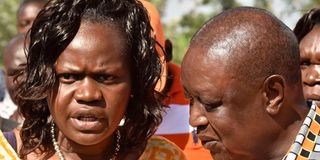
William Ruto has encroached on ODM turf. And as the Gladys Wanga and Dr Oburu Oginga faction cries foul, it appears that Ruto’s UDA is bent on erasing the power of Odingaism from its bases. But will that be possible?
To survive Ruto’s incursion, Wanga, Oburu and ODM’s present custodians must remember the oldest rule in the history of Odingaism: such movements are rarely destroyed in one fell swoop. They are undone slowly — when their generals begin negotiating in splinters and mistake a seat near power for power itself.
That is why the zoning quarrel is no minor squabble. The March 8, 2025, Ruto–Raila pact was sold as co-operation, not capitulation. But the current wrangles over whether UDA should plant candidates in ODM strongholds expose the real danger: what was marketed as partnership may yet prove to be a courteous invasion.
Homa Bay Governor Gladys Wanga speaks during the Orange Democratic Movement (ODM) Special Delegates Convention at the ASK Dome, Jamhuri Expo Centre in Nairobi.
Photo credit: Bonface Bogita | Nation Media Group
The current quarrel over zoning is not a minor dispute over electoral courtesy. It is a quarrel about political ownership. It is about who commands the emotional homeland of Odingaism.
For decades, ODM and its predecessors treated parts of Nyanza, the Coast and sections of Western as more than voting blocs. These were not just regions on a map but political banks. Now another party has entered that sacred geography where Odingaism thrived as a symbol of struggle.
Wanga’s complaint, therefore, should not be dismissed as ordinary coalition grumbling. It reveals an older instinct, one deeply rooted in Odinga politics: protect the base, because once it is breached, the movement loses the leverage that made it worth courting in the first place. That is why the question is not simply whether UDA should field candidates in ODM strongholds. The deeper issue is whether ODM still understands what made those strongholds strong in the first place.
To answer that, Wanga and Oburu must go back to the first great crisis of Odingaism.
In the 1960s, Jaramogi Oginga Odinga did not only possess symbolic authority. He had organisation that allowed him to command politics even when Kanu left him out post-KPU. This is the point often missed by those who reduce his career to oratory, martyrdom and confrontation with Jomo Kenyatta.
ODM Party leader Dr Oburu Oginga (left), President William Ruto and ODM Chairperson Gladys Wanga share a cake during ODM@20 celebrations at Sarova Whitesands in Mombasa on November 16, 2025
Jaramogi’s real strength lay in his effort to create parallel centres of thought, discipline and mobilisation. Starting from the days of Lumumba Institute, Jaramogi showed that structures were important to organise a party. Once that structure came under attack and was shut down, his vulnerability deepened. He was then isolated, caricatured, marginalised and eventually pushed toward political irrelevance.
History has shown that Jaramogi was not first defeated in argument and then stripped of power. He was first stripped of the mechanisms through which his politics reproduced itself. His decline followed the weakening of his machinery. The state understood something that opposition movements often realise too late: a political tradition can survive insults, propaganda and even detention. What it rarely survives is the slow loss of its independent organisational spine.
ODM currently has the weakest of leadership. Neither Dr Oburu nor Gladys Wanga enjoys national reach. The first lesson Wanga and Oburu must learn is that organisation matters more than emotion. ODM cannot preserve Odingaism through ritual alone. It cannot rely on funerals, commemorations, emotional speeches and the old reflex of loyalty.
It must preserve the branch structures, the nomination systems, the county hierarchies, the youth and women’s leagues, the discipline of the grassroots, and the everyday feeling among supporters that the party still remains their natural home. If UDA is allowed to operate freely inside ODM’s emotional core while ODM leaders console themselves with historical memory, then the movement will not die dramatically. It will be hollowed out politely.
The second lesson is subtler, but just as important. Negotiation has always been part of Odingaism. Those who imagine that the Odinga tradition was built on permanent opposition misunderstand its deepest logic. Jaramogi himself, after years in the wilderness, made a pragmatic turn during the Moi transition. Raila Odinga would later perfect that instinct.
In 2002, in 2008, in 2018, and at several moments in between, Raila demonstrated that Odingaism was never simply the politics of protest. It was also the politics of re-entry. It knew how to stand outside power and how to circle back toward it. It knew that exclusion can be politically useful, but only up to a point. After that, a movement must bargain or become theatre.
The lesson of Odingaism is not that one must always make deals; It is that one must make deals without surrendering the independent centre from which those deals derive their meaning. Raila could shake hands and still persuade the faithful that the movement remained intact because he himself embodied both the resistance and the accommodation.
ODM party leader Oburu Odinga is presented with the instruments of power during the Orange Democratic Movement (ODM) Special Delegates Convention at the A.S.K Dome, Jamhuri Expo Centre in Nairobi.
Photo credit: Bonface Bogita | Nation Media Group
As both Dennis Onyango, Raila’s spokesman, and Paul Mwangi, his lawyer, recently said, Raila created the Edwin Sifuna faction as part of his exit strategy. He could rage in public, negotiate in private and still keep the street convinced that the cause had not been sold. That authority was personal, historical and almost impossible to duplicate.
Their margin for error is much smaller. What looked tactical under Raila can look like drift under divided successors. What sounded like a strategy in the hands of one dominant figure can resemble surrender when pursued by factions. A handshake under central command can steady a movement. A handshake under uncertain command can become a tunnel through which the rival enters your house.
This is why the present zoning quarrel is so revealing. ODM’s demand for ring-fenced strongholds is more than a negotiating tactic. It is, in its own way, an admission of anxiety. A party does not ask for protected political ground when it feels invincible. It asks for such protection when it senses erosion where once it assumed command. UDA understands this perfectly.
Its refusal to respect informal boundaries is not just bravado. It is a calculated declaration that the ruling party no longer regards ODM strongholds as forbidden territory. It is testing whether Odingaism still has the organisational memory to defend its emotional homeland.
The third lesson Wanga and Oburu must take from history is that the Kenyan state has almost always tried to defeat Odingaism by dividing its elite before confronting its masses.
Kenyatta’s state narrowed Jaramogi’s room for manoeuvre until he stood exposed. Moi mastered the art of alternating between exclusion and selective embrace. He understood that one can neutralise a political tradition not only by keeping it outside, but by inviting parts of it inside on terms that weaken its coherence. Uhuru Kenyatta chose a softer route with the handshake, converting the energy of confrontation into elite-managed accommodation. Now Ruto appears to be attempting a composite method — one part cooperation, one part infiltration, one part faction management.
That is why ODM’s internal quarrels matter so much. A movement divided over its doctrine of engagement is already negotiating from weakness. Wanga and Oburu should, therefore, resist the temptation to dismiss every dissenting voice as sabotage.
ODM supporters during the Orange Democratic Movement (ODM) Special Delegates Convention at the ASK Dome, Jamhuri Expo Centre in Nairobi on Friday, March 27.
Photo credit: Bonface Bogita | Nation Media Group
The fourth lesson is the hardest of all, because it cuts to the heart of the Odinga inheritance. Odingaism cannot survive forever as a family-centred tradition.
For decades, the genius of the Odinga name was that it gave Luo Nyanza and allied regions one centre of gravity. It offered a negotiator, a symbol, a voice of injury and defiance. The name brought unity, emotional discipline and political direction. But it also postponed institution-building. It encouraged deference to a patriarch rather than investment in durable internal rules. As long as the patriarch remained central, the weakness stayed hidden. Once the moment of succession arrived, the weakness surfaced.
They can choose to be custodians of a shrine, or they can opt to be builders of an institution. If they lead ODM as guardians of memory alone, they will lose. If they lead it as a modern political force, with a defined programme, stronger county structures, a disciplined succession plan, and a language that speaks to the present rather than merely invoking the past, they may yet preserve Odingaism in another form.
Dr Oburu Oginga delivers his speech during ODM's Special Delegates Convention at Nairobi’s Jamhuri Grounds.
Photo credit: Bonface Bogita | Nation Media Group
And finally, Wanga and Oburu should learn that the young voter in Kisumu, Homa Bay, Siaya, Mombasa or Kakamega does not live on mythology. He lives in an economy of shrinking opportunity, digital agitation, unemployment, fragile hope and relentless inequality.
If ODM wants to keep its zones, it must speak in the language of everyday material life: jobs, devolution, fairness, county resources, corruption, dignity, land, markets, taxation, and the right of neglected citizens to a meaningful share of the republic. If it speaks only in the grammar of old wounds, it may discover that history moves crowds but does not always reproduce allegiance.
And there is yet another warning Wanga and Oburu should heed. Zoning cannot substitute for political muscle. They are right to worry about encroachment. But they should also recognise the risk in crying too loudly for fenced-off territory. Strong parties do not plead for protection as a first instinct. They build the muscle to win even under open contest. Zoning may buy breathing space. It cannot manufacture vitality. A movement that needs protection from competition in its own citadel exposes its weakness.
Can Ruto erase Odingaism from its bases? While it has endured detentions, betrayals, exclusion, coalition and reinvention, President Ruto thin, regionalise or scatter it into a small party Moi, the way Moi scattered Ford Kenya.
If Wanga and Oburu fail to learn that, Ruto will not need to defeat Odingaism. He will simply wait for its custodians to dismantle it on his behalf.