In the run-up to the heady 2007 General Election, witty former Assistant minister and Kibwezi MP Kalembe Ndile accused some influential individuals in President Mwai Kibaki’s government of chasing away votes every time they opened their mouths in public events.
It is a lament critics think could apply to some present-day powerful people ahead of the 2027 elections. While some of their statements may be intended to defend or reinforce a position, justify a situation or simply attempt to persuade voters, sometimes utterances trigger unintended consequences.
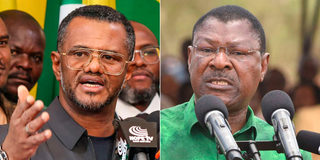
The recent comments by the UDA Secretary General Hassan Omar that even the dead could be made to vote for President William Ruto triggered national debate and condemnation, led by the opposition and Prime Cabinet Secretary Musalia Mudavadi .
Opposition leaders raise concerns over Hassan Omar remarks of deceased casting votes in 2027
“Even if someone has died,” Mr Omar declared, “we should take his finger before we bury him, put it in the BVR and cast his vote.”
This week, Mr Omar explained that his comments were taken out of context by those who do not understand Mombasa metaphors, proverbs and satire.
A few weeks ago, National Assembly Speaker Moses Wetang’ula claimed that some MPs have been selling Teachers Service Commission (TSC) employment letters received from State House to the highest bidder instead of giving them to their constituents for free.
Mr Wetang’ula had claimed that “there are some MPs who are given as many as 10 teachers' employment letters.”
“Yet, you later hear that they have been selling those letters. A parent came to me crying after being asked to pay Sh400,000 to secure a teaching job for her child. This practice is completely immoral,” he added.
While Mr Wetang’ula’s original intention was to demonstrate that President Ruto’s administration was well-meaning but was being let down by greedy elected leaders, his comments ended up raising questions on biased recruitment.
TSC and teachers’ unions have since dismissed Speaker Wetang’ula’s claims, but concerns about interference that is undermining independence of the commission remain. Some MPs have also come out to deny the claims.
“The commission wishes to clarify that the statement is not true and is misleading. Neither the President nor MPs have the mandate to issue TSC employment letters,” said Ms Mitei in a statement. “The remarks are not true and therefore misleading.”
Mr Alvans Odhiambo, the Kenya National Union of Teachers assistant executive secretary for Nairobi branch, described the Speaker’s pronouncements as alarming while Kuppet deputy Secretary-General Moses Nthurima said the allegation was "very unfortunate."
Speaker of the National Assembly Moses Wetang’ula at the chambers on April 26, 2023.
Photo credit: Dennis Onsongo | Nation Media Group
“TSC cannot be directed by the executive,” said Mr Nthurima.
The teachers’ unions stated that allowing politicians to hold or distribute letters exposes the entire education sector to corruption and heavily disadvantages qualified teachers who have undergone formal application processes.
City lawyer David Ochami noted that Speaker Wetang’ula’s comments should have triggered severe action against him.
“Wetang’ula’s pronouncements should have initiated a vote of no confidence against his own leadership in the House,” said Mr Ochami.
Mr Ochami’s argument is anchored in Article 237 (2) (b) of the constitution, which establishes TSC as an independent commission with exclusive authority to recruit, register and manage teachers on a merit basis, free from political direction.
Tinderet MP Julius Melly, who chairs the House Education Committee that oversees TSC, was among MPs who dismissed the claims as misleading.
“You cannot go issuing recruitment letters to teachers in the streets,” said Mr Melly, adding that there is a clear way of procuring the recruitment of teachers.
However, Speaker Wetang’ula’s remarks are not isolated. Interior Cabinet Secretary Kipchumba Murkomen, his Health colleague Aden Duale, Suna East MP Junet Mohamed and Mukurwe-ini MP John Kaguchia are among a coterie of leaders who have in recent months made pronouncements that demean their offices and do more harm than good.
Suna East MP and National Assembly Minority Leader Junet Mohamed during an interview in his office at Parliament Buildings on January 15, 2025.
Photo credit: Sila Kiplagat | Nation Media Group
During a joint political rally in Kakamega in July 2026, Suna East MP Junet Mohamed, the Minority Leader in the National Assembly, attacked Nairobi Senator Edwin Sifuna’s modest house in Bungoma.
He alleged that money exchanged hands during the October 2024 impeachment of deputy president Rigathi Gachagua and supposing some of it reached Senators like Mr Sifuna, they should have used it to better their lives.
Mr Junet’s original plan appeared aimed at denigrating Mr Sifuna, the former ODM Secretary General who now leads the opposition’s Linda Mwananchi faction, but he inadvertently made a major admission about bribery during the impeachment.
When Mr Junet was subsequently questioned about the claims in media interviews, he steered clear of the issue and, at some point, said clarification could be sought from Kericho Senator Aaron Cheruiyot, the Senate Majority Leader.
But Senator Sifuna fired back, stating that he built his modest village house back in 2015, is proud of it and is not driven by flashy material displays. He challenged Mr Junet to provide proof on the bribery allegations.
Cabinet Secretary for Interior and National Administration Kipchumba Murkomen speaks during a service at AIC Plainsview Church service in South B, Nairobi on June 14, 2026.
Photo credit: Billy Ogada | Nation Media Group
Then there is Interior Cabinet Secretary Kipchumba Murkomen, who on August 21, 2026, remarked, “don’t go there if you know there are goons.” This sparked public outrage, including calls for his resignation.
Mr Murkomen, while dismissing claims that Kenya was facing a security crisis, made worse by goons who attack people during political rallies or events, questioned why people would willingly put themselves in harm's way.
"We have no crisis in this country over goons. If you know there are goons in a certain location, why are you going there?" posed Murkomen just days after assuring that Kenyans have a right to go to any corner of the country.
His spirited defence of the security situation and feeble attempt at giving safety advice was turned into ridicule on social media with some accusing the Interior Cabinet Secretary of treating a serious problem casually.
Health Cabinet Secretary Aden Duale before the National Assembly health committee at Parliament buildings in Nairobi on May 15, 2025.
Photo credit: File | Nation Media Group
Meanwhile, Health Cabinet Secretary Aden Duale created a major political storm in July 2026 when his attempt to mobilise the North Eastern region backfired, triggering the "Hyena saga" after using a Somali proverb that critics interpreted as an ethnic slur against the Agikuyu community.
CS Duale's remarks, meant to praise the Kenya Kwanza government's development record in the north, instead drew widespread condemnation across Kenya's political landscape.
Critics translated this to be an attack on Mt Kenya people for their supposed hold on power and resources over the years.
But in a statement posted to his social media channels, CS Duale asserted that his remarks were misrepresented and taken out of context.
He explained that the Somali proverb he used is meant to illustrate the difficulty of changing established habits or power dynamics, rather than a targeted slur against any community.
This as he further defended his comments as a call for inclusivity, arguing that claims of ethnic incitement were inaccurate.
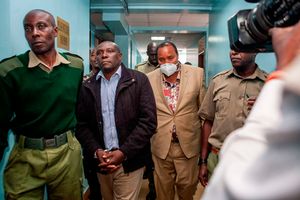
Then there is Mukurwe-ini MP John Kaguchia, who was arrested and arraigned for the remarks he made in his native Kikuyu language during a political rally in Kieni, Nyeri County.
According to allegations and court files presented by the National Cohesion and Integration Commission and the Directorate of Criminal Investigations, Kaguchia is alleged to have warned Mt Kenya residents against voting for President Ruto’s UDA in the 2027 General Election. He reportedly said those who defied this would be tracked to their homes and smoked out from their houses, including under the bed.
The alleged warning could have been aimed at consolidating the region’s vote but the strong reaction and subsequent court case were probably unexpected.