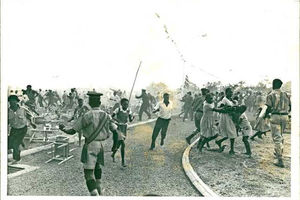
The event took place at a time of incredibly high political tension following the assassination of the popular nationalist and Cabinet Minister Tom Mboya just four months earlier. Prior to the meeting, it was reported that the President had been warned of an imminent explosion of anger. However, the Head of State defied these reports and walked straight into a hostile crowd in Kisumu, with his security detail on high alert.
Predictably, gunshots began to rent the air within an hour of the president’s arrival. When the gunfire stopped, the ground was littered with lifeless bodies, including women and children who had been shot several kilometres away as the police continued to fire indiscriminately along the Kisumu–Nairobi highway.
The question is: Why did President Kenyatta insist on travelling to Kisumu despite the warnings? Several speculations have been presented by pundits, but two of them are particularly plausible.
Firstly, the President wanted to demonstrate that he was in charge and could visit any part of the country without interference. Secondly, the Head of State intended to emphasise that he was above the law and that his decisions were final, regardless of public opinion.
Almost six decades later, parallels are being drawn. On Sunday, August 16, the ‘Linda Mwananchi’ brigade defied warnings and public opinion and made a disastrous entry into Homa Bay County for a series of political rallies. Human rights defenders have argued — rather convincingly — that the Orengo-led team had the constitutional right to travel to any part of the country, , to assemble and talk to their followers as established by law.
In any case, they argued that Kenya’s Bill of Rights is one of the most celebrated in the world. However, it is not clear why the group had to go to Homa Bay on that particular day and not at any other time, despite the imminent risks.
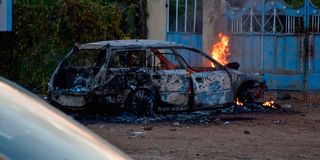
When the dust settled, many lives had reportedly been lost needlessly, and several people had been badly injured or maimed. This raises the question of whether human rights operate in isolation. Does the enjoyment of human rights take precedence over the protection of human life?
It remains to be seen whether the blood of the dead, the pain of the maimed and injured, and all the criminality arising from the debacle rests with the ‘guests’, the ‘hosts’, or both. Pundits have offered a variety of insights. Firstly, the political vacuum created by Raila’s absence left the Luo community bereft of a unifying figure who could call everyone to order. Raila seamlessly juggled the roles of ODM leader and Luo kingpin.
Several leaders, including James Orengo and Babu Owino, have stepped forward to try to fill his large shoes. So far, however, neither of them has managed to convince the community that they are the right person for the job, despite their fervent attempts. Observers have noted that the two politicians were at the forefront of leading their supporters to ‘colonise’ Homa Bay last Sunday, resulting in an unprecedented bloodbath.
For two decades, ODM has enjoyed a fanatical following in Homa Bay under the control of Raila Odinga.
ODM politicians know that to control the party in Nyanza, one must get hold of its Homa Bay branch.
Having failed to take over the party from Oburu Oginga due to the invisible hands supporting him, Orengo and Babu are now focusing their efforts on winning over the grassroots supporters from Gladys Wanga.
As the country gears towards the 2027 polls, the two gentlemen appear to be standing on sinking political grounds.
However, their ongoing efforts to undermine ODM are also destabilising the party, which could easily result in a zero-sum game. Furthermore, Orengo and Babu are highly uncomfortable with President Ruto as the head of the broad-based government of which ODM is currently a part. This makes things quite precarious for the two politicians should they go to the polls without reconciling with the Head of State.
Given the evident hostility in Mt Kenya West (Kiambu, Murang’a, Nyeri, Kirinyaga and Nyandarua), where Ruto received around 1.6 million votes in the 2022 elections, the Head of State cannot afford to gamble on votes in Nyanza as he prepares for a high-stakes re-election bid next year.
To this end, significant resources have been invested in Nyanza to increase the issuance of national identity cards and voter registration. The results so far are very impressive, especially in Homa Bay.
For around six decades, Homa Bay County has been left to develop economically in its own way. This has resulted in up to 70 per cent of its assets in fisheries, mining, maritime logistics, tourism, industrialisation, agriculture and the digital economy remaining unexploited. By August 2022, Homa Bay County, which covers an area of approximately 2,033 square kilometres, had only 184 kilometres of tarmac roads. In comparison, Kiambu, which covers an area of approximately 1,449 square kilometres, boasts a tarmac road network of over 2,000 kilometres. It is hard to believe that these two counties belong to the same country. President Ruto therefore advisedly chose Homa Bay County as the launchpad for the transformation of the Lake Victoria Economic Corridor.
Today, Homa Bay County is a shining example of what can be achieved through political goodwill. Consider the following: The ring road on Rusinga Island is already complete and in use. A similar project is ongoing on Mfangano Island. About 20 kilometres of the 74-kilometre Sori–Kiabuya–Sindo–Mbita road has been completed to tarmac standards, and contractors are on site.
This is the road that was mocked by leaders of Linda Mwananchi during their widely publicised rally at Sindo Market last Sunday. The Gor Mahia ring road, which will provide Ndhiwa constituency hinterland with its first tarmac road in 63 years, has been contracted.
Fish landing bays, modern markets, affordable housing units, student hostels, a 10,000-seater stadium and other national government projects are transforming the landscape of Homa Bay County.
Additionally, the president has appointed individuals from Homa Bay, including CS John Mbadi and PS Raymond Omollo, to high-profile roles in the government. Other senior government officials from the county include Sylvester Kasuku, George Wanga, Mark Matunga, Silas Jakakimba and Wycliffe Ochiaga.
The list is long. Homa Bay County, once an economic giant in hibernation, is beginning to stir, thanks to President Ruto. These achievements over the past four years are truly phenomenal and could provoke jealousy.
Many naysayers want the rest of the country to believe that the talk of development in Homa Bay is all ‘hot air’, with nothing tangible on the ground. It is no surprise, then, that the Linda Wananchi group chose to highlight the dusty section of the 74-kilometre road under construction, in an attempt to draw attention to the supposed neglect by the Ruto administration.
Truth be told, this road didn't just emerge from the woodwork during President Ruto's reign. It was always there since independence, and nothing was done about it. Lastly, there is the Governor Gladys Wanga factor. Prior to the fateful Linda Mwananchi rallies in Homa Bay, the Governor had endured sustained humiliation by leaders opposed to her. During a Linda Mwananchi meeting at Oyugis Town on May 18, 2026, Siaya Governor James Orengo used unprintable language against the person of Gladys Wanga. Orengo's remarks were widely condemned by women leaders as insensitive, disrespectful and sexist.
The Siaya Governor's allies have since defended his right of response, insisting that he was merely rebutting unpalatable comments made against him earlier by Governor Wanga. But there's an age-old African wisdom that the older person bears the bigger responsibility in a conflict. Orengo does not miss any opportunity to remind Kenyans that he is the senior-most elected politician in the country today. That seniority comes with responsibility. But the devil must be given his dues.
James Orengo has typically eschewed politics of violence throughout his political career, spanning four decades. Unfortunately, his newfound dalliance with some political hot-heads seems to be tainting the illustrious, issue-driven politics that Kenyans have come to admire over the years. Kenyans were shocked to hear some of Orengo's associates in Linda Mwananchi publicly announce that they were going to "colonise" Homa Bay. And true to their word, they arrived in Homa Bay in the company of suspicious individuals wielding firearms, machetes, and assorted crude weapons.
At the same time, some leaders around Governor Wanga were also caught on camera mobilising people in preparation for the major fight. As the relevant agencies wrap up their investigations into the unfortunate series of events that threatened to tear apart Homa Bay, leaders must call for restraint. In war, there are no winners or losers, only victims. The battle for the soul of Homa Bay can be won through persuasion, not violence.
Violence only breeds further violence, and nobody will be safe. The threat by some Linda Mwananchi leaders to return to Homa Bay, only a few days after their visit caused bloodshed there, speaks to an unaccomplished mission. This begs a further question: what exactly is the mission in Homa Bay, and who stands to benefit from it?
Professor Ongore is a Public Finance and Corporate Governance Scholar based at the Technical University of Kenya. [email protected]