When the heavy iron door slammed shut behind him in the early 1980s, Raila Odinga stepped not merely into a prison cell but a furnace – an unforgiving crucible that would scorch, shape and harden the contours of his destiny.
Detention without trial was not just a tool of the state; it was a deliberate architecture of pain. It was designed to erase the man, to silence the dissenter and to grind the soul into submission. In Odinga’s case, it did something else entirely: it forged a political figure who would come to embody defiance and endurance.
“As political prisoners, we were treated worse than convicted criminals,” he would later recall.
In the sterile, windowless rooms of Nyayo House, cruelty was engineered with precision. A bright bulb was installed in his cell – not to light it, but to burn into his eyes.
It succeeded. Years afterwards, his vision bore the testimony of state violence, a scar he carried quietly, like a mark from another world. It was the signature of a regime that preferred blind dissidents to seeing ones.
But Odinga’s torment did not end with the iron bars of Daniel arap Moi’s Kenya. Every regime that followed – Mwai Kibaki, Uhuru Kenyatta and William Ruto – would learn the same old trick: when Raila refused to bend, unleash the police. Over the decades, Kenya’s streets became theatres of this spectacle. He was teargassed in broad daylight, beaten with batons, shoved, insulted, mocked and left coughing in the smoke of a state’s contempt.
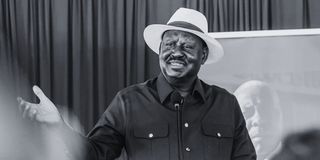
Former Prime Minister the late Raila Odinga.
Photo credit: File | Nation Media Group
Politicians ridiculed him, they jeered at his stolen elections and enemies prayed for his downfall. He became Kenya’s political punching bag – a man whose pain was almost ritualised. Yet every time the regime swung, Odinga returned.
Every humiliation and every act of repression did not weaken him; it thickened his political skin and deepened his symbolic power.
Detention, humiliation was not merely a chapter in Odinga’s life – it was the text from which his politics was written. In the late 20th century, in the grim machinery of Kenya’s one-party state, detention was an education without a classroom. For Odinga, it became a political apprenticeship in the shadows. He entered as a dissident and emerged as a symbol – living, breathing proof that the state could crush the body but not the will.
The cruelty of the regime was deliberate. It wanted not just to imprison but to erase. In the cold, airless dungeons of Kamiti Maximum Security Prison, inmates were held in solitary confinement, deprived of light, of sound, of human warmth. Some died, other left broken and ailing.
The long interrogations, the calculated humiliations, the engineered silences – they were meant to unravel men from the inside out. Yet Odinga endured. The bright bulb had dimmed his eyesight but it could not blind the vision that began to form in those cells.
His path to detention began in the volatile aftermath of the failed August 1, 1982 coup d'état. Though he never held a gun, Odinga’s alleged association with the plotters was enough to condemn him. Many died for less. He was “lucky,” some whispered. But luck is a thin shield against a state determined to make an example out of you. His six-year ordeal began in a world of darkness – a darkness not only physical, but political.
Time stopped in that cell – and he says as much in his autobiography. The outside world dissolved into a distant echo. Odinga would later recall how the silence became his only companion, how he began to hold long conversations with his own mind.
Deprived of newspapers, radio, TV, books or human voices, he built entire speeches in his head, constructed arguments, debated himself in the dark. What was meant to break him instead gave him a discipline of thought rare among politicians. Patience became his inheritance. Resilience became his weapon.
The cell stripped away all illusions. In that brutal architecture of repression, Odinga saw clearly what many outside only guessed: the state was not an impartial machine but a weapon of fear. The men who emerged from detention in that era were not dreamers; they were hard men forged by the knowledge of how low power could sink to preserve itself. Odinga was one of them.
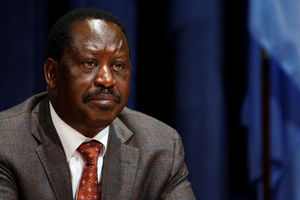
ODM party leader Raila Odinga speaks to the Sunday Nation at his Karen home, Nairobi on August 05, 2020.
Photo credit: Joan Pereruan | Nation Media Group
His patience, his ability to wait, to retreat and then to strike with precision – those instincts were born in Nyayo’s darkness.
When he was finally released in 1988, freedom was not freedom. Within months, Odinga was back behind bars.
His crime this time was simple: he dared to speak with those who were dreaming of democracy. The iron fist of the state was still tight around Kenya’s throat.
Yet something had changed outside: dissent was beginning to simmer. Students, the clergy, exiles and underground activists were daring to breathe louder. Odinga’s name now carried a weight that no propaganda could erase. The state had turned him into a prisoner; the people were turning him into a symbol.
The second detention was harsher. The Nyayo security state unleashed its cruelty again: beatings, sensory deprivation, endless interrogations. But Odinga had learned the anatomy of fear. You cannot terrify a man who has already stared into the abyss. What unsettled the regime most was not his opposition – it was his composure. In a world built on the breaking of men, Odinga refused to break.
During this period, he became a quiet architect of resistance. Even in detention, messages flowed in and out, slowly, dangerously. He learned to build networks in darkness, to keep the fire alive through whispers and coded lines. This ability – to think in ambiguity, to survive in the shadows – would define his political career for decades.
By the time the winds of change swept across Africa in 1990, Odinga was detained for the third time. But now, the context had shifted. Autocratic regimes were falling, donors were whispering reform and Kenyans were marching.
The streets were restless, the walls were trembling. Odinga’s detention was no longer just a tool of punishment; it became a political event. Alongside the likes of Kenneth Matiba and Charles Rubia, he became a rallying cry – a name that tasted of defiance on the lips of ordinary Kenyans.
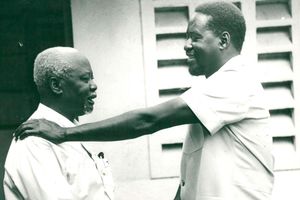
What the regime had intended as suppression became Odinga’s greatest political inheritance: moral capital. In a political culture where power was bought, stolen or inherited, Odinga’s legitimacy was forged in the crucible of pain. His name became shorthand for resistance. Yet even in his growing legend, he carried the shadow of his father – Jaramogi Oginga Odinga – the towering nationalist who had first defied the state. But his son’s scars were his own.
Detention did more than shape Odinga’s image; it sharpened his method. The man who walked out of prison was not an impulsive firebrand. He was a strategist who had learned that political change was a long game.
He could wait out opponents, absorb blows and choose his battles with surgical precision. Critics often mistook this patience for weakness. They did not understand the man who had learned, in silence, that sometimes the longest war is won not through shouting, but through endurance.
Years later, when he made alliances with former rivals – Moi, Kibaki and Uhuru Kenyatta – many were stunned. But to those who knew his history, it was the logic of survival learned in a cell. He had learned to fight on many fronts: in the streets, in the shadows and at the negotiation table.
Detention did more than polish his strategic instincts; it created “Agwambo,” the enigmatic figure who would come to symbolise the soul of resistance. In the Kenyan imagination, Odinga became the man who had looked tyranny in the eye and lived. His speeches carried the weight of darkness survived, of a man who knew how far the state could go. When he spoke of freedom, sacrifice and justice, it was not from theory. It was from memory.
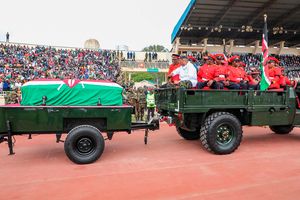
For decades, the state sent its police to beat him, the politicians mocked him and power slipped through his fingers. And yet, Odinga remained. Now Raila Odinga is gone. Death has claimed the man, but it cannot claim the story.
His legacy endures – in the chants on the streets, in the whispered prayers of those who resisted with him, in the memory of a nation that saw him face tear gas, humiliation and betrayal, yet rise again and again. Odinga’s body may rest, but his struggle breathes still, in every Kenyan who believes that defiance in the face of injustice is a virtue, not a crime.
In the long, complicated story of this republic, few images will endure as fiercely as this: Odinga standing in the smoke of police canisters, shoulders squared, eyes burning, refusing to bow.