The familiar spectre of political intolerance in the run-up to elections is slowly re-emerging as politicians deploy goons to suppress dissent and to enforce control.
This climate of political violence has its roots in the divide-and-rule tactics employed by the colonial government to create divisions in the nationalist movement. This left a deep, permanent scar on the body of Kenyan politics, according to documents from archives reviewed by the Nation.
Towards the end of the 1950s, as the British colonial government began to lift emergency restrictions in order to allow Africans to participate in politics, the unity that had existed among nationalists in their fight against colonialism slowly disappeared.
They began to fight among themselves over who would taste the stew first. The operation of the colonial state had made them realise how tribal divisions and ideological differences could be exploited to achieve political ambitions.
In 1960, this political rivalry degenerated into two rival political parties — Kanu and Kadu — whose leaders became sworn political enemies. To establish dominance in various regions and to curtail the influence of rivals, both parties organised youth wings that disrupted political meetings and assaulted opponents.
The political intolerance became noticeable in the year 1961, when Kenyan Africans first exercised their right to vote in universal suffrage. Both Kanu and Kadu guarded their regions jealously, unleashing violence on opponents who dared to encroach on their support bases. Early that year, Masinde Muliro, the Kadu’s deputy president and the representative of Nyanza North in the Legislative Council (LegCo), was assaulted and frogmarched out of Ramogi Hotel in Kisumu by goons. The area was considered a Kanu territory, and the home ground of Jaramogi Oginga Odinga, Kanu’s Vice President and the representative of Nyanza Central.
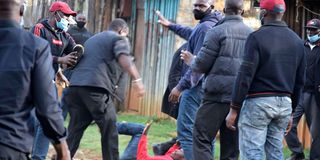
Goons on Moi Avenue in Nairobi on June 17, 2025 during protests following the death of Kenyan blogger Albert Ojwang.
Photo credit: Bonface Bogita | Nation Media Group
The incident unsettled a section of Western Kenya leaders, who issued a statement through Zacharia Simiyu, Chairman of Luhya unity, accusing Jaramogi of being behind it. “You yourself (Jaramogi) have enjoyed the hospitality of the Abaluhya people in Muliro’s constituency, as a member of LegCo who is in a rival party to that of Muliro. The Abaluhya people will not tolerate the intimidation of your people of their leader,” the statement read. “The Abaluhya people believe that these arrangements were arranged in the hotel where Mr Muliro was threatened, which is believed to be your own property….”
Struggle towards independence
After Muliro, Kadu's Organising Secretary, Peter Okondo, was also assaulted in Kisumu for opposing Kanu. In retaliation, on September 22, 1961, a group of goons allied to Kadu accosted Jaramogi outside Agricultural House on Coronation Avenue, now Harambee Avenue, in Nairobi, where a scuffle ensued. One of the men pulled a club out of his jacket and hit Jaramogi on the head. Jaramogi was taken to King George Hospital (now Kenyatta National Hospital) suffering from shock and serious injury to the head. From his hospital bed, Jaramogi appealed for people to remain calm, saying, “These things happen during the struggle towards independence. It is only a small thing, and that is how I regard it.”
That evening, Mr ACC Swan, Minister for Defence, issued a press statement saying, “The motive for the attack on Mr Odinga has not yet been established; it may have been personal, tribal or political.” The minister assured the public that every effort was being made to trace the assailants and appealed to them to disregard unfounded rumours about the motive of the attack. Meanwhile, in an effort to track down the suspects, the police were driving around Nairobi with two people who had witnessed the assault to help identify the suspects. Police investigations revealed that the attack had been planned at a meeting in Nairobi attended by Okondo and Muliro.
Although Jaramogi was released from the hospital after being treated, news of his assault triggered retaliatory violence in Nairobi. Four hours after the incident, a crowd of Kanu supporters gathered in Landhies searching for Kadu supporters. Another group of goons headed to Ofafa Maringo, where they stoned the home of Kadu youth wing leader Martin Shikuku and smashed all the windows. In Kisumu, 15 Kanu youth wingers broke into a local Kadu office and assaulted the branch secretary.
The return of Jomo Kenyatta on the political scene, towards the end of 1961, became another source of violent clashes within Kanu itself. As Kenyatta sought to reclaim his position as the definite African leader by campaigning in Nairobi, Mboya, who had all along dominated the political scene, especially in Nairobi, saw this as an assault on his political position and l base. This rivalry came to a head in August 1962, when Kenyatta and Jaramogi decided to hold a political rally in Nairobi, while Mboya was away in Europe.
Nairobi Kanu youth wingers led by a man identified as M. Nyanduso saw this as an attempt to undermine Mboya and threatened to cause violence. As a result, Mr AD Muigai, also known as “Lumumba”, was entrusted with mobilising goons from Central and parts of the Rift Valley to counter Nairobi youth wingers allied to Mboya. Kenyatta arrived at the rally earlier than expected and was met with protests from the Nairobi Kanu branch youth wingers, who tore up their Kanu cards before being kicked out by Lumumba’s group. In his speech, Kenyatta claimed to have heard that a group of “insects” had wished to stop the rally.
Kenyatta threatened to step down
“I have trampled down these insects, and they have now disappeared. It is time my colleagues stopped bribing you like prostitutes,” he said. Jaramogi supported Kenyatta by telling those at the rally to vote with a show of hands that Kenyatta was their only leader in Kenya.
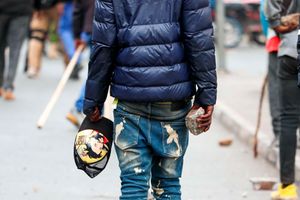
A goon carrying a stone along Moi Avenue in Nairobi on June 17, 2025.
Photo credit: Bonface Bogita| Nation Media Group
As the 1963 General Election to usher in Kenya's self-government approached, there were growing concerns about the future of an independent Kenya as violence dominated political campaigns. Within Kanu, officials were concerned that Kenyatta was not going out to campaign in Kadu areas despite being the party leader. They believed that Kanu was likely to lose unless he took the battle to Kadu's doorstep. With pressure mounting on him, Kenyatta threatened to step down, arguing that he was too old to be travelling around campaigning. After he was criticised by Kanu supporters for being too timid, he eventually made the bold decision to campaign in the Kadu territories.
Kericho was one of the Kadu zones that presented the biggest headache for Kanu. It was a vote-rich area, but with very radical Kadu elements that were threatening violence. For his trip to Kericho, Kenyatta, who was then serving as the Minister of State for Economic Development, was escorted from Nairobi by two full companies of General Service Unit officers. Three trucks full of armed policemen also joined the escort at Nakuru. Serving as Kenyatta’s personal bodyguard during the trip was General China, a former Mau Mau leader. Jaramogi joined the party at Kericho from Kisumu, where he had gone to mediate between Kanu and Kadu supporters following a clash.
A group of the infamous 'men in black' that was sent away by irate members of the public after allegedly roughing someone up during a CORD rally at Uhuru Park, Nairobi on May 31, 2014. Some of them were captured on camera vandalising election materials during an ODM election at Kasarani.
Photo credit: File | Nation Media Group
Before the Kericho rally began, police seized belts from every man in the crowd. This was based on the theory that " a man who must hold his trousers up can't really make trouble." The belts were so mixed up that at the end of the rally, no one could find their own. Fortunately, thousands of Kipsigis tribesmen turned out for the rally and remained peaceful except for the rain, which thinned the crowd, much to the annoyance of Jaramogi, who shouted: "Are you made of sugar that you should fear rain?"
As the elections approached, there were many predictions that violence would be widespread. A rally in Ukambani organised by Kanu and attended by Mboya and Kenyatta turned chaotic as Paul Ngei, who had left Kanu and formed an alliance with Kadu, flexed his political muscles. Kenyatta and Mboya had to flee and take cover. On March 12. In 1963, the Daily Nation published a long front-page editorial with the headline, "Stop This Violence For Kenya's Sake”. This was after a weekend of clashes in which a Kanu youth was knifed to death in Mombasa, and in Kitale, teargas was lobbed to disperse a crowd that attempted to stone Kenyatta's car.
In the weeks leading to the May 1963 internal self-government election, precautions were taken to deploy troops to likely trouble spots.
With power now in the hands of the African elites, state-sponsored goonism became the new norm.
Such groups included Jeshi la Mzee and Baghdad Boys, and many amorphous groups that continue to operate anonymously under the current political dispensation.