The government has rejected calls by opposition and civil society groups for the International Criminal Court (ICC) to scrutinise escalating political violence ahead of the 2027 General Election, saying that its internal security agencies and domestic legal institutions are capable of dealing with the threat.
The government’s position comes as the United States intensifies its campaign against the ICC, while the European Union and other international allies defend the court as an independent pillar of global justice.
The debate has revived memories of Kenya’s post-election violence cases nearly two decades ago, when the ICC opened an investigation into alleged crimes against humanity following the disputed 2007 presidential election.
Mr Musalia Mudavadi, the Prime Cabinet Secretary and Cabinet Secretary for Foreign and Diaspora Affairs, said Kenya remained committed to the rule of law and had no need to internationalise domestic criminal investigations.
“We have an obligation to strengthen and defend institutions like the ICC,” Mr Mudavadi said in an interview.
“We should not lose sight of the fact that at no time has Kenya refused to respect the rule of law. Whether we have been called upon in the international arena or in the local media, we have always respected the rule of law.
“This government has been taken to local courts many times. We have not defied court decisions; we have always respected them.”
Prime Cabinet Secretary Musalia Mudavadi.
Photo credit: Reuters
He dismissed calls for international intervention, saying Kenyan courts and security agencies were capable of dealing with political violence and lawlessness.
“And whatever anyone might want to say about us, even our current president, Dr Ruto, was courageous enough to face the ICC. It means that, at the end of the day, he respects the rule of law,” Mr Mudavadi said, referring to earlier accusations President William Ruto faced over the 2007/8 post-election violence.
His case was later dropped for lack of sufficient evidence. Six Kenyans had been indicted at the ICC at the time, including former President Uhuru Kenyatta. All the cases eventually collapsed.
The government’s position contrasts sharply with that of opposition leaders and civil society organisations, which want international scrutiny of what they describe as an emerging pattern of organised political violence.
On Wednesday, the United Opposition — a loose alliance of critics of President William Ruto — called on the ICC Prosecutor to initiate action against recent incidents of political violence across the country.
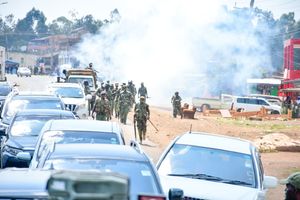
People’s Liberation Party leader Martha Karua, who read the statement on behalf of the opposition leaders, cited attacks involving former Deputy President Rigathi Gachagua in Rongai, Nakuru County; an incident involving former Interior Cabinet Secretary Fred Matiang’i at Mulot in Bomet County; violence surrounding a Linda Mwananchi rally in Homa Bay; and an earlier confrontation in Keumbu, Kisii County.
“This is a call to action on electoral violence in Kenya,” Ms Karua said.
“The escalating incidents of political violence witnessed in different parts of Kenya can no longer be dismissed as isolated confrontations between rival political supporters.”
The opposition has called for independent investigations, particularly into allegations that some of the attacks occurred in the presence of, or within the operational reach of, police officers.
The International Criminal Court building in The Hague.
Photo credit: Courtesy | AFP
“Should evidence emerge of widespread or systematic attacks against civilians being organised, financed, directed or tolerated by those in authority, we ask the prosecutor to investigate President Ruto, a former ICC indictee, and review the status of previous charges against him,” Ms Karua said.
Separately, human rights organisation Vocal Africa, in a letter dated August 19, 2026, addressed to the ICC Prosecutor, asked the court to scrutinise the escalating violence.
The organisation described its communication as an early-warning appeal under Article 15 of the Rome Statute and urged the ICC to take formal notice of developments in Kenya.
Vocal Africa warned that a combination of political intolerance, organised violence, ethnic mobilisation and weak accountability could create conditions for serious human rights violations.
The organisation said the use of organised groups during political activities had become increasingly common since the Gen Z protests of 2024 and 2025.
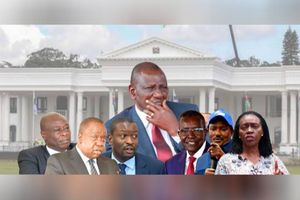
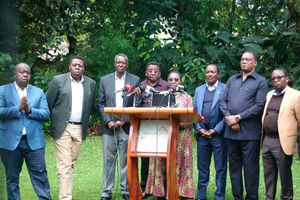
People’s Liberation Party leader Martha Karua (centre) leading United Alternative Government and Linda Mwananchi members in addressing journalists at Hermosa Hotel in Nairobi on August 19, 2026.
Photo credit: Evans Habil | Nation
It cited incidents in Homa Bay, Mombasa, Nairobi, Kisumu, Kisii, Nyeri, Nyandarua, Nakuru and Kajiado counties.
It specifically pointed to violence reported in Homa Bay on August 16 during political activities linked to the Linda Mwananchi movement. At least two people were killed and scores injured, while journalists covering the events were also attacked.
The organisation also cited incidents in Mombasa and Nairobi, including disruptions of public meetings and attacks on journalists and human rights defenders.
Another civil society organisation, ICJ-Kenya, has also joined calls for regional and international observers to monitor rising political hostility and the mobilisation of gangs ahead of the 2027 elections.
But whether the reported incidents amount to crimes under the jurisdiction of the ICC is a considerably higher legal question.
The ICC does not prosecute ordinary political violence simply because it is serious, disturbing or politically motivated.
Under Article 7 of the Rome Statute, crimes against humanity include acts such as murder, deportation or forcible transfer, imprisonment, torture, rape, persecution and other specified inhumane acts when committed as part of a widespread or systematic attack directed against a civilian population, with knowledge of the attack.
A violent confrontation at a political rally, even if serious, would not automatically constitute a crime against humanity. The prosecutor would need evidence demonstrating the broader context in which the violence occurred, including its scale or systematic nature, the civilian population targeted and, depending on the circumstances, the existence of an organisational or policy element.
The Rome Statute gives the Prosecutor power to analyse information received from individuals, groups, States and organisations about alleged crimes within the court’s jurisdiction.
Article 15 allows the Prosecutor to act on information received and, where there is a reasonable basis to proceed, seek judicial authorisation to open an investigation.
The opposition’s call for scrutiny is therefore legally possible, but it does not mean that the ICC has determined that crimes against humanity are being committed in Kenya. The opposition’s argument rests largely on the claim that the recent incidents should be examined collectively rather than individually.
“Taken together, they reveal a disturbing pattern that raises fundamental questions about the neutrality of our security institutions, the protection of constitutional freedoms, and ultimately, whether Kenya is being adequately prepared for a peaceful, free and credible general election in 2027,” the leaders said.
They have questioned how groups of armed civilians can mobilise, move openly and attack political leaders, journalists, citizens and even police officers.
The debate in Kenya comes at a time when the United States is intensifying efforts to weaken the ICC. The US never joined the ICC, and is now seeking to curtail its influence.
The Donald Trump administration has launched a coordinated, whole-of-government campaign against the ICC, led by Secretary of State Marco Rubio.
Since Mr Trump’s return to the White House, the ICC has been a particular focus of his administration. It has already placed the court’s Chief Prosecutor and eight judges under US sanctions, including financial restrictions and travel bans.
The latest actions by the US are rooted in long-standing concerns dating back to the formation of the ICC.
Although the US signed the Rome Statute establishing the ICC, former President Bill Clinton never submitted it to the Senate for ratification, partly because of concerns that membership could expose American service personnel and government officials to politically motivated prosecutions.
According to Stewart Patrick, a senior fellow and director of the Global Order and Institutions Programme at the Carnegie Endowment for International Peace, the US position is not unusual.
“The Rome Statute mandates that states party to the treaty comply fully, including arresting and surrendering suspects and providing evidence. US political leaders have worried about service members being prosecuted for actions committed in the territories of other ICC member states,” Mr Patrick said.