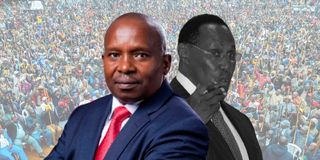
Deputy President Kithure Kindiki is learning a lesson: the second-highest office is secure only until electoral arithmetic changes. A deputy may sit one heartbeat from the presidency and still discover that, in the marketplace of ethnic alliances, his chair has already been offered to somebody else.
That is the meaning of the demand by the Orange Democratic Movement (ODM) that President William Ruto surrenders the DP slot. Kisii Governor Simba Arati and National Assembly Minority Leader Junet Mohamed have presented the claim as non-negotiable. They say the United Democratic Alliance (UDA) will produce the presidential candidate and ODM the running mate.
For Kindiki, this is notice that the office he occupies is on the negotiating table. Kindiki’s predicament recalls George Saitoti, the vice-president whom Daniel Moi kept in office while encouraging ethnic barons to imagine the seat could become theirs.
Saitoti was initially valued as the useful technocrat: brilliant, sober and politically unthreatening. Following the 1988 election, he ascended to the vice-presidency after Josephat Karanja’s fall.
Dr Josephat Njuguna Karanja.
Photo credit: File | Nation Media Group
Kindiki reached the deputy presidency after Rigathi Gachagua’ s impeachment. Saitoti’s politically ambiguous identity, rooted in Kajiado but marked by his Kikuyu parentage, made him an elegant bridge between Moi’s Rift Valley establishment, Maasailand and Central Kenya. He belonged to every constituency to serve the coalition, but not firmly enough to command an ethnic army.
Kindiki is intellectually formidable, disciplined and careful not to build an independent centre of power. He became DP because he appeared to offer what Gachagua no longer did: loyalty without noise, administration without rebellion and a route into Mt Kenya without the burden of an aggressive regional kingpin.
In the current dynamics, a president chooses a deputy twice: first as a governing partner, and later as an electoral instrument. The qualities that make a good subordinate do not necessarily make the most valuable running mate.
Kenya's first Vice President Jaramogi Oginga Odinga.
Oginga Odinga, representing the large Luo constituency, was Jomo Kenyatta’s first deputy. When their alliance collapsed in 1966, Kenyatta experimented with Joseph Murumbi, who lasted just months.
When Kenyatta turned to the remnants of Kadu, the obvious senior figure was Ronald Ngala, its former president and coastal supremo.
Yet in January 1967, Kenyatta chose Moi, Kadu’s former chairman. Ngala possessed seniority, but Moi offered the more useful demographic and territorial bargain. Through him, Kenyatta could draw the larger Kalenjin bloc and the Rift Valley into the centre, quieten the old Kadu demands for majimbo and prevent the former opposition from reassembling outside Kanu.
Moi’s elevation was, therefore, less a reward for rank than an instrument of absorption. Kenyatta used the vice-presidency to neutralise an opposition constituency while balancing the ethnic ledger.
Moi understood that distinction. After the 1997 election, he left the vice-presidency vacant for a year. It kept alive the hopes of Simeon Nyachae, Musalia Mudavadi and Kanu figures, while serving as bait for opposition chiefs whom he needed to shore up his parliamentary position.
While Moi held talks with Kijana Wamalwa, it was Raila Odinga who proved flexible, taking his National Development Party (NDP) into “cooperation” with Kanu in 1998. He did not need to give the chair away; its imagined availability was purchasing loyalty. The climax came after the NDP-Kanu merger.
At Kasarani in March 2002, Kanu created four party vice-chairmanships to accommodate Uhuru Kenyatta, Mudavadi, Kalonzo Musyoka and Katana Ngala. Saitoti found his name missing. When he protested, Moi ordered him to keep quiet. The VP discovered in public that longevity was not inheritance.
Later that year, Moi sacked him and left the office vacant again. In November, Mudavadi was named VP for the final weeks of the regime and placed beside Uhuru Kenyatta on Kanu’s presidential ticket. The office had become a balancing weight.
Ruto operates under a different Constitution. He cannot dismiss Kindiki by radio announcement or roadside decree. Unless Kindiki resigns, dies or is removed through a constitutional process, he is likely to remain DP until the current term ends.
The more consequential question is if he will appear beside Ruto in 2027. On that, the Constitution offers no protection.
Kindiki’s fate will be decided not by the dignity of his office or the depth of his loyalty, but by the votes Ruto believes he can deliver.
It’s brutal arithmetic. While Ruto won in 2022 by 233,000 votes, his victory rested heavily on Mt Kenya, where Gachagua helped present him as the region’s adopted candidate. The impeachment shattered that compact.
Kindiki’s defenders say the Mountain cannot abandon a government it built. However, voters do not remain in political houses because leaders furnished them. Kindiki must prove he is not merely Ruto’s representative to Mt Kenya, but the region’s representative in Ruto’s government.
Like Saitoti, Kindiki straddles identities but does not command the largest component of the bloc he is meant to deliver. He can speak for Tharaka-Nithi, Meru and sections of Embu, but can he neutralise Gachagua in the Kikuyu counties? If Ruto concludes that the answer is no, loyalty will be a sentimental asset in a transaction governed by numbers.
ODM knows this. It is not asking for the DP slot because the party doubts Kindiki’s competence. It is saying that if its parliamentary network, governors and traditional voting zones are to be transferred into Ruto’s re-election machine, the transaction must be visible at the top of the ticket. Wycliffe Oparanya, Gladys Wanga, Hassan Joho and others can then be floated.
President William Ruto (right) and Cooperatives Cabinet Secretary Wycliffe Oparanya during his homecoming ceremony in Butere, Kakamega County.
Photo credit: PCS
Yet ODM’s demand is also opening price, not accomplished fact. Fifty per cent of government and the running mate position would convert a partnership into a takeover of half the state. Ruto will ask if ODM can deliver its entire historic base.
He must also calculate what dropping Kindiki would cost. After removing Gachagua, discarding a second Mt Kenya DP would confirm the opposition’s claim that the region is useful only during elections. It could unite factions that are now split between Gachagua, Uhuru Kenyatta, undecided leaders and those still loyal to government. An ODM running mate might add votes in one region while welding together resistance in another.
That is why Ruto will probably do what Moi did: reassure the incumbent while allowing the vacancy to exist in everybody else’s imagination. He will praise Kindiki while his allies will declare that the seat is not vacant. ODM will be permitted to campaign for it, potential candidates will be encouraged to organise, and every faction will be asked to demonstrate its numerical value.
Saitoti received praise for years but was still humiliated. Loyalty preserves access, but only political utility preserves a place on the ticket. Kindiki must produce evidence that without him, Ruto’s route through Mt Kenya East narrows dangerously.
His weakness is that he cannot protest too loudly. This is because the moment he builds an independent ethnic movement, he will begin to resemble Gachagua. If he remains dependent on State House, however, he becomes Saitoti: a distinguished office-holder without a bargaining army. He must appear powerful enough to be retained, but not powerful enough to be feared.
Will he survive? His chances depend on whether ODM’s promised votes exceed the Mt Kenya votes his removal would repel, and if he can demonstrate ownership of a meaningful regional constituency.
The deeper lesson is that the deputy presidency remains trapped between constitutionalism and ethnic arithmetic. The Constitution protects the occupant, but coalition politics commodifies the candidature.
Saitoti once believed that years of competent and loyal service had placed him next in line. Moi taught him that in Kenyan politics there is no succession queue. Kindiki is now standing before the same ledger. Whether his name remains on it will depend less on how faithfully he has served Ruto than on how many ballots State House believes that name can still bring. It is that simple.