More than two decades have passed since the chilling macabre killing of former University of Nairobi (UoN) don and devolution architect Dr Crispin Odhiambo Mbai at his house in Adam’s Arcade, Nairobi by suspected hitmen.
The former head of political science at UoN was at the time in 2003 the chairperson of the critical technical committee on devolution at the height of the constitutional review push at the Bomas of Kenya.
The clamour for a new constitutional dispensation that would decentralise power and resources had divided the Narc government in the middle with pro and opposing factions emerging as political daggers were drawn.
Thrust deep into the middle of the political crossfire was Dr Mbai, an academic passionate about devolution. He would pay the ultimate price just five months into tense deliberations that began in April 2003.
Despite the Sunday afternoon of September 14, 2003 murder being described as an outright political assassination, the government has not been able to bring to book the killers of a key figure in Kenya's journey to a new constitution.
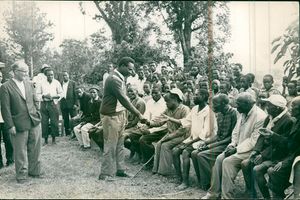
The late President Mwai Kibaki during the promulgation of the Constitution on August 27, 2010.
Photo credit: File | Nation Media Group
The country would, seven years later, have a closure on the process by heralding a new constitution in 2010, but for the family, justice has been elusive.
While several suspects were initially charged with the murder, they were eventually acquitted in 2005 for lack of evidence, even as the death remains one of Kenya’s most high-profile unsolved murders.
Former Kamukunji MP Norman Nyagah became a person of interest in the murder, with several leaders alleging his involvement. Interestingly, most of the leaders who implicated Mr Nyagah in the murder are long dead.
The late lecturer had been shot four times at close range in the thigh, abdomen, arms, and the head, with a bullet being lodged in his brain.
The late Dr Mbai's family still lives in fear following the bloody assassination. Accessing the home of a former don is not an easy task, as one has to go through several barriers.
Quietly nestled deep in Masakla village in Homa Bay Town constituency, Homa Bay County, the home is heavily fortified.
A metallic barrier straddles the breadth of the main entrance. Afterwards, an imposing modern gate stands majestically about ten meters behind the barrier. Once you go through the threshold, another stone gate awaits meters away before you eventually gain access to the home, but this is after detailed screening by a watchman guarding the gate.
“When the government wants to get someone, they will get that person but you can see the person who we were told shot my husband was eventually freed,” says Mr Mbai’s widow, Margaret Odhiambo Mbai, as we settle for an interview at her home.
“I would still want to see the case re-opened and to know the truth because that will set us free as a family. We hope one day someone will come up and revisit this case so that we can finally get justice.”
Recalling the events after the assassination, Ms Mbai points out the handling of her husband from their Nairobi home to the hospital and actions that followed as carefully planned to defeat justice.
The rushing of her husband to the hospital without being informed, being told he had collapsed, missing evidence and the interdiction of officers involved in the investigations, to her, pointed to a grand cover-up.
“All the six police officers who were investigating the case were interdicted and one eventually fired with new people coming in to take up the case. From that point, I knew the case was not going anywhere. We knew there were people up there who were involved,” avers Ms Mbai.
Recounting that fateful Sunday afternoon, Ms Mbai said the day started with going to church – Guadalupe Catholic – as usual with the children, but her husband remained behind because he was not feeling well.
From church, she would cook for the family before leaving for Kayole to inspect a project. But nothing prepared her for the events that unfolded afterwards.
“When I came back, I met (Norman) Nyagah waiting in his car outside the gate. He told me my husband had collapsed. He drove us, together with my sister, to Nairobi Hospital where he had been rushed,” she recalls.
But what she thought would be a normal hospital visit soon turned on its head with a series of perplexing turns of events, pointing to a well-planned cover-up by the perpetrators.
“On reaching the hospital, I learnt my husband had been shot and had not collapsed as I had earlier been told by Nyagah.”
The late lecturer had been shot multiple times while in the living room with his daughter, Catherine Mbai, upstairs.
Former Kamukunji MP Norman Nyagah.
Photo credit: File | Nation Media Group
As the operation was ongoing, Ms Mbai claims that the former lawmaker had allegedly told her younger brother and the watchman, Collins Ketore Kilel, who would become a suspect in the murder, to clean the blood in the house.
Attempts to lay her hands on the clothes her husband was wearing on the fateful day were thwarted as she was told they were soaked in blood and had been thrown away. But when she thought she had seen it all, the cover-up scheme was just beginning.
“We later on came to learn that even the doctor who received my husband at Nairobi Hospital was well-known to these people. The doctor admitted during the hearing they were family friends with Nyagah.”
The court process, she says, confirmed her worst fears – the government of the day was not keen on justice being served with evidence mysteriously disappearing in court, which had followed bungling of the investigations and interference.
Mr Kilel, one of the three suspects in the murder, others being Ramadhan Karume Otieno and Moses Gitogo Mbuthi, soon turned against the family, and even Mr Nyagah changed his earlier assertion that the deceased had collapsed after realising he had implicated himself.
The trial judge, Ms Kalpana Rawal, who would later be appointed deputy chief justice before her retirement, said the prosecution failed to place the three suspects at the scene of the crime, leading to their release, even after rejecting video evidence in the case.
The prosecution had deliberately put up a weak case, leading to the trial closing on April 28, 2005, with a “not guilty” verdict.
“I knew the government was hiding things because every time there was new evidence, the director of public prosecution would come to court himself. The killers were known and they were hiding in plain sight,” she recounts.
Intimidation and harassment
Even after their acquittal, Mr Otieno and Mbithi called for fresh investigations, alleging a conspiracy to “cover something by dragging us to court”. They added that, being a high-profile case, the murder should have been investigated properly.
Former Inspector of Police John Kiptoros Chemweno, who was involved in the investigations as a videographer before being arrested, interdicted and sacked by the State; corroborates some of Ms Mbai’s assertions.
He recalls how the investigations – in which he was part of a team of six officers tasked with the probe – were problematic because the individuals mentioned in the case were trailed on several occasions.
The former police officer remembers how they were barred from accessing Parliament to inspect Nyagah’s office after two of the suspects revealed to them they had met in that office, as well as Ngong Hills Hotel and Kawangware, to allegedly plan the murder.
“There was a lot of intimidation and harassment before the six of us were suddenly arrested and interdicted but I was the only one arraigned on flimsy charges of stealing a government tape as well as assaulting suspects during interrogation yet my work was only recording the interrogations,” says Mr Chemweno.
Former National Security minister Chris Murungaru was, at the time, livid that the interrogation tape had landed in the hands of the media.
But why was the government worried despite Mr Murungaru himself saying the government has “absolutely” no reason to cover up or interfere with the investigations, but was determined to have the perpetrators of the murder brought to book?
“I was targeted because I had a lot of information. I was even accused of leaking information to Kalenjin MPs. I was later sacked but even then, I was still being trailed by the police.”
Mr Chemweno was charged alongside journalist David Makali with stealing a police videotape and handling stolen property. The tape contained leaked confessions from suspects in the assassination of Dr Mbai.
Police Commissioner Edwin Nyaseda, who was at the time tracking the investigations, was suddenly sacked by President Mwai Kibaki in April 2004 – only 14 months into office – and immediately replaced with military brigadier Mohamed Hussein.
Then Sunday Standard Managing Editor David Makali (left) and policeman John Chemweno leave Nairobi Law Courts after they were cleared of stealing a police video tape.
Photo credit: File | Nation Media Group
Mr Makali believes Dr Mbai’s death was an assassination aimed at scuttling the Bomas talks by political leaders who did not want a change in the political system, as devolution was at the centre of the constitutional review talks.
“It was deliberate, premeditated, planned and executed. There was no accident,” Mr Makali avers.
He recalls names were dropped during the interrogation, with one of them being that of Mr Nyagah, and that is when the interference began, stalling the investigations in the process, even though there was enough evidence for the police to follow.
“It looked like somebody was trying to move away from the line that someone had masterminded the assassination to make it look like an ordinary crime but the problem was that the killers did not take anything from the house.”
Then, the Standard managing editor, Mr Makali, obtained the confession tape and published a story titled, “Mbai killers confess”.
“I was arrested and locked up and for two days, they looked for what to charge me with. I was eventually charged with stealing a government tape yet the tape was mine. You cannot steal your property,” says Mr Makali. “Up to today, I still believe there was a cover-up in the killing of Crispin Mbai.”
Statements by several leaders in the country pointed to the differences from the Bomas talks as the catalyst for the murder-most-foul.
Then chairperson of the Constitution of Kenya Review Commission Yash Pal Ghai linked the murder to forces he claimed wanted to derail the constitutional review process.
Ms Mbai recalls how her late husband would come home unhappy because they would agree on things, but then the following day, they would be back where they started.
The devolution committee’s mandate covered the contentious matter of how authority would be devolved from an all-powerful presidency to elected regional and local institutions under a new constitutional order.
The late former prime minister, Raila Odinga, at the time of the murder, intimated that prior to the murder of delegate 412, Dr Mbai had complained about threats from unnamed people in relation to his work at the Bomas conference.
“As chair, he navigated very dangerous corners. Devolution had then, and even today, very powerful enemies. He was able to create proper benchmarks to be met and because of that, he became a marked person,” said the late ODM party leader during the 2025 Devolution conference in Homa Bay County.
A delegate, Mr Kiriro wa Ngugi, shocked the plenary session when he claimed that he too had been threatened after accepting Dr Mbai’s invitation to participate in the devolution committee.
He said a Narc MP later warned him: “Mr Kiriro you are my friend but you are in trouble and you don’t know how much trouble you are in with this devolution thing.”
The talks had become heated to the point that the faction supporting the government of the day allegedly declared it would be “hard tackling and dirty play” going forward.
“Now I know what hard tackling is all about. We were told the other day that from now on, it is hard tackling,” said former Kisumu Town East MP Gor Sungu, following the murder.
“My suspicion is that it looks like a planned assassination. I don’t know what is in devolution that could lead to anybody’s concern. But those who have been threatening throughout the last week, I would call upon the police and other investigative agencies to do thorough investigations,” said Mathioya MP Joseph Kamotho, who died in 2014.
The late former Kasipul-Kabondo MP Peter Otieno Owidi would accuse Mr Nyagah of allegedly being one of the people behind the murder.
But Mr Nyagah has, in several interviews since the murder, denied the allegations, saying that if indeed he was responsible for the murder, he would not have gone through all the pains to try to save Dr Mbai’s life.
Former Internal Security Minister Dr Chris Murungaru.
Photo credit: File | Nation Media Group
“The biggest crime I did was to enter Crispin Mbai’s house after the shooting after a distress call by his daughter and taking him to the hospital. That is my linkage,” said Mr Nyagah in an interview with KTN some 12 years ago as he dropped Bible verses.
He claimed certain people were trying to incriminate him after the suspects alleged he paid them Sh50,000 and used his gun to commit the murder.
Mr Nyagah would claim that a gang of policemen sat together, organised witnesses and coached them on what to say. To him, the investigators were groping in the dark and were trying to cling to anything to implicate him.
“To me it is whitewash. They were looking for areas to cling on to try to frame me. Two of the people coached were people who worked for me before. After thrashing in Parklands by the police they finally came back to me and said what they had been forced to do.”
But asked why he would be framed with the murder of his neighbour, Mr Nyagah said he was a victim of circumstances.
The former lawmaker said he had never seen the deceased, and it was Kisumu East MP Shakeel Shabir who informed him that the person he had brought to the hospital was Dr Mbai.
“I can tell you I have never been to Mbai’s house. Never seen him at close quarters. The closest I have ever got to see him was that day he was shot,” he said.
The Mbai family and Mr Nyagah had been close neighbours for five years, with the former living in house number 6 and the latter in house number 5.
“I was very close to the president. Remember the politics of the day at the time. I say again, I became a victim of circumstances not touching me but trying to go to the leadership,” said Mr Nyagah.
“I believe if there was no interference at that point in time, from the advice that I was given by the lawyer, maybe the culprits would have been found if it was not made political.”
A 2013 report by the Truth, Justice and Reconciliation Commission (TJRC) concluded that Dr Mbai was killed because of his political views about devolution.
TJRC ordered the DPP to investigate and report on the circumstances, motives and those responsible for the assassination and subsequent cover-up within 18 months and the report be made public.
The report also recommended that Mr Nyagah be investigated because “there is sufficient evidence to link” him to the former lecturer’s murder.
But the former legislator has continued to maintain his innocence, saying if the government is interested in finding the people who killed Dr Mbai, then they can re-arrest the suspects and conduct proper investigations.
“I was not involved in the death of Mbai and therefore I know nothing. My prayer is, I hope the guilty ones do not go Scot-free.”
For Dr Mbai and Mr Chemweno’s family, the long wait for the truth and justice continues to be a burden to them.
“I have kept on praying that if he (Nyagah) knows anything, it will set him free if he said the truth so that even for him, when his time ends, he will not say he has gone down there having known some truth.”
The family of Dr Mbai has been struggling to make ends meet despite their patriarch having shed the blood in which the seed of devolution germinated and blossomed.
“It has not been easy raising the children alone. When my husband died, all the children were in school. What really pains me is that even after educating all the children, they still don’t have jobs except for her daughter who is a part-time lecturer. I have to again educate my grandchildren despite retiring in 2011.”
During last year’s Devolution conference, Mr Odinga appealed to the Council of Governors to set up a small kitty to help Dr Mbai’s family.
“As I have said several times, Mbai did not live to see the new constitution but it is fitting that today we are here celebrating in Homa Bay, not very far from his home and I want to appeal to the council of governors to create a small fund to help the family of the late Mbai.”
Ms Mbai remembers how her late husband worked hard for devolution, which he hoped would change the lives of Kenyans.
“I have reminded people that I hope the death of my husband will not be in vain. I would have been happy that although my husband died, the lives of many Kenyans have changed.”
Miles away in Elgeyo Marakwet County, Mr Chemweno’s family is leading a difficult life with the former police inspector now a farmer and a lay pastor.
Fired at his prime and with only 18 years to retire, he has knocked on every government door for reinstatement or compensation, but all have been fruitless.
“My life and that of my family have turned upside down since my sacking. I was the breadwinner but I am now battling diabetes. I am asking the court, as my last resort, to help me but if they cannot, it is only God who will,” says Mr Chemweno.
Mr Makali regrets that his source, who gave him the tape, was fired despite being acquitted by the court and has suffered because of the injustice he was trying to fix by sharing the truth.
“His family has suffered as he has been financially crippled. If justice is to be served, Chemweno needs to be compensated if not reinstated because what he did was in public interest. It is not too late.”