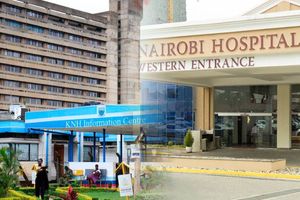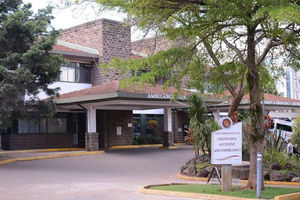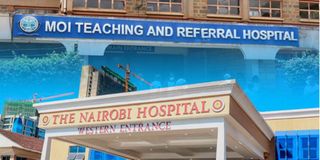
The Moi Teaching and Referral Hospital (top) and the Nairobi Hospital. Behind Moi Teaching and Referral Hospital lies the takeover of the privately-owned facility.

On the morning of June 12, 1998, a notice appeared in the Kenya Gazette that looked like the usual dry instrument of state administration. Issued by President Daniel arap Moi as Legal Notice No. 78 of 1998, it established the Moi Teaching and Referral Hospital Board as a state corporation. But behind that bureaucratic language lay a darker, largely untold story: the takeover of the privately owned Uasin Gishu Memorial Hospital.
Later, according to court documents, “hooligans” backed by police were sent in. They cut locks, broke doors and seized files in what was described as a violent takeover. The first casualty was symbolic as much as physical: the Uasin Gishu Memorial Hospital signboard was torn down.
In that sense, Moi Teaching and Referral Hospital was born not only through law and official notice, but also through force.
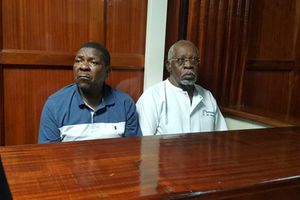
As the battle over Nairobi Hospital drags on, and after President William Ruto admitted ordering the arrest of its directors, an old fear has resurfaced: that the hospital could be steered onto the same path that swallowed Uasin Gishu Memorial Hospital.
Nairobi Hospital remains a private, member-owned institution, legally separate from the State. But the lesson from Uasin Gishu is that, in Kenya, once an institution is considered too important, too strategic or too politically charged to be left alone, state encroachment can begin by degrees — first through governance, then through process, and finally through raw power.
That is why the Uasin Gishu saga reads not as a relic of the past, but as a warning from the archives.
Incorporated on August 10, 1961, the Uasin Gishu Memorial Hospital was a company limited by guarantee without share capital. This meant that it was not a conventional profit-making business with shareholders waiting for dividends. Its original directors were men and women whose names belonged to an older chapter of Kenya’s settler and administrative history: James Robertson, William Elwell, Percy Wells Southorn, Lesley Nicholson Evans (Lt Colonel), George Carruthers, Johan Rousseaux and Nora Gough.
After the 1998 Legal Notice was published, the hospital protested through its lawyers, telling the court that President Moi had no lawful authority to transfer the rights, assets and liabilities of a private company to a state corporation simply by executive notice. If the Government wanted the land or the facilities for public use, they argued, there was a lawful path available: compulsory acquisition under the Constitution and the law, with due process and compensation.
But before the case could be heard, the Registrar of Companies struck the hospital off the register on February 4, 2005. In a single administrative act, the company at the heart of the dispute was removed from the register.
The effect was devastating. A company that has been struck off ceases, in the eyes of the law, to operate as a normal legal entity. As a result, the Uasin Gishu Memorial Hospital was crippled and could not easily defend itself or maintain litigation. Furthermore, it had lost the corporate footing on which its claims rested.
Indeed, as Paul Muite alleged in Parliament, the deregistration appeared designed to assist in the takeover of the hospital’s assets by Moi Teaching and Referral Hospital. He openly questioned whether the striking-off had been done in bad faith to pave the way for seizure. It was an allegation that transformed a company-law event into a political scandal.
Five days after the company was struck off, a letter from the Attorney-General’s chambers gave the Moi Teaching and Referral Hospital Board what amounted to an official blessing. There was, the board was advised, no legal impediment to taking over the management of Uasin Gishu Memorial Hospital in line with the 1998 Legal Notice.
At the centre of the hospital’s resistance stood Charles arap Kesse, the company secretary, who would later emerge in court papers as the principal chronicler of the hospital’s ordeal. Kesse laid out the company’s case in detail: that it had operated the hospital lawfully for decades; that it held title to the land; that the Legal Notice unlawfully sought to absorb its assets; and that the Government’s actions violated the constitutional protection of property.
The efficiency with which the takeover was executed was chilling. According to Kesse’s affidavit, on March 11, 2005, the takeover came in what he described as a “covert military-style action”. Armed police officers accompanied officials and employees linked to Moi Teaching and Referral Hospital.
here were also, he said, hooligans in the mix. In the melee, locks were cut, doors were broken open and staff were chased away. Files, accounting documents and hospital assets were seized, and the old signboard that welcomed patients to the Uasin Gishu Memorial Hospital was replaced with one announcing that the institution was now Moi Teaching and Referral Hospital (Memorial Wing).
This was despite the fact that Uasin Gishu Memorial Hospital was the registered proprietor of Eldoret Municipality/Block 7/125 and 7/126, the land on which stood the hospital’s wards, theatres, staff houses, laboratories, flats and related facilities.
But the hospital’s defenders were not finished. They moved to court and filed Miscellaneous Cause No. 350 of 2005, seeking restoration of the company to the companies register. On November 25, 2005, they succeeded. The High Court restored Uasin Gishu Memorial Hospital Limited to the register and ordered that its business, assets and property revert and vest in it as though the dissolution had never occurred.
It was a dramatic legal resurrection. Armed with that restoration, the hospital filed a fresh constitutional challenge in January 2006. This time, the dispute was framed not simply as a property battle but as a violation of constitutional rights.
The company argued that the Legal Notice and the subsequent occupation of the hospital amounted to deprivation of property without due process and without compensation, contrary to the retired Constitution.
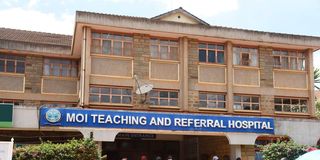
The Moi Teaching and Referral Hospital in Eldoret City, Uasin Gishu County.
It sought declarations that the Legal Notice was unconstitutional, illegal and void insofar as it purported to vest the company’s rights and assets in the Moi Teaching and Referral Hospital Board.
It sought declarations that the respondents had no lawful basis to deprive it of ownership. It sought conservatory orders against further interference.
The State fought back hard. It insisted that ownership was contested. It argued that the hospital had a long public character and that the Government had invested in it heavily. At the emotional centre of the respondents’ case was a powerful message: this was not just somebody’s private asset; it was an important public hospital, a referral facility, a national health institution. That message had obvious political force. It is always easier for the State to advance against a private institution when it can claim public necessity.
The High Court hesitated and declined to grant the full constitutional remedies sought, reasoning that the matter involved contested issues of ownership better suited to fuller evidentiary proceedings. In effect, the court stepped away from deciding the central wrong.
But when the matter reached the Court of Appeal, the tone changed.
The appellate judges examined the company’s legal status, the title history of the suit properties, and the effect of the Legal Notice. They concluded that Uasin Gishu Memorial Hospital Limited was a private company, not a state corporation.
They held that the suit properties were registered in its name. And they found that the inclusion of the company’s rights, duties, obligations and assets in the 1998 Legal Notice was unconstitutional, illegal, null and void.

The Nairobi Hospital.
It was a sweeping vindication of the company’s argument, and the court also ordered compensation. By the time the ruling came, years had passed. Moi Teaching and Referral Hospital had long entrenched itself on the ground.
Public services were being rendered there. The court recoiled from ordering the physical restoration of the hospital to the company, saying such an outcome would be unconscionable after so much time had passed. That was the cruel irony at the heart of the story: the company won the law, but lost the institution.
And that is exactly why the Uasin Gishu saga has returned to relevance at a time when Nairobi Hospital is caught in a storm of governance, influence and fear. The worry is not that Nairobi Hospital has already become Uasin Gishu Memorial. It is that Kenya has seen this pattern before: a private institution with public importance becomes vulnerable the moment the State begins to speak of instability, rescue or national interest. The process rarely starts with open expropriation. It begins with administrative moves, official interventions, procedural pressure and changing language. By the time the locks are cut, the struggle may already be half lost.
The battle over Uasin Gishu Memorial Hospital remains one of the clearest examples of how institutions in Kenya can be transformed. It involved the President, parliamentary allegations, registrars, lawyers, hospital managers, judges, police officers and men allegedly sent in to force the issue.
While it was a battle over land and control, it showed how the State can move against a private institution step by step — first through law, then through bureaucracy, and finally through raw force — until what begins as a dispute over governance hardens into a new reality on the ground.
Today, Moi Teaching and Referral Hospital stands as a symbol of public medicine, state power and institutional permanence. But buried within its history is the memory of a far more contested birth, in which law, politics and force combined to extinguish Uasin Gishu Memorial Hospital as it had long been known.
Its lesson for Nairobi Hospital is stark: once the State begins to treat a private medical institution as too important to be left alone, the struggle can move quickly from governance disputes to administrative encroachment, and from there to the loss of control itself.
Follow our WhatsApp channel for breaking news updates and more stories like this.
[email protected] On X: @johnkamau1