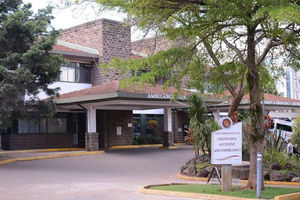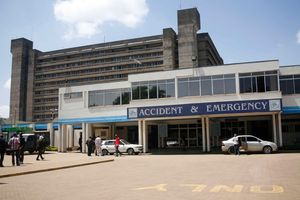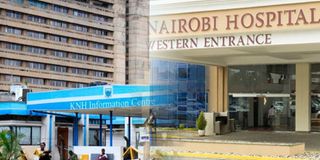
The Kenyatta National Hospital and the Nairobi Hospital.

The radiotherapy machine at Kenyatta National Hospital (KNH) has been broken for more than three months. Cancer patients are deteriorating in waiting rooms, missing treatment sessions, and running out of options.
While cancer patients wait and deteriorate, the government has been consumed by boardroom battles at Nairobi Hospital, a private facility that most of these patients will never be able to afford.
The contrast is stark. While the government mobilised a multi-agency task force, comprising the DCI, KRA, and the Asset Recovery Agency, and held 14 consultative meetings over a private hospital's governance crisis, patients at the country's main public referral hospital have been waiting three months for a machine to be fixed.
The Linear Accelerator, also known as Linac, has been broken since December. It is still not fixed. And the people paying the price are not the privileged few who can afford private hospital bills. They are ordinary Kenyans for whom the amount charged per radiotherapy session at private facilities is no small amount, and for whom a missed session is not an inconvenience but a death sentence.
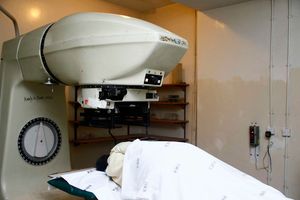
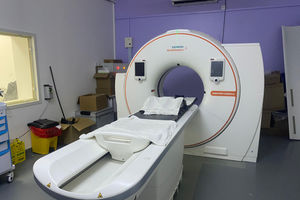
Linac, short for Linear Accelerator, delivers precise, targeted radiation therapy and is used to treat virtually all cancer types. It has become a cornerstone of radiation therapy, valued for its precision, versatility, and efficiency and ability to deliver "tattoo-less" treatment.
The machine, according to an insider, is not simply broken; it is exhausted. It has been in the hospital for decades, well beyond its recommended operational lifespan.

The Nairobi Hospital.
"This machine ought to have been decommissioned and replaced at least ten years ago. Instead, it was pushed beyond its limits because no one allocated the money to replace it. Getting a new one would cost between Sh800 million and Sh1 billion. That money has not been found. This is Kenya, there is money for other things, but not for the poor," the insider said.
In place of the broken machine, the KNH oncology unit has fallen back on an older cobalt machine, technology that cannot replicate the precision of LINAC-based radiotherapy for many cancers.
KNH ordinarily treats more than 100 cancer patients daily. With only the cobalt machine running, that number has dropped to below 50. The remaining patients are being turned away, redirected, or simply told to wait. Others have gone back home.
Phoebe Ongadi, Executive Director of the Kenyan Network of Cancer Organisations (Kenco), told Nation that the situation is a systemic failure, not an isolated technical breakdown.
"Radiotherapy machine breakdowns are not merely technical failures — they are barriers to life-saving care," she said. "Every delay, interruption, or missed session carries real consequences for patients battling cancer."
In cancer care, she said, time is never neutral. Delays in radiotherapy allow tumours to grow and reduce the effectiveness of treatment. In some cases, they permanently alter what is possible for a patient. Every week the machine sits unrepaired is a week that cannot be recovered.
3-month wait
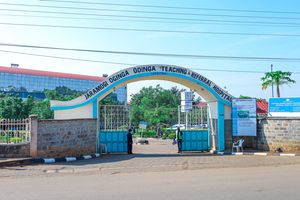
Patients who can afford alternative care have been referred to Kenyatta University Teaching and Referral Hospital (KUTRH) and Nairobi West Hospital, where treatment is offered at a subsidised rate of Sh600 per session. For some, that is manageable. For many others, it is not.
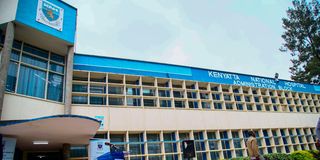
Kenyatta National Hospital.
One cervical cancer patient, in her late 40s, has been waiting for more than three months. She travelled to KUTRH twice, paying the subsidised fee from money meant for her family's upkeep. After two sessions, she could no longer continue.
"What I make in a day is what we eat in a day. At times I am not able to make even that Sh600 for treatment," she told Nation.
She looked at her finances and made the calculation that many cancer patients in Kenya are forced to make: treatment or food. She chose food. She has not been back since. She prays and waits at home, uncertain what the delay is doing inside her body.
These are not unusual cases. They are the ordinary reality of what happens when the only affordable radiotherapy facility in the country goes dark.
KNH Acting Chief Executive Officer Dr Richard Leyisampe told the National Assembly's Departmental Committee on Health, during a fact-finding visit to the hospital two weeks ago, that the hospital currently treats around 100 cancer patients daily, but with the Linac out of service, that capacity has been halved.
"Fifty per cent of our patients could not get our services," he said. "In most instances, we refer them to Kenyatta University Teaching and Referral Hospital to support them."
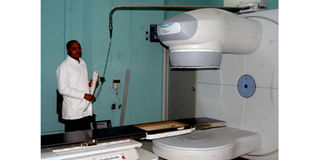
A Radiation Therapist operating the Linear Accelerator Radiotherapy Unit at the Kenyatta National Hospital, Nairobi.
Dr James Nyikal, who chairs the parliamentary health committee, said patients are missing out, and the two machines cannot replace each other.
"The truth is that some patients are missing the services they deserve. The cobalt machine cannot replace the Linac for certain cancer types. For patients with tumours requiring targeted precision radiation, the difference between the two machines is clinically significant," he said.
Health Cabinet Secretary Aden Duale told Nation that a new machine is arriving next week and will begin serving patients by the first week of April. He added that he will personally commission it, alongside the reopening of six theatres that have not been operational.
"We feel the pain of our cancer patients and we are doing all we can to rectify the situation," the CS said.
Kenco has called on the Ministry of Health, KNH management, the National Treasury, and Parliament to treat this not as a one-off equipment failure, but as a systemic crisis requiring systemic solutions, including serious long-term investment in expanding and modernising radiotherapy services across the country.
As cancer cases in Kenya continue to rise, the pressure on the country's already limited radiotherapy infrastructure will only increase.
Follow our WhatsApp channel for breaking news updates and more stories like this.