As internal feuds deepen, the Orange Democratic Movement (ODM) faces its most consequential moment since its formation two decades ago.
With Raila Odinga no longer at the helm, long-suppressed ideological differences, generational ambitions and strategic disagreements have burst into the open, forcing the party to confront hard choices about its identity, alliances and path to power ahead of the 2027 General Election.
At the centre of the storm is a destabilising question on whether ODM exists to oppose, cooperate, or capture power by any available route.
The answer is splintering the party into rival camps and spawning at least seven plausible scenarios, each with profound implications for ODM’s survival and relevance. The most immediate—and controversial—scenario is ODM formally entering a coalition with President William Ruto’s United Democratic Alliance (UDA).
In practice, ODM is already partly there, having joined the broad-based government arrangement that followed months of protests and political instability in 2024.
ODM leader Dr Oburu Oginga is explicit: “We have three options; continue as broad-based, go it alone, or join other new partners. The decision must be made this year, 2027 will be for campaigns,” he said in his New Year message.
ODM co-deputy leader Simba Arati told Nation on Friday that the party would listen to supporters before making a decision.
“We shall get into power either through coalitions or independently. We will weigh the situation and listen to the people,” he said.
He sought to calm nerves, saying that the party remains intact despite competing views on its future. He said that ODM is going through a transition following the death of their party leader, Raila Odinga.
“When a big tree falls, the little birds scatter,” the Kisii governor said, adding that internal debate was natural after the fall of a towering figure.
Mr Arati maintained that the ODM leadership was firmly in place, led by Siaya Senator Dr Oginga and his three deputies — Vihiga Senator Godfrey Osotsi, Mombasa Governor Abdulswamad Nassir and himself.
“There is no vacuum in ODM leadership. We are working towards steadying the ship,” he said.
Siaya Senator and ODM Party leader Oburu Oginga.
Photo credit: Kevin Odit | Nation Media Group
A formal coalition with Kenya Kwanza would offer ODM tangible benefits, including access to State power, influence over policy and development projects for its strongholds.
Dr Oginga said that ODM’s cooperation with Dr Ruto is anchored in a 10-point agenda covering inclusivity, devolution, public debt audit, youth empowerment and reparations for victims of protest-related violence.
But critics warn the price could be existential. ODM’s brand as a protest movement—built over decades of opposition politics—risks being hollowed out. Some fear ODM could end up as a junior appendage of UDA, its grassroots machinery quietly repurposed for Dr Ruto’s re-election bid.
Those fears were amplified early this week when Senator Osotsi accused President Ruto of orchestrating a “hostile takeover” of the party.
He alleged that ODM legislators in Western Kenya were quietly being absorbed into UDA’s regional campaign teams under the cover of the broad-based government.
“This is a systemic effort to hollow out ODM’s grassroots machinery and repurpose it for the 2027 campaign,” Mr Osotsi said, citing a January 6 meeting at the Golf Hotel in Kakamega attended by ODM MPs and UDA operatives.
The second scenario is ODM leaving the broad-based arrangement and forming or joining an opposition coalition. For many party loyalists, this would restore ODM’s ideological clarity and reconnect it with its historic base.
Siaya Governor James Orengo is among the senior ODM members who have been vocal critics of the broad-based arrangement. He has warned that ODM risks “dying like other liberation movements in Africa” if it abandons the people and retreats into political comfort.
“But if ODM is strong, and you stand on the basis that your leader Raila, wanted a strong and free country, we must fight everywhere,” Mr Orengo said.
However, the biggest challenge is that ODM no longer has Raila’s unifying authority. Rebuilding an opposition coalition would require new leadership, fresh resources and a clear presidential strategy—none of which are settled.
There is also the risk that ODM could become just one player in a crowded opposition field, diluting its national clout.
A third option—but fraught with internal tension—is for ODM to remain intact, heal its divisions and contest the 2027 election as a standalone party.
Dr Oginga has drawn a firm red line on what this would mean. If ODM goes it alone, he said, there will be no open presidential contest in the party.
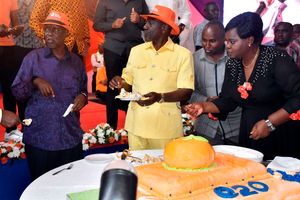
ODM Party Leader Oburu Oginga, Deputy Party leaders, Simba Arati and Godfrey Osotsi during the ODM@20 anniversary at Mama Ngina Waterfront in Mombasa on November 15, 2025.
Photo credit: Wachira Mwangi | Nation Media Group
“If we are to go it alone as a party, let people not bring debates and chest-thumping that they want to vie,” he said. “If you want to be an ODM presidential candidate, you must first remove me as party leader. Our constitution states that the party leader is the automatic presidential candidate.”
“I will be on the ballot if our party decides that we go it alone,” Dr Oginga said.
This has unsettled a party accustomed to rallying behind Raila Odinga as its undisputed flag bearer. While going it alone would preserve ODM’s identity and bargaining power, it also risks igniting leadership wars and alienating ambitious younger leaders who see 2027 as their moment.
Another path is for ODM to maintain unity by force—using its National Delegates Convention (NDC) to discipline or expel leaders deemed rebellious or disloyal.
This approach could impose order and ideological clarity, particularly on the contentious “Wantam” versus “Tutam” debate over whether to support or oppose President Ruto’s second term. But it carries heavy risks: litigation, defections and the loss of influential figures with strong grassroots followings.
ODM Secretary-General Edwin Sifuna has already convened a meeting of leaders perceived to be in the reformist camp, an indication that confrontation may be unavoidable.
Mr Sifuna led the meeting on Thursday, which brought together Mr Orengo, Turkana South MP John Namoit, Nominated Senator Catherine Mumma, Suba North MP Millie Odhiambo, Kisumu Woman Representative Ruth Odinga, Embakasi East MP Babu Owino, former Makadara MP Reuben Ndolo and ODM Trustee and former Busia Senator Amos Wako, among other leaders.
The reverse scenario is equally plausible: the perceived rebels could use the NDC to wrest control of the party.
Embakasi East MP Mr Owino has been the most vocal voice in this camp. “We want ODM to call delegates' convention. It’s time to take over the party leadership,” he declared.
Former ODM party leader Raila Odinga (centre). Inset (from left): Junet Mohamed, Gladys Wanga, George Aladwa, James Orengo, Edwin Sifuna and Babu Owino.
Photo credit: File | Nation Media Group
During ODM’s 20th anniversary celebrations held in Mombasa County in November last year, Mr Owino questioned why he had been sidelined in the party leadership appointments.
A takeover would represent a generational and ideological rupture, potentially reorienting ODM toward confrontation politics. It could also trigger walkouts by moderates and deepen uncertainty at a time when the party is already under strain.
If the ideological and personal rifts prove irreconcilable, ODM could split—formally or informally—into multiple parties or factions.
This would clarify positions: a pro-cooperation faction aligned with the government, and a hardline opposition wing rooted in protest politics. But history suggests such splits are electorally costly. Fragmentation would weaken ODM’s negotiating power, divide its vote and erode its national reach.
The most drastic outcome would be ODM dissolving into a new coalition under a different identity. This would mark the end of one of Kenya’s most influential political brands.
While such a move could offer short-term relevance within a winning coalition, it would sacrifice ODM’s history, structures and emotional bond with its supporters. For many in the party, that would amount to surrender.
But Dr Oginga has already ruled out this scenario and rejected claims that he or other leaders were plotting to sell ODM.
“Nobody can sell ODM party so long as I’m at the helm,” he said. “It’s too expensive to sell ODM, so I wonder how much it can be sold.”
He described ODM as a mass movement with structures down to polling stations, saying rumours of a sellout were politically motivated distractions.
“Some people simply want to divert us and keep us explaining mundane things,” he said.
Fueling these scenarios are competing constituencies within ODM’s traditional base. The Ramogi Professional Caucus (RPC), a network of technocrats, has urged the Luo community to pivot toward cooperation with the Ruto government.
“Decades of evidence show that confrontation leads only to our isolation,” said RPC chair Joshua Nyamori. Governance expert Rachel Omollo echoed the sentiment, saying professionals “strongly back President William Ruto and the broad-based government framework.”
ODM Secretary General, Edwin Sifuna, addresses residents of Funyula at Bukiri Primary School in Busia County on February 28, 2025.
Photo credit: Alex Odhiambo | Nation Media Group
Others disagree. “We cannot build a prosperous future on streets filled with tear gas,” said RPC member Andiwo Obondo, pushing back against calls for mass action.
Dr Oginga had initially made it clear that ODM would not accept anything less than the Deputy Presidency in any coalition arrangement, but his hard stance appears to be subsiding.
This follows warnings from some UDA insiders that dropping Deputy President Kithure Kindiki would be politically suicidal, particularly in Mt Kenya East.
Dr Oginga, however, insists that ODM will have to make its decision this year.
“We will not wait until 2027 to make a decision,” he said. “No party is formed to be in the opposition.”
Whether ODM evolves, fractures, or fades will depend on which of these seven scenarios it chooses—and how much of itself it is willing to sacrifice along the way.
3. Remain intact, resolve wrangles and go it alone in the 2027 election.