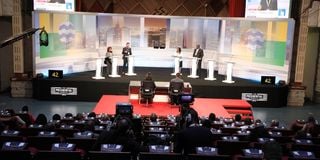
I have noticed that many Kenyans are generally enthusiastic about discussing mundane issues like football, entertainment or the evolution of night life in Nairobi. However, the moment debate takes a political trajectory, they become apprehensive, allowing only a minute or two to gauge the flow.
Once they establish which side of the political aisle (Wantam or Tutam) one belongs to, they lose interest or start showing renewed energy. One peculiar thing about political debates in Kenya is the unwillingness of participants to cede ground, even in the face of superior ideas.
The decision to support a political formation or give it a wide berth is seldom driven by ideological persuasion, but rather “what is in it for my community and me?” It is about access to state largesse. This points to a dangerous reality: Kenyans are losing interest in critical thinking. After all, they proudly aver that their political (read ethnic) “kingpins” think on their behalf. This herd-mentality is producing a non-thinking society that is unable to debate policy alternatives and generate and choose superior options for implementation.
The result is a society that embraces Lilliputian political models, leading to adverse selection where low-quality ideas crowd-out better options. A thinking society is built through debates. Debates are the arenas through which intellectuals test the viability of their theories and beliefs. A debating culture fosters the development of critical thinking skills.
Regular debates between experts and politicians help to thrash out contentious policy issues, and find solutions for them. When intellectuals participate in national debates, they act as catalysts for change by interrogating the foundations of values and standards governing society.
By simplifying complex ideas into accessible information, intellectuals help citizens to unearth misinformation and hidden agenda in government and corporations. Intellectuals support innovation and problem-solving by unlocking flaws in leadership mindset and systems. A winning society values and embraces intellectual inputs in policy debates. The role of the intellectuals in these debates is to use critical thinking and reflection to juggle ideas, in order to understand reality, and suggest solutions to problems.
In debates, people take positions that can be diametrically opposed to each other, but through strength of persuasion, they may converge.
Debating eschews binary (either or) thinking. Apparently, Kenya’s political debates are not sufficiently amenable to accommodate structured intellectual participation.
I have been watching this phenomenon as people post polarising material on social media. If you want to test intellectual maturity and tolerance levels among a politically polarised populace, throw at them a highly divisive topic like the 2027 presidential election. Today, there is a sharp division between “Wantam” and “Tutam”. Many have become so thin-skinned on this topic that they cannot tolerate anyone not supporting their viewpoint.
Being independent-minded, however, does not preclude one from holding an opinion. It means the individual starts from a position of indifference, then critically considers the issue, and where data is needed, collects, collates and analyses it before drawing conclusions.
More often than not, the position arrived at in this manner will support one of the opposing views or reject both. That is where the problem begins. Intellectuals tend to take the scientific approach, which is critical, analytical and often data-driven. Supporters of either side cannot countenance such a position. They feel let down by intellectuals who refuse to back their positions.
To make matters worse, some assign unsavoury names or tags to intellectuals holding independent opinions. They forget that intellectuals are trained to think, and in fact, relish disagreeing with popular opinions.
Research has shown that societies that routinely invite intellectual inputs into public debates show better progress and faster transformation. Societies that scorn intellectual inputs tend to remain backward.
I have witnessed intellectuals being targeted with unprintable invectives for discharging their duty of interrogating the scorecards of their governors. Many have been blackmailed into oblivion, leaving society exposed. The ostracisation of intellectuals by the public is orchestrated by politicians who do not want to be accountable to citizens.
Some politicians sponsor “cyber goons” to rebut critical observations made by intellectuals, which might awaken the public to demand accountability.
Aren’t intellectuals part of society? Are they not supposed to participate in debates to help create better options for implementation? Is it wrong for an intellectual to give an opinion? Is the opinion supposed to sit well with everyone on both sides of the political isle? Would we rather Kenyan intellectuals kept off real issues that affect society? Isn’t it a sign of intellectual maturity to allow everyone to give their opinion, however divergent?
To progress, Kenyans must listen to one another, pick critical issues and rebut them with well-considered and articulated logical responses. If one does not agree with the other’s opinion, they should present their own for consideration, without any abuse or blackmail.
Scholars are trained to juggle ideas in order to synthesise alternatives. To deny them an opportunity to share their opinions is to deny society ideas from some of its most sharpened and finest brains.
People are bound to hold divergent opinions on key issues. That is nature. If debate is curtailed, society is likely to end up with inferior decisions that can only stunt it.
Diversity of opinion breeds synergy. Challenging contrary opinion in a logical manner is the way to facilitate society to advance from ignorance. A society that does not embrace debating culture as a way of generating alternative ideas for transformation is bound to become a society of missed opportunities.
Prof Ongore is a Public Finance and Corporate Governance Scholar based at the Technical University of [email protected]