In 1982, Ngugi wa Thiong’o, the celebrated Kenyan author and academic, who died on May 28 this year, arrived in Britain on a six-month visitor’s visa to promote his book, Devil on the Cross . But fearing for his safety on his return to Kenya, Ngugi applied to stay longer in Britain and became a leading critic of the Kenyan government in diaspora, something that angered Daniel Moi’s government and made him a key subject of discussion in secret diplomatic cables between London and Nairobi.
Even before leaving Kenya, Ngugi had been a thorn in the flesh of the Kenyan government, which he always described as “neocolonialist” and “exploitative.” As a writer and an artist, Ngugi was much rooted in the Kikuyu cultural and political tradition. His most famous play, the Trial of Dedan Kimathi performed at the Kamirithu open air theatre and the Kenya National Theatre, lionised the Mau Mau leader, but was critical of Jomo Kenyatta’s regime as of Moi’s.
He had been detained in 1977, by the Jomo Kenyatta government following the banning of his performance play Ngaahika Ndeeda (I shall Marry when I want), which authorities considered to be subversive. In 1978, after Kenyatta’s death, he was among political prisoners who were released under a general amnesty declared by Kenya’s new President Moi, but he was still subjected to constant harassment by state agents because of his activities.
It is against this backdrop that when he arrived in Britain and received information that Moi planned to eliminate him by “giving me a red-carpet welcome at the airport”, he decided to remain in Britain. Since his visitor’s visa was short and did not allow him to work, he requested the Home Office to allow him to stay longer in order to work as an artist. However, it took the Home Office a little bit longer to make a decision on Ngugi’s application.
By then Ngugi was planning to visit Sweden to receive a literary award but was fearful that with his documents still not in order, he was likely to be barred from re-entering Britain. For this reason, he wrote to the Immigration Department at the Home Office seeking an assurance that he would be allowed back in Britain after collecting his award in Sweden.
It was at this juncture that the Home Office (the equivalent of the Interior ministry) changed his visa from visitor to an artist’s in November 1983, giving him some freedom to leave and enter Britain and also to work. This was renewed every year.
However, owing to Kenya’s sensitivity about dissidents in exile and London’s desire to maintain good relations with Nairobi, the Foreign Office (the British ministry for Foreign Affairs) was not happy with the Home office’s unilateral decision to give Ngugi a work permit. “Although we would not dispute the Home Office’s course of action, we were not consulted at the time; we have since stressed to the Home Office that the FCO needs to be consulted on cases of political interest beforehand and hoped that this reflected his understanding of the situation,” an official in the East African Department at the Foreign Office wrote.
Ngugi would later be employed as a writer in residence by the greater London Arts Association, in the London Borough of Islington. This gave him an opportunity to engage with exhibitions, develop his craft and publish his new writings. But his presence in London still irked the Kenyan government, which was putting pressure on Britain to expel him. Although the Mwakenya movement had been largely emasculated in Kenya, Moi’s government feared that it was being kept alive by Kenyan dissidents abroad led by Ngugi.
On September 25, 1984 Simeon Nyachae, who was then serving as Chief Secretary in the Civil Service, summoned Simeon Heamans, the Deputy British High Commissioner, to raise with him the question of Ngugi and Micere Mugo, who was in exile in Zimbabwe but made regular visits to London. Nyachae’s concern was that the activities of these two dissidents were hostile to Kenya and asked the British diplomat whether there was a way the British government could restrict their activities.
Ngugi wa Thiong'o with Stephen Ndegwa, the author of the first full Kikuyu poetry book titled 'Kihoto Mbere' during a Kenya Editor's Guild breakfast meeting in Nairobi.
Photo credit: File | Nation Media Group
Reporting about his meeting with Nyachae to his seniors in London, the diplomat wrote in documents seen by the Weekly Review: “He (Nyachae) asked if there was not some way of restricting the activities of people whose actions were directed against countries friendly with Britain, and I said there was no way unless such activities were illegal.”
He informed Nyachae that unless the two broke British laws by engaging in criminal activities, the British could do nothing to infringe on their rights.
“I stressed that there’s nothing we could do unless they break the law. I pointed out that this applied equally well to anyone from anywhere, and that we did not seek to restrict visitors to Britain except in as much as we required them to obey the law,” wrote the diplomat.
At this point Nyachae struck a reconciliatory tone, observing that perhaps the best thing was for Kenya to ignore the two because focusing on their activities was giving them unnecessary attention. Even though, Nyachae noted that President Moi was very sensitive on the matter and would not let it go easily, he promised to convince him to ignore Ngugi and Mugo. He also promised to tell President Moi that it would be difficult for Britain to tame these dissidents, as “they would simply move elsewhere and carry on”. He pointed out that if Kenya could not persuade Zimbabwe to restrict activities of Mugo, it was not fair to expect Britain to do more than others.
Just a week after meeting Nyachae, the diplomat was summoned to State House Nairobi by President Moi, who wanted to bid him farewell as his diplomatic posting to Kenya was coming to an end.
“This morning I was summoned by Moi who simply wanted to say farewell and thank me. In the course of his tour d’ horizon, he mentioned the dissidents but did not seem particularly disturbed and did not put it in such a way that I was obliged to reply. Nyachae was present and said that he had talked with the president beforehand and hoped that this reflected his understanding of the situation,” the British envoy wrote.
The issue of Ngugi came up again two weeks later when the then Kenyan Minister for Foreign Affairs Elijah Mwangale met British Secretary of State for Foreign and Commonwealth Affairs Sir Geoffrey Howe on October 16, 1984. Mwangale alleged that Ngugi and his associates in London were plotting to overthrow the government and that they were receiving funds from the Eastern bloc which gravitated around the Soviet Union.
The East African Department at the Foreign Office sought to dispel this by arguing: “Ngugi seems to act as an individual rather than as part of an organisation, and we have no evidence that he is actively working against the Kenyan government in anyway which could be illegal under British law. He is outspoken in his public criticism of the Kenyan government, but he is a dissident intellectual rather than a politician and certainly is no terrorist. We have repeatedly stressed to the Kenyans that everyone in this country is accorded the same liberty within the law.”
When Geoffrey Howe returned to Kenya the following year on January 11, 1985, President Moi who was very angry with Ngugi’s heightened activities in London, confronted him directly over the matter. During the meeting that took place at State House Nairobi, President Moi complained to the British Foreign Secretary that Ngugi was planning to start a communist party and was becoming a bad influence to Kenyan students in the UK.
The president also wondered why Ngugi was allowed to operate freely in Britain while his own son, Gideon Moi, needed a visa to visit London. The president’s demand was for the expulsion of Ngugi from Britain.
In August 1986, Moi again express his displeasure about Ngugi’s refuge in Britain when he received the newly appointed British High Commissioner to Kenya Sir John Johnson at State House Nairobi in August 1986. The head of state repeated his common line that Ngugi was planning to overthrow his government, and that the British press was siding with Kikuyu politicians led by Charles Njonjo who were planning to destabilise his government.
Reporting to the Foreign Office about President Moi’s accusations that the British government was siding with Kikuyu politicians, Johnson wrote: “I intervened to point out that the British government in no way controlled the press. There was no question of any tribal bias in Britain’s view of Kenya. Our concern was to see unity and continuing political stability.” On the question of Ngugi wa Thiong’o he stated, “We turned to the problem of Ngugi wa Thiong’o. Moi thought that we should make things so uncomfortable for him that he would leave Britain. I pointed out that he had not broken the law and we could not victimise him. But we were keeping a close eye on him.”
Meanwhile, because of the pressure from Moi there was growing tension between the British Foreign Office and the Home office about the possibility of Ngugi securing permanent residence in the UK.
Under immigration rules in those days one qualified for permanent settlement after four years on a work visa. Ngugi’s work visa was always renewed annually from the time it was first issued in November 1983, which meant that he was eligible for permanent settlement in November 1987.
The Foreign Office as the ministry in charge of foreign relations felt that granting Ngugi permanent residence in the UK could jeopardise the relations between Britain in Kenya. As one official from the Foreign Office wrote, “Ngugi is a prominent and vocal opponent of the present Kenyan government who considers himself the intellectual force behind the underground subversive organisation Mwakenya, and consequently a persistent irritant in our relations with the Kenyan government.”
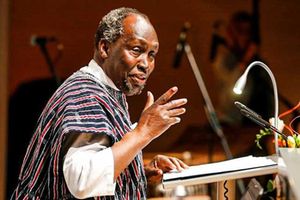
Ngugi wa Thiong'o addresses fans on June 13, 2015 in Nairobi during a book signing event to celebrate the golden jubilee of his first book 'Weep Not, Child'.
Photo credit: File | Nation Media Group
The feeling among many officials in the East African Department at the Foreign Office was that Ngugi should be allowed to remain in Britain but not permanently. On the other hand, the Home Office as the ministry in charge of immigration felt obligated to grant settlement to anyone who met immigration rules as long as they were not criminals.
In January 1987, Ngugi who was away in Zimbabwe on an expired permit, made an application to re-enter Britain, but surprisingly the immigration officer endorsed his Ghanaian passport with an indefinite leave to enter the UK, which meant that he could now enter and remain in the UK without any restriction.
What made this odd was that it was granted to Ngugi before he met the requisite time for settlement, which was four years. The move angered the Foreign Office which accused the Home Office of providing Ngugi with a base to launch attacks against the Kenyan government. It was possible that the Home Office granted Ngugi the leave out of sympathy, but feigned knowledge by claiming it was granted by mistake.
Officials at the Foreign Office only came to learn about Ngugi’s new status when Debbie Grimmer of the immigration department at the Home Office ambushed them with a letter requesting their views on a plan to remove all restrictions to allow Ngugi to remain permanently in the UK.
“The above named (Ngugi Wa Thiong’o) claims to have been granted indefinite leave to enter the United Kingdom by virtue of an erroneous endorsement in his passport. This claim has been examined and it is proposed that the time limit be removed from Mr Thiong’o’s stay enabling him to remain in the UK indefinitely. However, before proceeding with this action, I should appreciate your views on the proposal and to know any objection you might have. An early reply would be appreciated in view of Mr Thiong’o’s desire to travel shortly,” Grimmer wrote to Jenkins of the East African Department in the Foreign Office.
The East African Department in its response protested the move saying, “We are very concerned at the proposal that an error in Ngugi’s Ghanaian passport should be, in effect, legitimised and his claim to indefinite leave accepted as a fait accompli. Ngugi is the Kenyan government’s public enemy number one. We know that President Moi has been disturbed by his presence and activities in the UK. He would almost certainly take a decision by us to grant Ngugi indefinite leave to enter the UK as unfriendly gesture.”
The official also expressed concerns about Ngugi’s multiple passports stating, “I am also disturbed by the fact that Ngugi appears to have two passports, one Ghanaian and the other Kenyan. Surely we could legitimately object to this. We also seem to be having problems keeping a track of Ngugi’s movements (Something we had previously agreed we should do). Can this be tightened up?”
Replying on behalf of the Foreign Office, Montgomery Pott warned that it would be very difficult to deny Ngugi settlement pointing out that the courts could still grant him. “I would not wish to raise any false expectations. The first is that Mr Ngugi would be able to appeal to the independent immigration appellate against such a refusal. To justify the refusal, it would probably be necessary to disclose some sensitive information and even if we were prepared to do so (which I doubt) it must be uncertain what view the appellate authorities would take on such an unusual refusal, particularly as we are not seeking his deportation.”
Montgomery also observed that denying Ngugi settlement could force him to apply for asylum thus creating further problems. “This is something you wish to avoid. He has advisers who are well-versed in immigration procedures and know the complications which can be made simply by applying for asylum.”
His final advice to the Foreign Office was, “It might be better to allow the case to run its natural course with Ngugi quietly getting indefinite leave to remain as a writer. The more resistance we put up the higher profile the case will become and the greater difficulty with Kenyan relations.”
The Foreign Office heeded this advice and concluded that denying Ngugi settlement could only give him more attention and sympathy. The problem now was how to justify Ngugi’s UK permanent residence to Kenyan authorities who wanted him to be expelled. In their strategy to convince the Kenyan government officials at the Foreign Office thought, “In those circumstances, we might best try to limit the damage by persuading the Kenyan authorities that it would be better for them for Ngugi to be effectively neutralised as an intellectual in exile preaching in the safe haven of the UK, where we could keep an eye on him, rather than to be given a freer rein to whip up support for Mwakenya and other dissidents’ groups nearer home. “
In 1989, there was another attempt by the Foreign Office to have Ngugi and his close associate Yusuf Hassan Abdi, the current Kamukunji MP, who was then working in London as a journalist, expelled from Britain. Yusuf was being accused of being the leader of Ukenya Party, which had connections with Mwakenya while Ngugi had written an article condemning the Kenyan government on a number of issues which the Foreign Office felt were not true. Consequently, the Foreign Office wrote to the immigration department in the Home Office warning the activities of the two posed a threat to Anglo-Kenya relations.
An officer from the immigration department at Lunar House wrote back on April 9, advising, “I appreciate your concern about UK/Kenyan relations, but it seems to me that the best course is for us to be seen to be dealing with both these people strictly in accordance with our immigration laws. The higher profile the cases become the more problematic they are likely to be from the bilateral relation standpoint.”
It was around this time that Ngugi moved to the US where he settled and taught at various prominent universities such as Yale, New York and California.