The 81st session of the United Nations General Assembly (UNGA 81) is being held in New York, America, this week under the theme restoring trust, managing transformation: a United Nation that delivers to all.
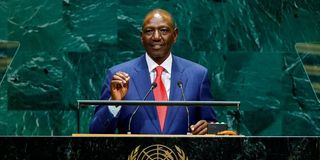
When President William Ruto joined other world leaders at the meeting, he not only shouldered Kenya's socio-economic burden, but also bore a duty to place Africa and the Global South at the table where major financial and political decisions were being made.
In this responsibility, the President finds a comrade in the Prime Minister of Barbados Mia Amor Mottley. The two have distinguished themselves as the latter-day champions for Africans in the continent and the diaspora. Coincidentally, the theme for UNGS 81 aligns directly with the president's domestic development blueprint Bottom-Up Economic Transformation Agenda.
This blueprint underscores structural transformation, transparent deployment of capital, and managing resources effectively to build economic resilience, and deliver tangible results for ordinary citizens.
Pitching for Kenya, President Ruto championed local industrialisation, and highlighted investment pipelines in energy, manufacturing and technology, emphasising that Kenya is a premier global investment hub looking to open up new market frontiers. While revisiting his pet subject of regional equity, the president vehemently demanded UN Security Council (UNSC) reforms. He decried Africa region's lack of permanent representation at the UNSC, emphasising that the state of affairs was unfair and grossly unjust for a continent that is home to more than 1.5 billion people, and 54 member states.
He insisted on two permanent seats with veto power. Speaking on behalf of the Global South, Ruto challenged the existing international financial architecture, demanding that lenders stop incorporating prejudice into funding models for "risky" borrowers from the developing world.
Typically, the skewed debt pricing that treats developing countries as homogenous high-risk entities makes cost of loans inhibitive for these nations, often leading to debt distress. The president advocated for a system that prices risk fairly so that heavy debt interest payments stop suffocating vital funding for critical public services such as healthcare and education.
By addressing these sticking issues at the highest global platform, President Ruto has positioned Kenya as an influential diplomatic and economic heavyweight.
On the sidelines, away from the official UNGA engagements, the president participated in, and co-chaired several strategic roundtable discussions to advance trade, technology and economic investments. The US-Kenya Business and Investments Roundtable brought together CEOs of leading American multinational corporations, to pitch investment opportunities in Kenya. The President co-chaired the African Finance Corporation Roundtable to discuss infrastructure and development financing for the African continent, including Kenya.
In addition, Ruto co-chaired the Global Africa Business Initiative Roundtable, that championed investment partnerships in energy, manufacturing and technology. Notably, the Head of State co-chaired an AI roundtable, along with Finnish President, Alexander Stubb, to address global digital economies and AI implementation.
By co-chairing roundtables and hosting summits alongside global leaders such as European Council President, Antonio Costa, President Ruto has elevated Kenya into a crucial strategic partner for Western, African and global capital ecosystems. Additionally, his recognition as a "Global Champion of Adequate Housing" has solidified Kenya's thought leadership in socio-economic development models.
Kenya has increasingly assumed the role of an essential regional anchor and multilateral deal-maker for the UN. This position is fortified by Kenya's leadership in international peace and security operations, including the high-stakes - Multimonth Security Support (MSS) mission in Haiti. The significance of Kenya's new-found stature in critical global matters is immense; it grants the country unparalleled leverage to lead continental diplomacy, host major global corporate and digital offices, and command respect in international deal rooms where global resources are distributed.
As the old adage goes "when it rains, it pours."
In a historic milestone announced by World Athletics, Nairobi has officially won the bid to host the 2029 World Athletics Championships, beating major World cities such as London and Rome. This makes Kenya the first African nation to ever host the senior global showpiece since its inception in 1983. It is not lost on Kenya watchers that this huge feat is part of the country's fast-growing global stature.
One question, however, remains in the minds of Kenyans: was the President's multi-million trip to UNGA 81 worth the millions of Kenyan taxpayers' money spent on it? From a purely economic and strategic standpoint, the trip was hugely successful, and worth every shilling that was spent on it.
While critics are skeptical about the returns from UNGA 81, it is massively evident that the trip was not a diplomatic "talk-shop", but a critical "deal-room." Through strategic multilateral and bilateral engagements, Kenya positioned its vast critical mineral reserves to secure supply chains and value-addition partnerships with American firms.
A number of specific projects and programmes are on the pipeline for funding following the President's roundtables. Negotiations are at an advanced stage to secure a Sh2. 2 trillion funding for proposed Lamu refinery. Once implemented, this project is estimated to generate thousands of jobs.
Secondly, there is accelerated progress on the African Development Bank-backed AI 10 Billion initiative, designed to mobilise up to $10 billion by 2035 to fund Africa's digital, tech and trade infrastructure.
Kenya is a key player in this space in Africa. Even more spectacular is the Kenya Diaspora Impact Platform, a collaborative investment vehicle backed by the UN in Kenya and Equity Group Holdings. The initiative aims to securely route diaspora funds into micro, small and medium enterprise (MSME) financing, and community projects.
Beyond the projects, the Head of State challenged the Kenyan diaspora to pool their wealth, expertise, and global networks to actively invest back home through newly structured government-verified platforms, thereby becoming direct architects of national transformation.
On their part, African diaspora appreciated President Ruto's representation of African sovereignty on global stages, and praised him for aggressive pushback against exploitative international.
President Ruto has elevated Kenya's visibility on the global stage. It now behoves us as citizens to play our part in keeping the country up there.
Professor Ongore is a public finance and corporate governance scholar based at the Technical University of Kenya. [email protected]