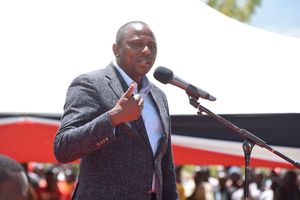
Shortly after being accused by President William Ruto of being at the head of a coup attempt and engaging in terrorist activities, former deputy president Rigathi Gachagua flew out of the country on Wednesday night for an extensive visit to the United States.
That is telling. Plotting removal of the president by violent and unconstitutional means is treason, one of the most serious crimes in the statute books for which the penalty on conviction is death. Terrorism is also treated as a serious crime, attracting severe jail terms and in some cases the death sentence where there are fatalities.
Gachagua fires back at Ruto over coup allegations
In most circumstances, it is inconceivable that anyone under investigation for treason, terrorism and other serious crimes that touch on national security would be given freedom to leave the country for an overseas visit. The police would move fast to prevent a suspect in such offenses from even reaching the airport. Such a person would be arrested, with the police seeking approval from courts to hold the suspect for an extended period as investigations continue.
That Mr Gachagua was allowed to fly out the same day President Ruto issued a stern warning in the wake of the Saba Saba riots of July 7 that nobody involved in fomenting chaos would be spared is the strongest indication that the government is not ready to proceed with arrest of opposition leaders.
The former DP has assumed opposition leadership since his break with the President and eventual impeachment. Government reaction since the GenZ revolt broke out in June last year reveals a strategy aimed at pinning the blame on Gachagua, and his populous Mt Kenya region support on general, for the increasingly bloody youth revolt capped with the June 25 anniversary of the GenZ protests and the Saba Saba riots.
President Ruto dismisses court order on blocking access to Nairobi CBD
Mr Gachagua, leader of the new Democracy for Citizens Party, has been the most prominent face and voice in efforts to craft a united opposition. His two-month absence while in the US, billed as a diaspora engagement tour, will see him step back from the front-line and leave the battle to his colleagues, the most prominent being Kalonzo Musyoka of Wiper, Martha Karua of People’s Liberation Party, Eugene Wamalwa of Democratic Action Party, and former Interior Cabinet Secretary Fred Matiangi who is not yet formally affiliated with any political outfit, but is being fronted by retired President Uhuru Kenyatta’s Jubilee Party.
If security agencies were not ready to arrest Mr Gachagua despite all the tough talk from Dr Ruto, Deputy President Kithure Kindiki , Interior Cabinet Secretary Kipchumba Murkomen and a whole clutch of Cabinet secretaries and MPs echoing the ‘coup plot’ narrative, then it is unlikely they will move against the other senior opposition leaders.
Mr Gachagua’s extended overseas visit, say some close allies on condition of anonymity, is not so much about meeting Kenyans in the diaspora, but about stepping away from the limelight so that the government loses the excuse to perpetually point fingers at him.
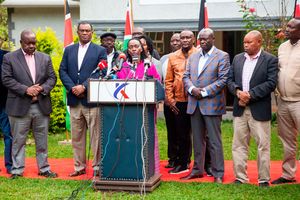
Democracy for the Citizens Party leader Rigathi Gachagua (center) addressing journalists at his home in Karen, Nairobi, on July 9, 2025.
Photo credit: Bonface Bogita | Nation Media Group
It is not yet clear what his colleagues in the opposition front will do in his absence, but a series of nationwide tours will continue.
It is also likely that there will be relative calm in coming weeks and months unless the government makes the now perennial blunders, which incite the youth into action.
After enlisting former opposition chieftain Raila Odinga in his broad-based government in the wake of the calamitous events of June last year, which climaxed in the historic storming of Parliament by Gen Z protestors, Dr Ruto assumed that the worst was over.
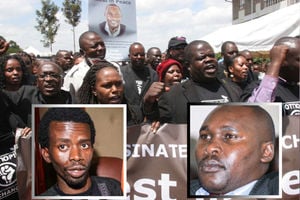
However, he now has to contend with the fact that it was only the lull before the storm, with much of the damage over the past month being self-inflicted. The killing of blogger Albert Ojwang in a police cell ignited fury, which directly fuelled the violence witnessed leading to the June 25 anniversary. The brutal police crackdown on protestors, the low point being the shooting of an innocent street trader Boniface Kariuki, added fuel to the fire.
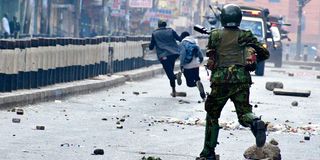
The high death roll witnessed—31 fatalities on Saba Saba and 19 on the Gen Z anniversary—has presented the picture of a brutal regime where trigger-happy policemen have been given license to use lethal force on protestors.
And despite the President’s pledge to end the practice, it is evident that elite units that are said to be drawn from the Directorate of Criminal Investigations, the Anti-Terrorism Police Unit and the National Intelligence Service, continue to abduct suspected ringleaders of youth protests, hold them in illegal confinement and even carry out extra-judicial executions.
President Ruto’s comments after Saba Saba indicate that he has no intention of backing down despite widespread criticism on his human rights record. Yet he must be painfully aware from troubles over the past three weeks that incorporation of Mr Odinga’s party in government and harsh security measures have not quelled the anger that is so evident in the streets.
Mr Odinga’s bastions were previously the focal point of anti-government demonstrations. It is now evident that a general discontent among the youth in many parts of the country, as well as a newly-radicalised Mt Kenya region, is posing more challenges than Dr Ruto knows how to deal with.
The general strategy has clear attempts to point the finger at Mt Kenya. Politicians from Dr Ruto’s UDA party and Mr Odinga’s ODM have been vocal in accusing a region that enjoyed the dividends of leadership by three out of five Kenyan presidents, undermining the government just because one of their own is not in power.
Ruto: Attacking or raiding a police station is declaring war
There have been visible attempts to re-create the 41 versus 1 move of the 2007 elections where the opposition ODM, which then include Mr Odinga, Dr Ruto and Prime CS Musalia Mudavadi among others, tried to dislodge President Kibaki by presenting a coalition of all other ethnic groups against the Kikuyu.
The new push, however, might be backfiring because it seems to have succeeded only in radicalising the region, which previously was not keen on politics of violent protests.
The scale of looting, arson, attacks on government installations and violent confrontations with police in Nyeri, Kiambu, Nyandarua, Kirinyaga, Meru, Nakuru and counties in the wider Mt Kenya region during recent protests was unprecedented in scale and fury.
While the government has condemned the violence, it is evident from the rhetoric in various platforms that Dr Ruto’s political allies and social media warriors are actually celebrating what they see is insurrection centred in Mt Kenya.
They are keen to seize the opportunity, and set to launch a series of political roadshows there aimed at highlighting the perils of anti-government agitation, which leads to destruction of property, loss and life and serious damage to the economy.
Efforts to pluck the region from Mr Gachagua’s grip, sources in government reveal, will also include sponsorship of a peace messaging campaign to be fronted by selected religious leaders, prominent businesspeople, entertainers and other well-known personalities.
Whether this will work remains to be seen. The anti-Mt Kenya rhetoric has found an effective counter in the #IamKikuyu and #WeAreAllKikuyus hashtag campaigns on social media where personalities from other regions are expressing with the community and even adopting Kikuyu names.
Dr Ruto’s threats to crack down hard on those allegedly out to topple his government have found strong support within his political base. But there are also moderate voices who are urging him to reach out and listen to the voices of discontent.
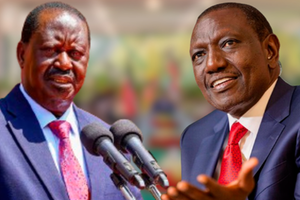
The Saba Saba Day proposal by Mr Odinga for a national conclave could provide some wiggle room. The ODM party leader is the acknowledged king of protest politics in Kenya, going back to his days as one of the Young Turks at launch of the 1990 campaign against single-party rule. He is a Saba Saba veteran.
Successive presidential campaign losses — starting with the blatantly rigged poll that returned Mwai Kibaki in 2007, onto losses against Uhuru in 2013 and 2017 and against Ruto 2022—saw him call out supporters in waves of deadly streets protests that ultimately saw the victors sue for peace and bring him to the high table.
Since decamping from opposition to Dr Ruto’s side, however, a seemingly mellowed Odinga has been preaching peace and dialogue rather than street protests.
On Saba Saba Day, he proposed a national conclave of all interest groups to discuss the national crisis and agree on solutions.
He did not detail exactly what would be on the table, but adding that the outcomes would be subjected to a referendum indicated he had in mind significant constitutional amendments.
That would suggest he was thinking of reviving two of his pet initiatives out of previous post-election settlements. There was the abortive Building Bridges Initiative deal he struck with Mr Kenyatta after the 2017 elections, and the one reached by a bipartisan parliamentary team to end the 2022 post-election dispute.
Both pacts proposed changes to the governing structure which cannot pass unless approved by a referendum, the most significant being return of the Office of Prime Minister.
That and other proposals, however, do not address the burning issues raised by the GenZ uprising last year and which continue to cause turmoil to date.
Matters such as youth unemployment, tribalism, corruption, high cost of living, human rights abuses, the rich-poor gap, and conspicuous consumption by the political elite, can be addressed through political will rather than constitutional amendments.
The opposition, as well as civil society and other groupings who have been calling the government to account have already dismissed Raila’s proposal as diversionary and self-serving.
Yet all will have to acknowledge at some point that it is only through honest and open dialogue that critical issues which threaten to tear the country apart can be solved.
In the absence of that, it will be a zero-sum leading to the 2027 elections, where whoever wins will have to preside over a deeply-divided nation.
The question is if there is an honest broker can be entrusted to lead a process of national healing and reconciliation.