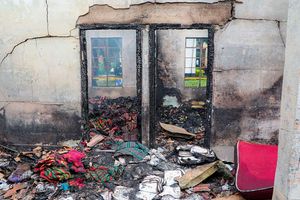
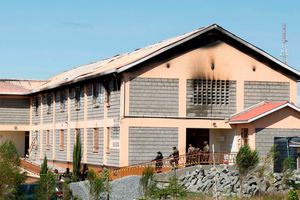
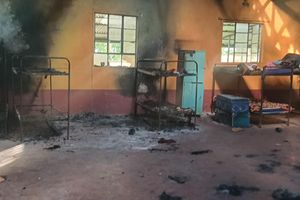
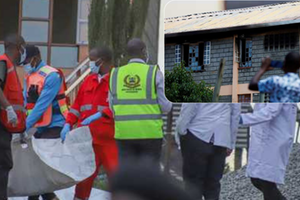
The death of 16 girls from Utumishi Academy in Gilgil during a school inferno, allegedly ignited by fellow students, should not be treated as another sad headline to be mourned for a week and then forgotten. It is not merely a school tragedy. It is a mirror held before the nation. In that mirror, we see the society we have become. Angry, careless, noisy, corrupt, violent, and increasingly numb to human suffering.
There are moments when a country must stop and ask itself difficult questions. Not questions about which politician visited the scene first, who issued the strongest condolence message, or which committee will be formed to investigate the obvious. The deeper question is this: how did fire become one of our most common languages of anger?
Kenya has a long and painful history with fire as a weapon of rage, revenge and political message. We saw it in the colonial-era Lari Massacre of 1953, where violence consumed homes, bodies and memory. We saw it at Kiambaa church, where people who had sought refuge in a house of worship were burnt alive during the madness of the 2007/2008 post-election violence. We saw it in Kyanguli, where boys perished in a dormitory fire in 2001, and in other school tragedies that should have permanently changed how we think about boarding schools, discipline, safety and rage.
Yet, each time, we mourn, we pray, we form committees, we write reports, and then we return to normal. But what is this normal? It is a normal in which school dormitories remain unsafe, emergency exits are locked, students live under pressure, administrators hide warning signs, and the country waits for another tragedy before pretending to care.
The Utumishi school fire is, therefore, not an isolated act of juvenile cruelty. It belongs to a wider national disorder. The child who lights a match in a dormitory may probably not understand the full horror of what would follow. But she is growing up in a country where destruction has been normalised by adults and leaders. Outside school, adults burn tyres to protest. They uproot public infrastructure. They stone vehicles. They loot shops belonging to innocent people. They burn markets. They invade farms. They destroy because destruction has become a short-cut to being heard. They also loot public coffers because it is now a national norm.
We have taught our children, by example, that anger must leave ashes behind.
This is the tragedy. The school is no longer separate from the nation. It is a miniature republic. Its prefects mimic the arrogance of power. Its bursars mimic the corruption of tender systems. Its boards mimic political patronage. Its administrators mimic the secrecy of government. Its students absorb the language of impunity from the national theatre around them. When the larger country is sick, the school cannot remain healthy.
We should, therefore, stop pretending that school unrest is only about bad students, harsh teachers, examination pressure or poor food. Those may be triggers. But they are not the whole story. The deeper problem is that our institutions have lost moral authority. Many young people no longer believe that complaints will be heard and that rules are fair, that leaders are accountable, or that justice arrives through proper channels.
When Gen Z rose to complain, they were teargassed and shot! They still see some people steal and prosper. They see politically connected individuals face scandal and then reappear in higher office. They see corruption rewarded, loyalty rewarded, noise rewarded, violence rewarded.
Then we act surprised when they also learn to destroy. Politicians have not helped either and have normalised another form of public disorder: blocking of roads to address supporters. Highways, streets and market roads are turned into political stages without regard for the ordinary citizen trying to get home, the trader rushing goods to market, the patient being taken to hospital, or the ambulance trapped in the manufactured chaos of power.
A leader stands on a car roof, microphone in hand, while traffic piles up for kilometres and the public is expected to clap for its own inconvenience.
This, too, is violence — not the violence of flame, but the violence of entitlement. It tells citizens that political theatre is more important than public order, that the ambitions of one leader can override the rights of thousands, and that even emergency can wait for politics to finish speaking.
Debris and damaged property at a storage facility following a fire at Alliance High School in Kikuyu, Kiambu County on June 4, 2026. School operations were suspended indefinitely as investigations into the incident continued.
Photo credit: Lucy Wanjiru | Nation Media Group
Politicians have turned the country into a permanent campaign ground. Every church service, funeral, school function and roadside gathering is converted into a battlefield of insult and mobilisation. The pulpit has become a podium. The school ground has become a rally. The funeral has become a political studio. The result is a country saturated with speech but starved of wisdom.
We are now living in a tower of Babel. Everyone is shouting. Few are listening. Government shouts at opposition. Opposition shouts at government. Citizens shout at churches. Churches shout back through politicians. Police shout through tear gas. Bloggers shout through abuse. Parliament shouts through heckling. The result is not democracy. It is national noise.
Even the sacred has not been spared. When police officers invade opposition-linked functions, disrupt gatherings, hurl tear gas into churches, or behave as if the law is an inconvenience, the message sent to the nation is dangerous. A church should be a sanctuary. A political opponent should be protected by the same Constitution that protects the President.
If tear gas can enter a church and nobody of consequence is held accountable, then what lesson are we teaching the young? That power answers to nobody. That violence is administrative procedure. That the uniform is above the law. Is anyone in court for disrupting former Deputy President Rigathi Gachagua’s functions? Has anyone taken responsibility for the violence visited upon worshippers? Or have we moved on, as usual, to the next outrage?
This culture of moving on is our national disease. People disappear and the State offers silence since the days of prominent personalities such as Pio Gama Pinto in 1965, JM Kariuki in 1975 and Tom Mboya in 1969. Families cry in court and the republic looks away. The mother of Mwenda Mbijiwe has cried for her son in public, not merely as a parent seeking a missing child, but as a symbol of many families who discover that in Kenya, disappearance is followed by bureaucracy, fatigue and silence. A citizen vanishes, and the country continues as if the absence of a human being is a minor administrative inconvenience.
We have had deaths that raise questions, deaths that require full public explanation, deaths around which rumours grow because official truth arrives late, badly, or not at all. Former Lugari MP Cyrus Jirongo’s death in December 2025, officially treated as a road crash, still drew public demands for clarity because Kenyans have learnt, painfully, not to trust silence. When institutions communicate poorly, conspiracy becomes the people’s archive.
The same distrust explains the uproar over the proposed American-linked Ebola quarantine facility at Laikipia Airbase. It may be defended as a public health arrangement. It may be part of a broader preparedness plan. It may even have technical merit. But in a country where public trust has been squandered, secrecy is inflammable. Kenyans are asking simple questions: Why here? Who approved it? What exactly was agreed? A government that cannot explain itself should not demand blind trust.
Corruption is no longer an event in Kenya. It is an atmosphere. It is in procurement, in schools, in hospitals, in roads, in counties, in parastatals, in bursaries, in police stations, in examination systems, and in the politics of appointment. It has become so ordinary that we no longer ask whether someone is clean. We ask whose side they are on.
That is how nations decay. Not in one dramatic collapse, but in small daily surrenders. A tender inflated here. A dormitory inspection ignored there. A police excess excused. A disappearance forgotten. A church compromised. A school board politicised. A health system milked. A public protest hijacked by looters. A government secret defended with arrogance. A tragedy buried under the next scandal.
John Kamau is a PhD candidate in History, University of Toronto. Email: [email protected] ; On X: @johnkamau1