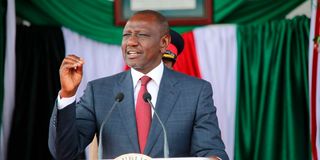
President William Ruto has a bold plan: To make Kenya a First World nation in the next 30 years.
“I have engaged various leaders, including former Prime Minister Raila Odinga ( now deceased), Gideon Moi and my brother Uhuru Kenyatta , on how Kenya can transition from a Third World country to a First World nation by 2055,” he said on October 12 at a church service in Nairobi.
The Weekly Review contacted the chairperson of the President's Council of Economic Advisers, Dr David Ndii, Head of the Presidential Communication Service (PCS) Munyori Buku, and State House Spokesperson Hussein Mohammed.
We asked about whether there were policies that have been put in place towards achieving this goal and what the government and those to come would need to do to achieve first-world status.
Mr Buku says the president intends to anchor this plan on three major planks: agriculture, energy and infrastructure.
On agriculture, he says the plan is to build 50 mega dams that will irrigate 2-3 million acres of land in the next decade in a food security plan he says includes ensuring reduction and eradication of food imports.
“For Kenya to be fully food secure, it cannot continue to depend on rain-fed agriculture,” he says.
Another pillar is infrastructure, where Mr Buku notes that the government will focus on the transport network, which includes roads, rail, expansion of ports and airports.
“The plan is to build 1,000 kilometres of dual carriageways across the country, 10,000km of roads in rural areas to help farmers reach markets and enhance connectivity,” he said.
The next pillar is energy, where he notes that the country must increase it power generation to 10,000 megawatts.
“This is the only way the country can industrialise and attract more investors to set up businesses in the country.”
He notes that is clear that the government cannot finance these big projects on its own so it would need to bring in the private sector to finance many of the projects.
“More than 70 per cent of the funds will come from both foreign and domestic investors. We have received a lot of interest already from investors in other countries who want to partner in some of these projects,” he says.
To understand what a First World country is, let us begin with the parameters.
The grouping of countries as First World, Second World and Third World came to be during the Cold War.
The United States of America and its allies, mostly in Western Europe who mainly practised capitalism, were referred to as the First World.
The Soviet Union, China, Cuba and their allies, who were mainly communists, were the Second World.
Then the rest of the countries, which did not lean on any of the sides, were named the Third World countries. But that name was not based on any clear category but fell upon countries that were impoverished and that led to the term referring to “poor” countries.
It is also important to note that classifications of First World, Second World and Third World are no longer used in policy or academic contexts, and instead countries are now grouped based on their Gross National Income (GNI) per capita, according to the World Bank.
The categories are high income, upper-middle income, lower-middle income and low income.
High income countries have a GNI of more than $13,935, upper-middle income $4,496-$13,935, lower-middle income $1,136-$4,495 and low income with less than or equal to $1,135.
Kenya is currently grouped as a lower-middle-income country with a GNI per capita of $2,110.
Other African countries with a higher classification than Kenya are Algeria, Botswana, Cape Verde, Equatorial Guinea, Gabon, Libya, Mauritius and South Africa, which are all upper-middle income countries while Seychelles is the only African country which is a high income country.
First World countries are defined by a high human development index, a high Gross Domestic Product (GDP) and a strong democracy.
Other factors are advanced healthcare systems, good education systems and reliable infrastructure.
President William Ruto awards Judy Mwikali Mutiso, with a certificate for her outstanding academic performance in Bachelor in Theology during the Scott Christian University 59th graduation ceremony, Machakos County on December 6, 2024.
Photo credit: PCS
According to the World Population Review, countries with a Human Development Index (HDI) score — a United Nations measure of life expectancy, education, and income — of 0.800 or higher are considered to have “very high human development”, which would roughly equate to a first-world country.
In their 2023 report, only 73 countries made it to the First World list. Kenya had a HDI value of 0.628, positioning it at 142 out of 192 countries and territories. This means that for Kenya to become a First World country, it must move up at least 69 positions to 73.
Another indicator of a First World country is high GDP. According to the International Monetary Fund (IMF), GDP is an indicator that gives information about the size of the economy and how an economy is performing. The growth rate of a country’s GDP is often used as an indicator of the general health of its economy.
According to Ken Gichinga, chief economist at Mentoria Economics, Kenya has all it takes to become a First World country much sooner than 2055 if only the right policies are put in place.
“All we need to have a strong judicial system so that people feel they have the confidence to do business,” he says.
He adds that to achieve First World status, Kenya would have to ensure it has fully independent and strong anti-corruption bodies, and strengthen the judiciary to ensure it is well resourced.
Dr Samuel Nyandemo, an economics expert, however, believes that the idea that Kenya can become a First World country is simply wishful thinking and cannot be achieved unless serious interventions are put in place.
“Goodwill from the top leadership is essential for this dream to be achieved; failure to which it will simply remain a rhetoric,” he says.
He notes that countries such as Singapore and South Korea, that are often referenced by President Ruto, worked extremely hard to be where they are now.
“The culture of hard work does not come through prayers. It emanates from instilling that culture that we must work for our country,” he adds.
Dr Nyandemo says such countries mobilised their domestic resources and put them into proper use, and then developed a culture of transparency, accountability and hard work.
Infrastructural development
“For Kenya to achieve First World status, we have to almost be obsessed with job creation, keep track and have statistics of where jobs are being created and where jobs are not being created and interrogate why to come up with interventions.”
According to both experts, the key sectors that need to be the centre of focus are infrastructural development, technology and digitisation, agriculture, foreign direct investment and industrialisation.
President William Ruto with his deputy Kithure Kindiki and other leaders during the 10th Annual Meru Dairy Farmers Field Day at the Meru ASK Showground in Meru County on June 21, 2025.
Photo credit: DPCS
“We need to focus on rural electrification and boost production of electricity to make it not only available, but more affordable,” says Dr Nyandemo.
On the other hand, Mr Gichinga says: “Leveraging technology and digitisation brings productivity which can really attract investors because the cost of doing business becomes very small.”
Agricultural modernisation and diversification are also important pillars because it will help boost food security, the economists argued.
“We are using our own hard currency to purchase food from outside, which we could produce in our own country, which is just unfortunate. A First World country should be able to feed its citizens,” Dr Nyandemo emphasises.
Foreign direct investment should be encouraged as it helps boost the economy. This should however, be done in a transparent manner, Dr Nyandemo adds.
“We need to create a conducive atmosphere in order to attract both foreign and domestic investors. This means we must fix our taxation system. Tax regimes should not frustrate investment but rather attract even more investors.”
Mr Gichinga also notes that Kenya’s taxation system should be progressive and one that is proportional to where people are in life.
Other investments that need to be made are in the healthcare and education sectors, the economists said.
“The reason why we have had big multinationals come to Kenya is because we have good human capital so we need to make sure that we continuously invest in good education and healthcare,” notes Mr Gichinga.
Dr Nyandemo observes that investing in the education sector should be in a way that makes education affordable.
“Currently, education looks like a preserve of the rich. Many children cannot access quality higher education because it is very expensive. We must try to invest wisely in health and education.”
Devolution must also be strengthened to unlock the potential in counties, they added.
“The idea behind devolution was not to just take power to the grassroots, which is political devolution, but to have economic devolution where we put important economic activities in the counties,” says Mr Gichinga.
Both experts also agree that the biggest obstacle to achieving this goal is corruption, conflict of interest and poor governance.
“The big challenge we have is conflict of interest. For example, some counties may not be developing because there are those who may not want to release all the resources to the counties because that could weaken their power, “explains Mr Gichinga.
Dr Nyandemo adds: “If you are found to be corrupt, the price must be very high. Corruption discourages the efforts of hard work. So, we must really tackle corruption head-on.”
Mr Buku, the State House aide, says the government has moved to fight corruption.
“The government has moved many government services to the e-Citizen platform and now manages to collect more than one billion in revenue daily from just a few millions before the move,” he said.