Former United Kingdom Prime Minister Winston Churchill once admitted that he frequently ate his own words and found them a “wholesome diet”.
American radio and television writer Andy Rooney later cautioned: “Always keep your words soft and sweet, just in case you have to eat them.”
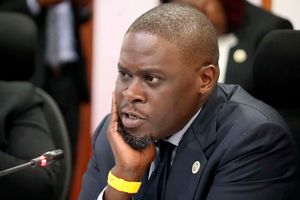
Nairobi Governor Johnson Sakaja.
Photo credit: John Nyagah | Nation Media Group
Kenyan politics provides regular evidence of this pattern. Rhetorical reversals are common as leaders adjust to power, coalitions and realities of the new offices they hold.
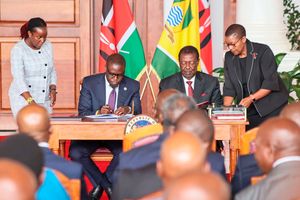
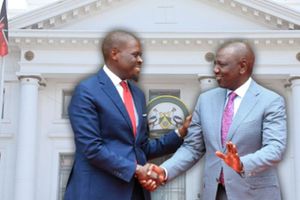
The latest example came this week from Nairobi Governor Johnson Sakaja, who signed a deal with President William Ruto on cooperation between the national government and the county administration.
Nairobi County Governor Johnson Sakaja (centre left) and Prime Cabinet Secretary Musalia Mudavadi (centre right) during the signing of a cooperation agreement between the National Government and the Nairobi City County Government at State House, Nairobi.
Photo credit: Wilfred Nyangaresi | Nation Media Group
Mr Sakaja was the senator of Nairobi when his predecessor, Mike Sonko, signed a similar deal with the then President Uhuru Kenyatta . He had vowed never to allow such an agreement. Reality, it seems, has a way of softening even the staunchest critics.
The Sh80 billion deal came almost five years after Mr Sonko signed a similar pact with Mr Kenyatta on February 26, 2020, handing key county functions to the national government.
President Ruto said: “Taken together, these enhanced cooperation measures will make Nairobi more livable, more secure, and more efficient.”
Sakaja inks Nairobi-National Government deal at State House
Mr Sakaja said: “This agreement solidifies arrangements and provides legal framework for additional support, including partnership in security and order.”
“Instead, in true spirit of devolution, it is a lawful statutory collaboration expressly anchored on Section 6 of the Urban Areas and Cities Act,” he said.
Prime Cabinet Secretary Musalia Mudavadi.
For his part, Mr Mudavadi moved from a Bottom-Up critic to a champion of the economic model. Before joining President Ruto’s camp, Mr Mudavadi mocked the policy on August 1, 2021, saying it would impoverish Kenyans
But on August 16, 2023, he praised the Bottom-Up Economic Transformation Agenda during a policy dialogue on productive capacities development.
“The launch of the Holistic Productive Capacities Development Programme for Kenya dovetails into policies and structural reforms articulated by the national Bottom-Up Economic Transformation Agenda, whose main objective is to improve the livelihoods and welfare of Kenyans,” he said.
On the other hand, Dr Ruto, who once dismissed the “Handshake” between his predecessor, Mr Kenyatta, and former Orange Democratic Movement (ODM) leader Raila Odinga walked the same path. While giving a speech during a tour abroad when he was the Deputy President on March 4, 2022, he said that a “mongrel government” had been created.
“The ‘handshake’ took away the oversight role of (the) opposition. In Kenya today, we don’t have an opposition; there is a mongrel of an organisation. People don’t know whether we have an opposition in government or the opposition in government,” he said.
He repeated the same remarks while giving his acceptance speech hours after the Supreme Court upheld his election during the 2022 General Election.
“We will not have a handshake that creates a mongrel of a government where no one knows where the line is,” President Ruto said on September 5, 2022.
However, in March 2025, after Gen Z-led protests, Dr Ruto entered his own handshake with Raila Odinga through a memorandum of understanding. He later praised Mr Odinga and Mr Kenyatta as “patriots”.
‘Illegitimate government’
Former Prime Minister Raila Odinga, who died last year, called Mr Kenyatta’s presidency illegitimate after the bitterly contested 2017 election.
“We hold President Uhuru Kenyatta and his illegitimate regime responsible for (the) unfortunate turn of events,” he said on November 18, 2017, after chaos rocked Nairobi upon his return from abroad.
But by March 9, 2018, he had become Mr Kenyatta’s “handshake” partner, saying: “We have to put Kenyans and Kenya first.”
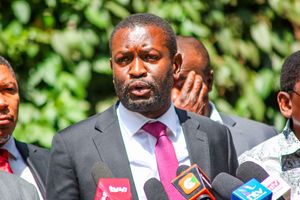
Kiharu MP Ndindi Nyoro addressing journalists in his office at KICC in Nairobi on March 18, 2025 about development activities in his constituency.
Photo credit: Evans Habil | Nation
Former National Assembly Budget Committee chairperson, Kiharu Member of Parliament Ndindi Nyoro has changed tune after backing tax increases in the Finance Bill 2024. He warned then that rejecting the Bill would result in budget cuts for the Higher Education Loans Board and the National Government Constituencies Development Fund. But last Thursday, he opposed the planned tolling on the Thika Superhighway.
Mbadi finally visits State House
John Mbadi: Give President William Ruto his skunk
On October 26, 2022, Mr John Mbadi the then Suba South MP criticised Dr Ruto’s nominees to his Cabinet.
“We have a choice to make; reject over 60 per cent of these names or give President Ruto his skunk .” He also said he had “never visited State House” and had “no interest” in doing so.
However, in July 2024, President Ruto appointed him National Treasury Cabinet Secretary, and now he is a frequent visitor at State House for Cabinet meetings.