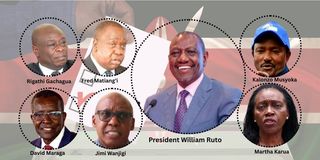
Kenya is scheduled to hold high-stakes general and presidential elections on August 10, 2027. The Rigathi Gachagia -led United Opposition is already building a star-studded team of political heavyweights, including James Orengo, Kalonzo Musyoka , Fred Matiang'i, Edwin Sifuna, Martha Karua , and a handful of other stalwarts, to face President William Ruto at the polls.
Of course, the opposition team is fully cognizant of President Ruto's political war-chest, built incrementally over the last three decades. Neither side is leaving anything to chance. The duel promises to be a "battle royale."
The 2027 electoral cycle, therefore, poses an immediate threat to the National Treasury's goal of reducing the fiscal deficit to 3.3 per cent of GDP by FY 2028/2029, from the current figure of 5.8 per cent.
However, the next one year is likely to experience fiscal populism and expenditure as the State heightens recurrent spending on visible localised projects to pacify communities and court voters. This grossly undermines the strict austerity measures needed for structural fiscal consolidation.
If the projected pre-election domestic borrowing of Sh775 billion is realised, it will absorb the bulk of the available banking liquidity, driving interest rates higher. This will crowd out the private sector and choke off credit to MSMEs.
The forecast injection of massive liquidity (estimated at Sh300 billion by some accounts) into the economy, to operate outside the purview of CBK, represents a major macroeconomic shockwave that directly influences inflation.
Worse still, it will spike the velocity of money, driving up prices of basic goods and services, including foodstuffs and transport. Parallels are already being drawn between the forthcoming 2027 elections and the 1992 elections, which marked Kenya's return to multiparty democracy after the removal of section 2A of the old Constitution that made Kenya a de jure one-party State in 1982.
The hotly-contested 1992 elections saw key opposition figures, Jaramogi Odinga, Mwai Kibaki and Kenneth Matiba pose an existential threat to President Daniel Moi's regime, forcing the State into a massive money-printing frenzy to try to survive the onslaught. This drove inflation to a historic high of 46 per cent in 1993, causing a decade of economic stagnation.
To make it worse, the State-sponsored ethnic clashes disrupted the critical agricultural sector, causing production of maize (staple food), and other crops to drop drastically. The peril of international isolation constantly drained foreign exchange reserves, triggering a severe balance of payments crisis.
The 1992 General Election should, therefore, serve as a historical warning that unconstrained political survival strategies cause severe macroeconomic damage.
Kenya is facing the 2027 election with a shaky fiscal outlook, largely attributed to the debt servicing trap. Debt repayment has become the largest single budget line item, absorbing approximately 70 per cent of ordinary revenues (customs duty, income tax, VAT and excise tax).
With Sh7 out of every Sh10 going straight to pay lenders, the government is forced to borrow more money to run its cost of governance. In such circumstances, a general election is a most unwelcome irritant as it deepens the country's economic woes.
Historically, the National Treasury has behaved like the proverbial ostrich by ignoring the economic realities and setting aggressive revenue targets for KRA, based on ambitious economic growth forecasts.
When KRA misses these targets — as it often does in turbulent periods — a massive fiscal hole opens up mid-year. In a terribly squeezed credit situation, the country often goes for high-cost commercial offshore loans, adding immediate repayment pressure before yielding productive economic returns.
This behaviour has created an unsustainable hand-to-mouth fiscal model, that hardly, if ever avails adequate resources to the productive sectors like agriculture, tourism, manufacturing, ICT, mining and financial services. Without investment in the productive sectors, economic expansion is slow.
With stunted GDP growth, incomes grow at a snail's pace, constraining tax collection. Poor tax collection takes the country back to fiscal deficits, occasioning borrowing for budget support, and the vicious circle of indebtedness continues.
As the country nears the 2027 General Election, Treasury Cabinet Secertary John Mbadi must burn the midnight oil in order to maintain stability of the Kenyan fiscal ship. Toward this end, the CS has already initiated a proactive early fiscal strategy, focused on accelerating national budget timeliness and maintaining rigid fiscal discipline.
Because Kenya goes to the polls on August 10, 2027, a standard budget cycle would overlap dangerously with peak campaign period, triggering market uncertainty. For this reason, the budget calendar has been compressed to ensure that Parliament reviews and approves expenditure estimates by March 31, 2027.
The challenge, however, is the quality of scrutiny that will precede ratification of the budget estimates given the shortened timeline. The Budget Policy Statement is expected to reach Parliament by November 16, 2026, to allow sufficient time for public participation in the Finance Bill 2027, in order to lock tax structures.
It suffices to say that, given that public participation is scheduled to take place at a time when the political landscape is already toxic, the National Treasury may have to develop a new approach that removes pressure from the executive and redirects it to politicians.
In addition, the National Treasury has committed to strict implementation of the Zero-Based Budgeting approach that requires evidence-based justification for expenditures. Regarding tax administration, the National Treasury is taking steps to widen the tax base through capital formation and digitalisation to increase the tax reach to the informal sector.
The challenge, however, is the unguarded political grandstanding and sloganeering that typically send wrong signals to investors regarding Kenya's suitability as an investment destination.
Furthermore, the government plans to maintain a real GDP growth of about 5.3 per cent, while holding inflation within the 5 per cent (±2.5%) target band.
Last but not least, prioritising resource allocation to the productive sectors to promote productivity and GDP expansion.
Ultimately, whether or not these strategies succeed will depend on the ability of Parliament and the National Treasury to enforce fiscal discipline and ensure that politicians comply with the law on campaign expenditure.
History tells us that there are laws for the general public, and there are laws for politicians. To expect politicians to obey a law that curtails their expenditure (read: search for votes) is like asking an athlete who is training his/her eyes on a trophy to self-inflict a leg wound. Let's pray for a smooth campaign period.
Professor Ongore is a Public Finance and Corporate Governance Scholar based at the Technical University of Kenya. [email protected]