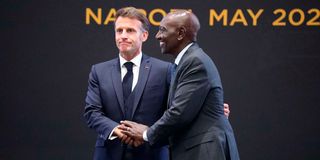
Many observers have passed a verdict that the 2026 Africa Forward Summit, hosted in Nairobi by France and Kenya, was a misstep. They have presented strong arguments.
However, what they have not accurately articulated are the economic realities that shape contemporary international relations.
Kenya’s deepening security and economic partnership with France – highlighted by a defence pact, joint military exercises and hosting of the summit – signals a strategic shift in French engagement in Africa following its humiliating exit from the Sahel countries of Mali, Burkina Faso and Niger.
The dalliance allows Kenya to boost its regional security role and attract investments, while France pivots its strategy towards East Africa, bypassing the traditional “Francafrique” baggage associated with its former colonies. The shift is viewed with scepticism as it suggests France is rebranding its influence rather than abandoning its transactional neo-colonial approach to the continent.
With the military cooperation between France and Kenya (and Nigeria), the junta-led Sahel countries may face further isolation, undermining their leverage on anti-French sentiments to force concessions.
The Sahel nations view Kenya as a “Plan B” for French influence and a traitor, potentially causing a disruption of pan-African solidarity against neo-colonialism.
Further, Kenya’s ratification of a five-year defence deal with France and the controversial provisions on troop deployment and immunity for French soldiers, is viewed as a licence for the men in uniform to perpetrate atrocities in Africa without bothering about possible prosecution.
In addition, the Sahel nations view this defence pact as signifying a lack of empathy for the decades of economic and political exploitation they endured under the Francafrique system. This exacerbates anger in a region that only recently expelled French forces over sovereignty concerns.
Furthermore, the alternative partnership on maritime security and intelligence that eschews traditional French military bases in West Africa has sent African nations back to the drawing board to reconsider their own security postures.
Pundits still argue that by embracing France, Kenya is becoming a “diplomatic showroom” where France can flex its muscle, ignoring its policy failures in Francophone West Africa. To this extent, analysts opine, Kenya risks being viewed by other East African countries as a conduit for neo-colonial power.
The Sahel nations interpret Kenya’s enthusiasm over the €3 billion in green energy, water and sanitation deals as prioritising money over pushbacks against historical exploitation.
In response, an equally large number of analysts have argued that by embracing France, Kenya faces some minor diplomatic friction among Francophone nations, but that the risk of widespread and permanent isolation is low.
The relationship is primarily viewed through a pragmatic transactional lens rather than a total alignment with France’s neo-colonial overtures in the continent. That said, Kenya appears to have considered mitigation measures for specific risks associated with its newfound rapprochement with France.
Without a doubt, Kenya is poised to encounter severe diplomatic friction with the Alliance of Sahel States (AES), especially because these nations view Kenya’s military cooperation with France as offering its former colonial master a diplomatic reset to extend its neo-colonial tentacles farther afield.
However, a critical analysis reveals that Kenya’s exposure in this regard is minimal, given its weak economic and historical ties to the Sahel. Besides, Kenya is geographically far removed from the Sahel, and there are no significant trade dependencies to lose.
On accusations of undermining continental sovereignty by allowing foreign military elements while nations like Coté d’Ivoire and Senegal are renegotiating a drawdown of French military presence, it is instructive that Kenya has no colonial legacy with France. The relationship is framed purely around trade, climate finance and investment.
The perception that Kenya is keen to undermine its pan-African standing flies in the face of the actual attendance at the summit. Of the 30 heads of state at the summit, nine were fully or partially Francophone, including Cameroon, the DR Congo, Mauritania, Congo, Morocco, Rwanda, Senegal, Togo and Tunisia, signalling broad acceptance of the Kenya-France cooperation. The speculated minor intra-East African friction over regional hegemony and Western alignment doesn’t seem to pose much of a threat, given Kenya’s diplomatic resilience via the East African Community.
Kenya’s deep ties with its Francophone neighbours – DR Congo, Rwanda and Burundi – remain insulated. Kenya acts as an essential economic transit corridor and security partner, a reality that cannot easily be sacrificed at the altar of France’s geopolitical baggage. In any case, Kenya’s foreign policy relies on the concept that geopolitics is language-neutral. This policy should be adhered to by treating France as a business partner and climate finance ally rather than a political master.
That way, Nairobi will navigate the backlash from disgruntled West African nations while elevating its global standing. More pragmatically, however, Kenya seems to be paying the Francophone West African nations in their own currencies following discrimination against the country’s candidates for continental jobs.
It is not lost on Kenya that on February 15, 2025, the entire Francophone West Africa ganged up against the country’s candidate for the African Union Commission Chairman, former Prime Minister Raila Odinga, who was billed as the most qualified candidate for the job.
Djibouti’s candidate, Mahmad Ali Youssouf, won the position largely on account of being Francophone. In 2017, Kenya’s Cabinet Secretary, Amina Mohamed, suffered a similar fate when she lost to Chad’s Moussa Faki Mahamat in an election that was heavily influenced by Francophone-Anglophone rivalries.
Diplomatic observers have, therefore, concluded that Kenya is growing fatigued by Francophone West Africa’s manifest isolation of its candidates in favour of “their own”, purely on account of colonial language barriers.
In November 2026, the UN General Assembly and UN Security Council will vote to consider candidates for appointment to the positions of judges of the International Court of Justice.
Kenya has nominated Prof Phoebe Nyawade Okowa for consideration and will be leveraging France’s elaborate networks and influence in the two agencies to help secure the appointment. The newfound rapprochement between Kenya and France is, therefore, not without anticipated mutual benefits.
Prof Ongore is a Public Finance and Corporate Governance Scholar based at the Technical University of [email protected]