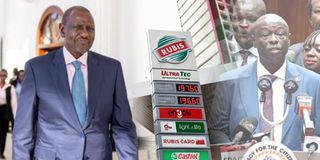
This past week has witnessed incessant calls by the opposition for Energy and Petroleum Cabinet Secretary (CS) Opiyo Wandayi, to "step aside" on accusations of impropriety and incompetence in handling of the current fuel crisis in the country.
The spike in fuel prices has not made things any better for the CS, who has maintained his innocence the whole time. The discussions on fuel prices, the Government-to-Government (G2G) framework, the war in Iran, and the blockage of Hormuz Strait have remained largely elitist, leaving ordinary Kenyans with only one question: who will reduce the cost of fuel to make life more bearable for them?
Politicians have jumped in to fill the information void, predictably distorting the facts for political capital. This begs the question: what exactly is happening in the oil sector? To be sure, the current high cost of fuel in Kenya is a result of a "perfect storm" where geopolitical shocks have collided with local fiscal pressure.
While fiscal policy decisions directly affect the final price, the core economic price is set by the "landed cost" - the actual cost of buying and shipping refined fuel to the Port of Mombasa.
Kenya imports 100 per cent of its refined petroleum. Between February and March, the landed cost for petrol, diesel and kerosene rose by 41.55 per cent, 68.72 per cent and 105.15 per cent, respectively.
To mitigate these spikes, the government reduced VAT on petroleum products from 16 per cent to 13 per cent, and utilised approximately $48 million from the Petroleum Development Fund to stabilise domestic prices.
Politics aside, the current fuel price spikes in Kenya are primarily driven by the US-Israel-Iran war, which has severely disrupted global oil supply chains and pushed landed costs to record highs. The devil is in the detail.
The ongoing war in the Middle East oil- producing countries has introduced a significant "risk premium" to global oil prices and other benchmarks. The war has specifically occasioned a slight weakening of the Kenyan shilling against the US dollar (from about Sh129 to Sh130 to the dollar). Consequently, the dollar-denominated fuel imports have become more expensive.
Moreover, shipping costs have increased as cargo ships re-route to avoid conflict zones, leading to higher freight charges and insurance premiums (rising 0.25 per cent to 2.50 per cent in some cases). All these costs are factored into the landed costs that Kenyan consumers pay for fuel at the pump.
Iran is a major oil producer. The hostilities have led to fears of prolonged global supply shortages, occasioning hoarding and price spikes due to increased demand against dwindling supply. The conflict has effectively put shipments through the Strait of Hormuz at a standstill since February. The Strait of Hormuz is the single most critical choke point for Kenya's fuel security.
Roughly 80 per cent of Kenya's fuel is sourced from the Middle East (Saudi Arabia, UAE, Kuwait), whose tankers have no alternative route other than Strait of Hormuz.
Therefore, the closure of this narrow waterway on February 28 removed approximately 12 million barrels of oil per day from the global market that cannot easily be bypassed by land pipelines, leading to delayed shipments by up to a fortnight or halted entirely.
As a result, the supply of petroleum products to Kenya has not been reliable for about two straight months now, causing fuel shortages in pockets of the country, such as in Isiolo .
Many countries across the globe that were caught unawares by this conflict, without adequate strategic fuel reserves, have suffered similar consequences of supply chain disruptions. This fuel shortage is not unique to Kenya; it has put many developing economies through shock, forcing them to seek external financing for budget support and to stabilise their currencies.
To mitigate its effects on the economy, Kenya has requested rapid financial support from the World Bank to manage these exogenous shocks and stave off domestic inflation. To further mitigate the challenges of fuel shortage, Kenya has sought to buy fuel outside of the G2G framework for pragmatic reasons.
Firstly, there is relative reliability in supply. The G2G partners are heavily reliant on the Strait of Hormuz, which is currently blocked, rendering fuel supply unreliable.
Seeking external cargoes (such as the MT Paloma consignment, which has come under heavy criticism by the opposition) is an attempt to diversify fuel sources that could potentially stabilise domestic prices.
Secondly, private importers have at times brought in "spot" cargoes to fill gaps in domestic supply.
As the fuel crisis unfolds, Kenya should have already picked at least two vital lessons. Foremost, is the need for strategic autonomy. The current conflict has brought to the fore the vulnerability of relying on a single shipping corridor.
This has prompted global calls for more diversified energy partnerships at the domestic level, there is an urgent need for the government to seek a critical mass of informed citizens to support its strategic decisions in times of crisis.
Unfortunately, the country is headed for a do-or-die political contestation next year, making it difficult for the political class to be bipartisan in its approach to national issues.
When politicians become openly partisan, their supporters follow suit, rendering government decisions, however well-intentioned, to become suspicious, ab initio (from inception). Until Kenyans are able to separate selfish political posturing from real economic issues of the day, the country will continue to miss out on significant opportunities.
Kenya needs to fix its politics in order to make significant steps towards realising the much-desired transition to a middle-level income economy.
Professor Ongore is a Public Finance and Corporate Governance Scholar based at the Technical University of Kenya. [email protected]