Oburu Oginga’s ongoing attempt to steady the Orange Democratic Movement (ODM) ship after Raila Odinga’s death in October 2025, is not simply a succession question. It is a struggle over custody of Odingaism.
It is about whether ODM remains the political shrine of Raila Odinga, guarded by the family, or if it must now become something larger, looser and more institutional than the man who gave it meaning.
That is why Cabinet Secretary John Mbadi’s public spat with Kisumu Woman Representative Ruth Odinga should not be dismissed as ordinary party noise. It is the rumble of a deeper tremor inside ODM, a party that has survived tear gas, betrayals, stolen victories, defections, state repression, and electoral heartbreaks, but now appears to have reached the harbour without the captain who defined its voyage.
The question is no longer merely who will steer the ODM ship after Raila Odinga. It is whether the Odinga family still retains a moral first claim over the party, or whether ODM must now loosen itself from the gravitational pull of Bondo and remake itself as a modern political outfit.
Some critics, and I am sorry to reference Robert Alai, now say that the Odinga family treats ODM as an entitlement. That may sound harsh, even ungrateful, given the family’s long history of sacrifice. But politics is rarely gentle with memory. The very surname that once brought detention, surveillance, humiliation and economic ruin can, in a different season, begin to look like a claim of ownership. That is the delicate line Oburu must walk. The Kenyatta family has at times faced the same.
For Oburu, this is not an abstract lesson. His own life was rearranged by that surname.
When he returned from Moscow in 1970, he came home with what any young nation should have celebrated: a doctorate in economic planning, exposure to global ideas, and the confidence of a man trained to serve in the development machinery of a new republic. But Kenya did not see only a trained economist. It saw Jaramogi Oginga Odinga’s son. It saw Moscow. It saw a communist and smelt danger. It saw the Odinga name as a security file.
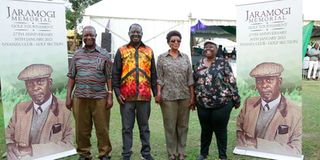
The Jaramogi family after a meeting held at Kang'o Ka Jaramogi on February 1, 2025. Dr Oburu Oginga is sandwiched by niece Winnie Odinga and sister Ruth.
Photo credit: Pool
That was the tragedy of his Soviet education. The Soviet Union had given him discipline, academic formation and ideological exposure. Kenya converted all that into suspicion. When Oburu presented himself for work, his credentials were not weighed on their own merit. They were placed beside his father’s rebellion, the Kenya People’s Union (KPU) rupture, the Cold War atmosphere and the state’s deep fear of dissent. A PhD became less important than a surname.
Oburu’s sister, Ruth Odinga, has invoked her own predicament in this debate. For her, the Odinga name was not an ornament of entitlement, but a burden carried through fear, exile and humiliation. She recalled how, after the 1982 attempted coup, she fled into exile — first to Uganda, then Tanzania and Zimbabwe, and later Norway — as the state’s hostility toward the family deepened.
Kisumu Woman Rep Ruth Odinga.
Photo credit: File I Nation Media Group
Her memory of return was equally telling. Travelling with Jaramogi’s name on her passport turned ordinary movement into a political ordeal. The surname, now seen as a symbol of privilege, had once functioned like a warning stamp at Kenya’s borders. As she said: “John Mbadi has seen life in exile in the movies. I lived the experience, and it is not something you would wish for your worst enemy. Travelling to Kenya with the Odinga name on my passport was such a nightmare,” she said.
Her brother, Oburu, did not get any privileges either. The most telling scene came when he sought to teach economics at the University of Nairobi. Vice Chancellor Josephat Karanja, who knew him from London, asked the question that revealed the mood of the state: was he a communist? Oburu’s answer was almost professorial. One could not be a communist unless one belonged to a communist party. But facts were not the issue. Suspicion was. Moscow, Odinga, KPU, Jaramogi — these were enough. Shortly afterwards, the rejection came.
Then followed the insult disguised as employment. With his PhD, Oburu was appointed a District Officer! In 1970s, Kenya, a doctorate holder did not become a junior provincial administrator. That was an insult. To accept it would have been to swallow humiliation. To reject it was to accept exile from the centre of the state. Oburu rejected it.
Fast forward. In the 1970s, the Odinga name locked Oburu out of the state. In the post-Raila ODM, the same name may lock others out of the party. That is the danger. If ODM members begin to feel that every disagreement with the family is treated as betrayal, then the party will become smaller than Raila’s dream. It will become a family enclosure rather than a national movement.
Yet history also demands fairness. The Odinga family did not inherit comfort. It inherited a struggle. Jaramogi’s break with Kenyatta cost the family dearly. When Jaramogi was detained and KPU crushed, the punishment did not stop with the man. It travelled through his children, his businesses, his home, his name. Odinga’s Lolwe Bus Company had the National Bank recall its loan, and all the buses were auctioned. Oburu’s furniture and Mercedes were seized. Jaramogi’s livestock, tractors, posho mill and properties were swept into the machinery of punishment.
That history explains why the Odinga family can never look at politics as a casual game. For them, power has always had consequences. Losing was not just losing an election. It could mean detention, bankruptcy, exclusion, betrayal and humiliation. In that sense, Oburu’s instinct to guard ODM is understandable. He is not merely protecting a party office. He is protecting a long memory of struggle.
Dr Oburu Oginga delivers his speech during ODM's Special Delegates Convention at Nairobi’s Jamhuri Grounds.
Photo credit: Bonface Bogita | Nation Media Group
The fact that the family suffered does not mean ODM belongs to the family. Sacrifice gives moral authority; it does not give a permanent title. This is where Oburu must be careful. If he leans too heavily on the family’s suffering, he may convert democratic sympathy into dynastic irritation. Kenyans can honour sacrifice and still reject entitlement. ODM members can respect Raila’s memory and still demand a party that breathes beyond the Odinga household.
The Mbadi-Ruth confrontation, therefore, matters because it puts this hidden tension in public. Mbadi’s reported argument points to a faction that believes ODM must not be held hostage by family memory. Ruth’s anger reflects the family’s fear that those who ate from Raila’s table now want to erase the table itself. Both sides are speaking from wounded places. One fears capture by bloodline; the other fears betrayal by beneficiaries.
The family cannot assume that those who invoke Raila will protect his legacy. Nor can party officials assume that pushing back against the family automatically makes them institutional reformers. Some may be defending ODM. Others may simply be positioning themselves in the post-Raila scramble. History teaches that succession moments attract patriots, opportunists and cowards in equal measure.
Oburu’s role, therefore, should not be to impose family control. It should be to manage a historic transfer. He must become a bridge, not a barricade.
That means defining Odingaism beyond the Odinga surname. What did Raila represent at his best? Constitutionalism. Devolution. Resistance to authoritarianism. Defence of political prisoners. Expansion of democratic space. The courage to challenge stolen elections. The willingness to carry the frustrations of the excluded. The language of social justice, even when imperfectly practised. If ODM can turn these into party doctrine, Raila will survive. If it turns them into family property, Raila will shrink.
This is where Oburu’s own temperament may be useful. Unlike Raila, he was never the storm. He was quieter, more managerial, more cautious. His life taught him survival in hostile systems. At the Coast, after being denied a house that had been allocated to him, he responded with the crude symbolism of a pig’s snout nailed to the door. It was not elegant, but it worked. It showed a man who had learnt that power often understands only pressure.
Oburu’s burden is therefore historical. He must not only protect the Odinga legacy from erasure but also protect it from captivity. He must remind ODM that the Odinga name was once punished for dissent, while ensuring that the same name is not now used to punish dissent inside the party. That is the paradox.
In the end, Oburu’s Soviet story offers the most powerful warning.
John Kamau is a PhD student in History, University of Toronto. Email: [email protected] ; X:johnkamau1